

Entebbe, Uganda: The National Agricultural Research Organisation (NARO) has developed a total of 1,038 transformative technologies over the past three decades, including 289 improved crop varieties now widely consumed across Uganda and the region.
Delivering a keynote address at the 13th Certified Public Accountants Economic Forum on Thursday, July 10, 2025, NARO Director General Dr. Yona Baguma revealed that each of these technologies has the potential to evolve into a full-scale industry, contributing to national productivity and agro-industrial transformation.
“Every time you sit at the table to eat, NARO is your silent visitor because your meal is largely, if not entirely, originating from NARO,” Dr. Baguma told the packed forum at Imperial Resort Beach Hotel, Entebbe.
Organized by the Institute of Certified Public Accountants of Uganda (ICPAU), the three-day forum (July 9–11) attracted participants from government, the private sector, and development agencies.
Dr. Baguma unveiled innovations ranging from vitamin-enhanced crop varieties and black rice for diabetics, to high-yield dairy pastures and anti-aging coffee cosmetics. He also cited NARO’s homegrown victory over cassava mosaic disease, a scourge still affecting farmers globally.
“Local innovation has solved problems here that the world is still grappling with. What we solve here can change the world,” he said.
He also highlighted Vitamin A-rich maize variety 63, a breakthrough in tackling malnutrition, especially for weaning children. In the sweetpotato sector, NARO has developed cream, yellow, and even purple-fleshed varieties, with the latter known to detoxify the body and fight fatigue.
Among the standout innovations was black rice, a variety with a low glycaemic index that supports diabetics by regulating blood sugar levels. “It’s not just about growing food. It’s about growing health,” he said.
Turning to Uganda’s livestock sector, Dr. Baguma decried the widespread low productivity due to poor genetics and inadequate nutrition, noting that many farmers feed their animals on grass with limited nutritional value.
He however noted that Uganda has the largest pasture germplasm collection in Africa, with over 1,000 pasture accessions, which NARO is using to develop customized feed systems for different agro-ecological zones. Of particular note is the rollout of Lab Lab pastures, which he said dramatically increase milk yields for zero-grazing dairy farmers.
NARO is also improving poultry genetics, aiming to boost local chicken egg production from an average of 14 to 24–28 eggs per cycle, and shorten the time to reach table weight to just 4 – 6 months.
In goat farming, he said, two breeding programs are underway using breeds from South Africa and China. These aim to cross with indigenous goats to produce animals weighing up to 100kg, meeting the growing local and global demand like in Middle Eastern markets. Similar efforts are ongoing in the beef sector, with Brahman genetics being used to produce 400–500kg cattle within 18 months, improving meat tenderness and economic viability.
“Our abattoirs are idle not because they lack infrastructure, but because we lack an adequate number of animals to supply them,” he observed.

Dr. Baguma noted that NARO’s potato innovations have already saved Uganda over USD 9.8 million annually, replacing imports with locally grown varieties tailored to meet industrial processing standards in color, size, and shape.
Another game-changer is the groundnut variety with the highest oil content, lined to be used by food industries to reduce dependency on imported ingredients. Meanwhile, cassava varieties developed by NARO are now used in brewing Eagle Lager, in partnership with local breweries.
Dr. Baguma also introduced a new coffee-infused bread product. Blending flour with 8% coffee powder, it enhances mental clarity, reduces brain fatigue, and contains antioxidants that support gut and cellular health. “You don’t just eat to fill your stomach; you eat to nourish your body,” he said.
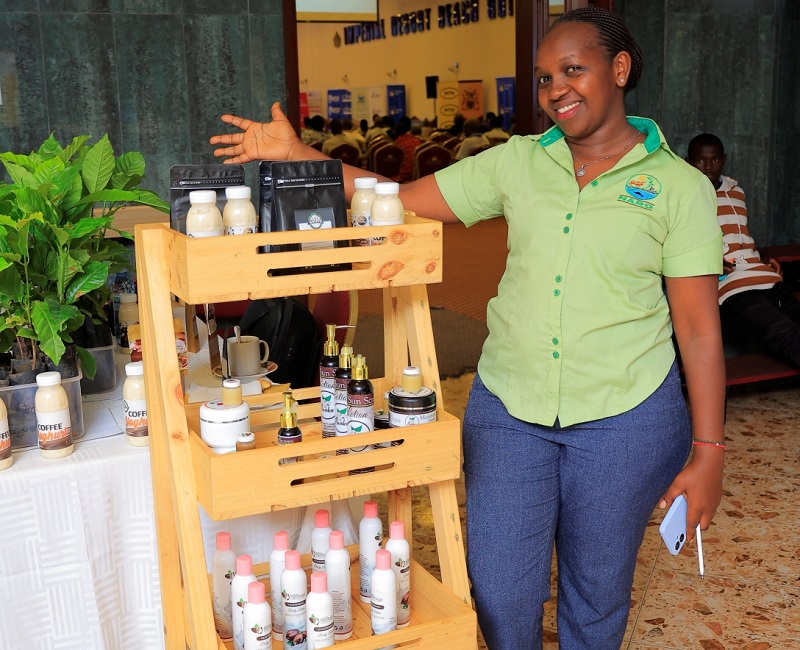
NARO is also branching into cosmetic and health care products made from coffee, such as coffee lotion, scrubs, and oils, all designed to delay skin aging and promote skin repair.

In an impressive showcase of circular economy thinking, NARO has developed over 10 products from cow dung, including liquid soap, pesticides, fertilizers, fish feeds, and even shampoo.
Dr. Baguma urged farmers to harness these technologies to generate electricity and add value to their waste.
He also announced the development of a world-class fish smoking kiln, capable of reducing toxic compounds to below 1 part per billion, far outperforming the EU safety limit of 5 parts per billion. The kiln is hailed for eliminating hazardous substances during fish processing, opening doors to export markets.
Perhaps the most significant announcement was NARO’s development of a world-leading anti-tick vaccine, which is poised to save Uganda UGX 3.8 trillion annually in livestock losses. Backed by government support, with UGX 50 billion allocated this year, the vaccine has proven over 90% effective, a feat unmatched globally.
“We conducted thorough evaluations on vital organs- kidneys, brain, spleen – and the results are clear: our vaccine is safe, effective, and world-class,” Dr. Baguma asserted.
NARO is also working on a quadrivalent Foot and Mouth Disease (FMD) vaccine, blending SAT 1 and three other strains from Egypt, to end the country’s dependence on expensive vaccine imports.
Dr. Baguma concluded by praising innovations like Aflasafe, a product developed to combat aflatoxin contamination in grains, improving food safety and expanding export potential.
He paid special tribute to President Yoweri Kaguta Museveni and government structures for their consistent support of agricultural research, and called for greater collaboration across sectors.
“As accountants and financial minds, you must understand that every technology we roll out has value. Each is a potential industry,” he said.
If you would like your article/opinion to be published on Uganda’s most authoritative news platform, send your submission on: [email protected]. You can also follow DailyExpress on WhatsApp and on Twitter (X) for realtime updates.