
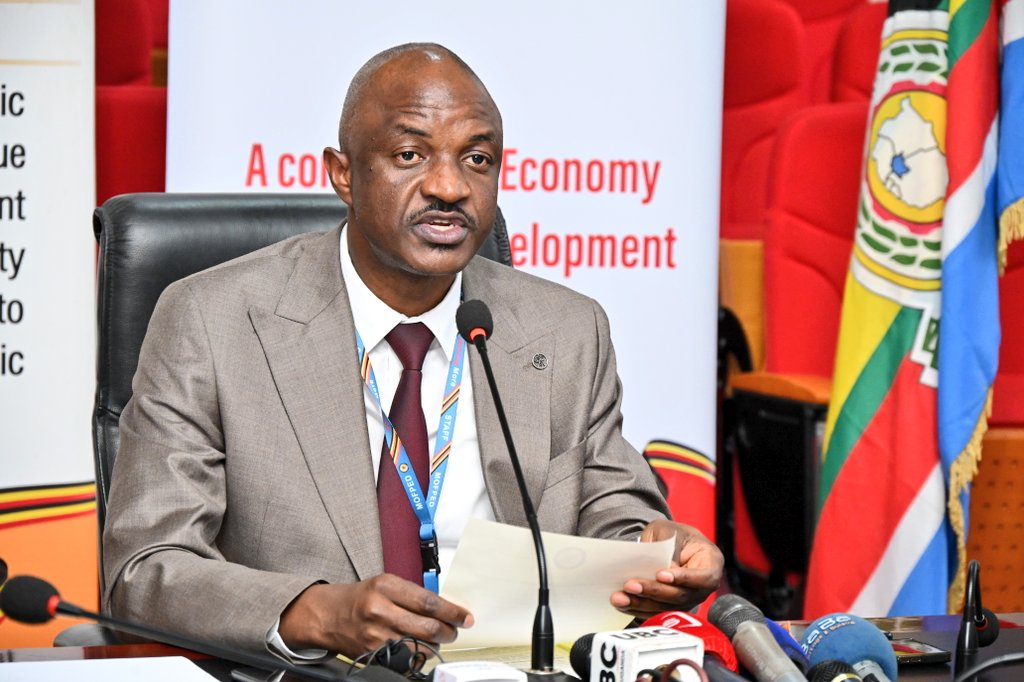
Kampala, Uganda: Uganda’s Ministry of Finance has issued a directive banning the use of foreign currencies in all government procurement and public sector contracts, in a landmark policy shift aimed at protecting the strength of the Ugandan Shilling and insulating the economy from global currency shocks.
The directive, released through the FY2025/26 Budget Execution Circular signed by Permanent Secretary and Secretary to the Treasury (PSST) Ramadhan Ggoobi, mandates that all government payments and contracts must now be conducted in Ugandan Shillings (UGX), with exceptions only for projects directly tied to external financing agreements.
“This is to ensure stability and avoid cost escalations arising from foreign exchange volatility,” Mr Ggoobi noted, citing the President’s assent to the Appropriation Bill as the basis for enforcing currency localization in government spending.
The new policy applies to all Ministries, Departments, Agencies (MDAs), and Local Governments, and covers contracts processed through the e-GP (electronic Government Procurement) system and the Integrated Financial Management System (IFMS). Notably, even international competitive bidding processes must now reflect UGX pricing.
The announcement comes at a time when the Ugandan Shilling is outperforming many regional currencies, gaining strength against the US Dollar due to increased forex inflows and tighter monetary control. This policy, analysts say, could further cement investor confidence in Uganda’s fiscal management.
“Uganda’s currency is one of the most stable in Africa right now. This directive consolidates that position by protecting public funds from the unpredictability of global exchange rate movements,” said economist Steven Mujuzi of the Economic Policy Centre.

According to the circular, exemptions to this directive will only apply to Development Partner-financed projects where foreign currency usage is explicitly required by funding agreements. All other forms of public procurement, regardless of scope or vendor origin, must comply with the UGX-only regulation.
“This is in line with Section 45 of the Public Finance Management Act, 2015,” Mr Ggoobi emphasized, “and will also eliminate speculative pricing in foreign currency, especially in contracts with long execution timelines.”

Domestic Arrears and Audit Crackdown
Alongside the currency directive, the government has earmarked Shs 1.4 trillion in the 2025/26 fiscal year to clear outstanding domestic arrears, part of a broader plan to wipe out all such liabilities over the next three years.
Accounting Officers have been warned to avoid entering into new commitments without confirmed funding, with the Treasury introducing mandatory independent audits prior to any disbursements. Any violation of this protocol could lead to contract termination, job loss, or personal liability.
“These measures will not only restore trust among suppliers but also promote fiscal discipline and transparency,” Ggoobi said.
The currency localization initiative is among several reforms under the Fourth National Development Plan (NDP IV) and is closely aligned to the government’s Tenfold Growth Strategy, which targets inclusive economic transformation ahead of the 2026 General Elections.
If you would like your article/opinion to be published on Uganda’s most authoritative news platform, send your submission on: [email protected]. You can also follow DailyExpress on WhatsApp and on Twitter (X) for realtime updates.