
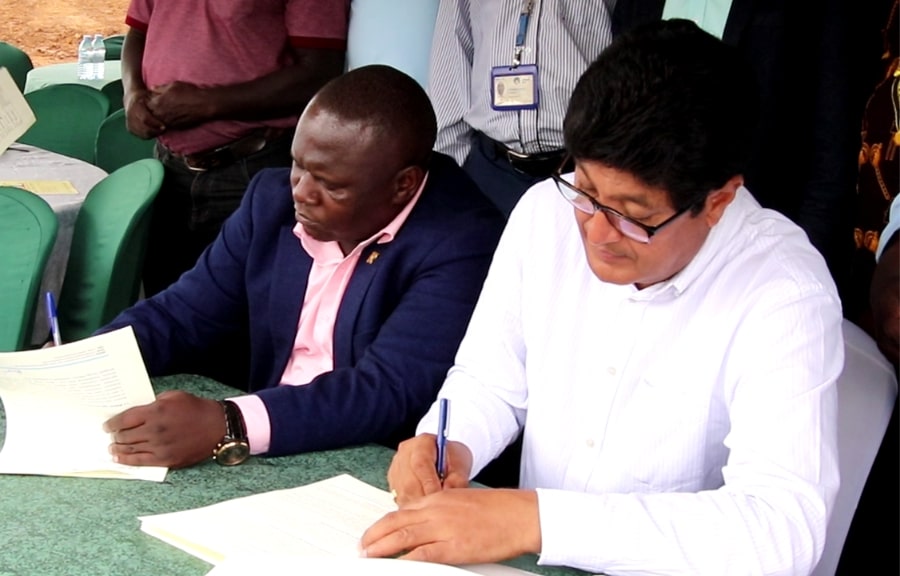
Nwoya, Uganda: Farmers in Nwoya District have secured a breakthrough market opportunity following the signing of a landmark Public-Private Partnership (PPP) agreement between Bukona Agro-Processors Limited, the Ministry of Energy and Mineral Development, and Nwoya District Local Government.
The agreement signed on Thursday, July 17, at Bukona’s newly licensed ethanol blending plant in Malaba Town Council, Tororo District, aims to boost Uganda’s ethanol production while providing thousands of farmers with a guaranteed market for their cassava and grain harvests.
Under this partnership, Bukona Agro-Processors will procure over 30,000 tonnes of grains and cassava annually from farmers in Nwoya District for processing at its ethanol production plant located in Koch Amar Sub-County, Nwoya.
This development comes shortly after the Ministry of Energy officially licensed Bukona’s Malaba blending facility under the amended Biofuels Act as part of Uganda’s green energy strategy to reduce carbon emissions by mixing ethanol with petroleum products.
Nwoya District currently boasts 4,800 village savings and loan associations, 170 farmer groups, and 16 cooperative societies engaged in farming—many of whom have struggled with unstable markets and poor pricing for their produce.

Pravin Kekal, Director of Bukona Agro-Processors Limited, said the partnership directly addresses these challenges by guaranteeing farmers a ready market. “With this deal, farmers won’t just grow crops—they’ll have somewhere to sell them,” he noted. Kekal also confirmed that Bukona has signed a separate financing agreement with Centenary Bank to enable farmers to access agricultural credit to boost production.
Nwoya District Commercial Officer Godfrey Odoki Ocitti, who signed the agreement on behalf of the district, said local government will provide technical training and logistical support to ensure farmers deliver high-quality cassava and grains. He revealed that the district’s 36 agro-processing plants will serve as storage and collection centres, making it easier for farmers across Nwoya to deliver produce efficiently. Agricultural extension workers will further guide farmers on meeting required quality standards.
Odoki described the partnership as a game-changer in Nwoya’s transition from subsistence agriculture to commercial farming, bringing more households into “the money economy.”

Hatim Muyanja, an Energy Officer at the Ministry of Energy and Mineral Development, confirmed Bukona is among eight companies licensed to blend imported petroleum with ethanol under Uganda’s green energy policy. He noted additional blending plants are under construction at strategic border points including Malaba, Mutukula, Mahathi, and Busia.
“All fuel entering Uganda will be blended with ethanol before it goes to the market,” Muyanja explained, stressing the move is designed to lower carbon emissions and protect the environment. Bukona’s ethanol blending plant is initially expected to blend approximately five million litres of petroleum annually, with projections to increase production to 20 million litres within the next three to five years.
This partnership marks a significant opportunity for Nwoya’s farmers, offering them a steady market and better pricing for their produce while positioning Uganda closer to its cleaner energy goals. Local leaders and farming groups in Nwoya have welcomed the development as a catalyst for broader transformation within the agriculture and energy sectors across the country.
If you would like your article/opinion to be published on Uganda’s most authoritative news platform, send your submission on: [email protected]. You can also follow DailyExpress on WhatsApp and on Twitter (X) for realtime updates.