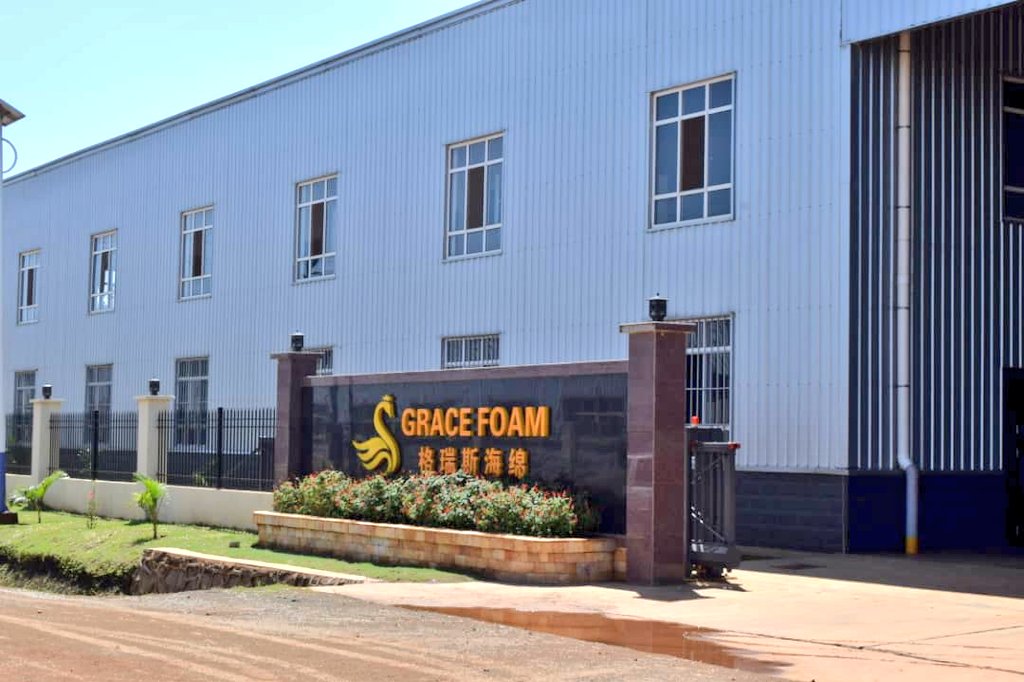
Kampala, Uganda: A storm is brewing within Uganda’s manufacturing sector after revelations that the Ministry of Finance committed taxpayers’ money to settle import duties for Grace Textiles International Investment Ltd (formerly Grace Foam), a Chinese-owned firm in Tangshan Mbale Industrial Park, while Ugandan companies are left to shoulder their own heavy tax burdens.
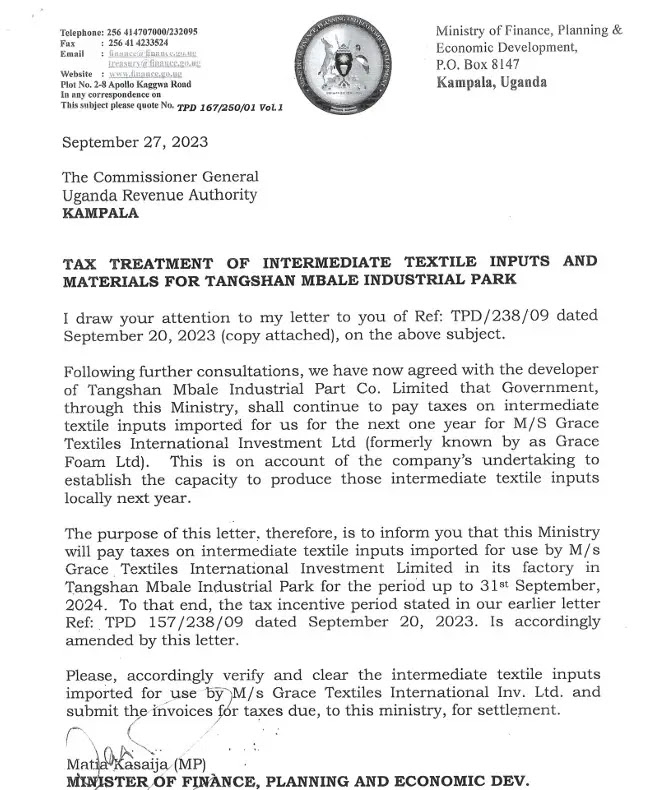
A letter signed by Finance Minister Matia Kasaija on 27th September 2023 explicitly directed the Uganda Revenue Authority (URA) to verify and clear textile inputs imported by Grace Textiles, and submit invoices “for settlement by the Ministry,” and further confirmed that government would continue footing the company’s import tax bill until September 2024, despite earlier suspension of the scheme in 2022.
“Government, through this Ministry, shall continue to pay taxes on intermediate textile inputs imported for use… in Tangshan Mbale Industrial Park,” reads the Minister’s letter, copy of which this website has exclusively seen.
But the deal has triggered outrage after URA demand notices revealed that Grace Foam had already accumulated more than UGX 17 billion in unpaid import taxes between July and September 2024, even after the special arrangement.
Ugandan firms cry foul
While Grace Textiles enjoys tax waivers, Ugandan-owned manufacturers, many with far greater investments, say they are being pushed to the brink.
In a protest letter dated 13th June 2024, Kampala Associated Advocates, acting for Sunbelt Textiles Ltd, accused the Ministry of discriminatory policy, saying whereas the firm employs over 1,200 Ugandans, consumes local raw materials such as cotton and cassava starch, and pays more than UGX 600 million in monthly taxes plus UGX 400 million in power bills, it receives no government support, yet Grace Textiles does.
“The factory in Mbale imports finished textiles and only packages them for wholesale or retail, yet its import duty is paid by government,” the KAA letter reads. “Meanwhile, Sunbelt invests heavily in weaving, dyeing, printing, and value addition, but is taxed at every stage. This is discriminatory and contrary to the presidential Buy Uganda Build Uganda (BUBU) initiative.”
Land grab and profiteering claims
KAA further accused the operators of Tangshan Mbale Industrial Park of abusing the industrialisation policy. While land for the park was given out free to attract investors, the developers allegedly turned around and sold plots for up to USD 150,000 per acre, instead of prioritising genuine manufacturing projects.
Two factories, two realities
- Grace Textiles (Mbale Industrial Park)
– Less than 200 employees
– Imports finished products, rebranded “Made in Uganda”
– Government pays its import taxes
– Land acquired under industrial park scheme - Sunbelt Textiles (Jinja)
– Over 1,200 employees
– Uses Ugandan cotton and raw materials
– Pays UGX 600m in monthly taxes + UGX 400m in electricity
– Building a 213-acre industrial park to process cotton for export
Tax Waiver Policy under fire
The controversy also raises questions about the legal framework for such tax commitments. Under what authority did the Ministry assume private tax obligations? Why was the arrangement quietly reinstated in 2023 despite being halted in 2022?

For many observers, the secrecy surrounding the deal undermines transparency in Uganda’s industrialisation drive. “This is not just about one company,” said a sector insider speaking on condition of anonymity. “It’s about fairness, accountability, and whether Uganda’s industrialisation policy is empowering manufacturers or subsidising importers.”
“Such policies distort the market and discourage local investors,” another source familiar with the case added. “It’s unfair for a genuine Ugandan manufacturer to compete with an importer whose taxes are paid by government.”
As URA demand notices pile up and local manufacturers grow restless, all eyes are now on the Ministry of Finance to explain how much public money has already been paid on behalf of Grace Foam, and whether similar relief will be extended to Ugandan-owned industries that employ thousands and add value to local raw materials.
For now, the silence from both URA and the Ministry has only fuelled suspicion that Uganda’s industrialisation agenda is being skewed in favour of a few foreign firms at the expense of homegrown manufacturers.
If you would like your article/opinion to be published on Uganda’s most authoritative news platform, send your submission on: [email protected]. You can also follow DailyExpress on WhatsApp and on Twitter (X) for realtime updates.