
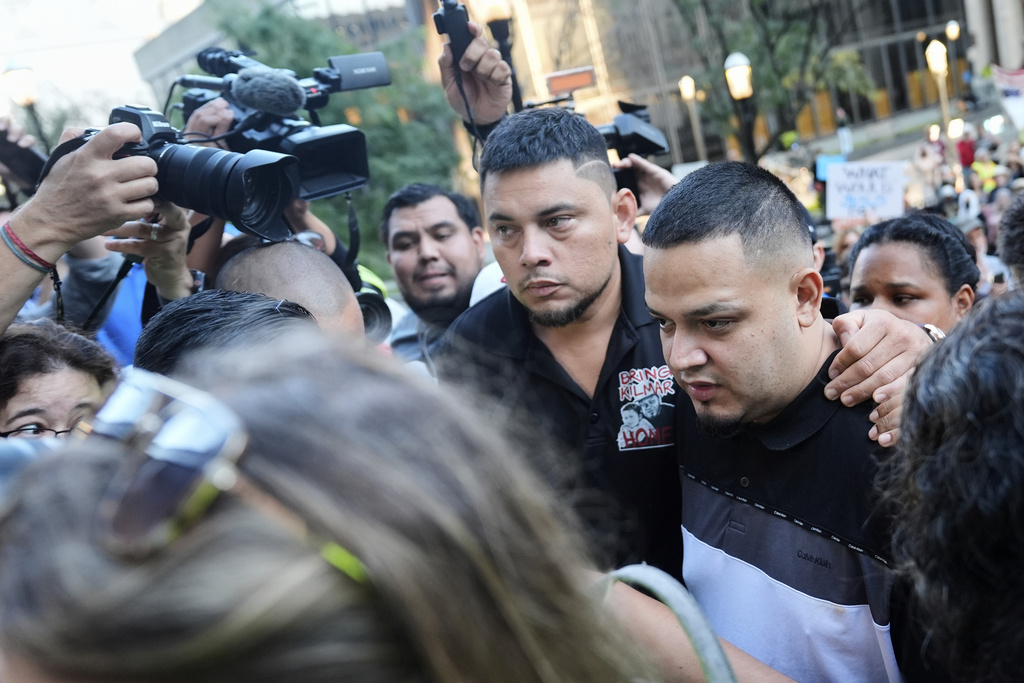
Washington, USA: The Trump administration this week announced plans to deport Kilmar Ábrego García to Uganda, in a case that has become a flashpoint in the president’s sweeping crackdown on immigration.
The move comes months after Ábrego was mistakenly deported to El Salvador, despite a U.S. judge’s order protecting him from removal to that country.
Ábrego’s lawyers accuse the government of pursuing a “vindictive and selective” prosecution aimed at punishing him for challenging his earlier deportation. The decision to send him to Uganda – a country with which he has no known ties – has drawn sharp criticism from human rights advocates and legal scholars, who say it exposes the chaotic and arbitrary nature of Trump’s deportation policy.
Who is Kilmar Ábrego García?
Ábrego, 30, grew up in El Salvador, fleeing at age 16 after gangs extorted and terrorised his family. He joined his brother, a U.S. citizen living in Maryland, and found work in construction while building a family of his own. In 2018, he moved in with his partner, Jennifer Vasquez Sura, who was pregnant with his child.
His troubles began in March 2019 when he was detained at a Home Depot by police acting on a tip that he belonged to MS-13, a notorious transnational gang. Though never charged, Ábrego was handed over to Immigration and Customs Enforcement (ICE). He has consistently denied gang ties and has no criminal record in either the U.S. or El Salvador.

A U.S. immigration judge denied his asylum claim on technical grounds but ruled he could not be deported to El Salvador due to a “well-founded fear” of gang persecution. He was released under federal supervision, obtained a work permit, and complied with ICE check-ins for years.
How did his case escalate?
In 2022, Ábrego was stopped in Tennessee while driving nine passengers, leading to suspicion of migrant smuggling. He was not charged then, but federal prosecutors later indicted him, sparking claims from his lawyers of political motivation.
Earlier this year, ICE mistakenly deported him to El Salvador’s maximum-security prison, where he alleged beatings and torture. The Trump administration admitted the error but continued labeling him a gang member, even as the U.S. Supreme Court ordered his return.

Why Deportation to Uganda?
After his return to the U.S. in June, ICE informed Ábrego’s lawyers that he would be deported to Uganda – a country where he has no family, history, or legal connection.
Court records show government officials offered him a deal: plead guilty to human smuggling and be deported to Costa Rica, where he would be treated as a refugee, or face removal to Uganda. He declined the plea.
Homeland Security Secretary Kristi Noem has vowed the administration will not relent until Ábrego is expelled from the U.S. His attorneys argue the Uganda deportation plan underscores the administration’s disregard for due process and international law.
If you would like your article/opinion to be published on Uganda’s most authoritative news platform, send your submission on: [email protected]. You can also follow DailyExpress on WhatsApp and on Twitter (X) for realtime updates.