
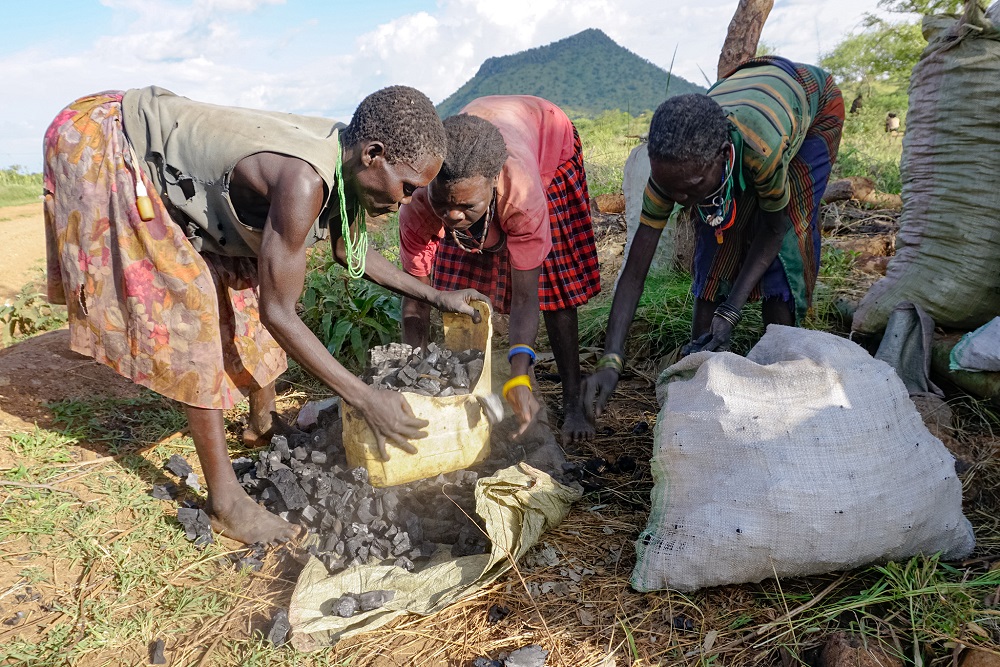
Kotido, Uganda: Along the dusty roads of Kotido district, rows of charcoal sacks tower by the roadside, awaiting buyers or trucks bound for distant cities. For 43-year-old Mary Nangiro, a mother of eleven in Lolelia Sub-County, the trade is a lifeline.
“I began burning charcoal in 2019 when drought wiped out my sorghum,” she explains. “It’s the only way I can feed my family now.”
What began as a survival tactic has spiraled into a full-blown industry consuming more than 4,000 trees every month across Kotido—over 40,000 annually, according to local forestry data. The losses of shea, acacia, and tamarind trees are deepening water stress, eroding soils, and threatening food security in one of Uganda’s driest regions.
A Lucrative Chain, but Locals Lose Out
Karamoja’s charcoal trade took root in 2009 when traders from Mbale introduced earthen kilns. The method is simple: cut trees, burn them slowly in soil-covered pits, and collect charcoal days later. Producers like Nangiro earn about UGX 15,000 per sack. Middlemen then resell in Kampala at prices as high as UGX 110,000, capturing most of the profits.
“Locals barely break even,” notes Christine Lokiru, Kotido’s Natural Resources Officer. Her office has mapped hotspots in Rengen, Maaru, Kolasarich, and Chamkok—areas accounting for 90% of tree losses.
Joel Olal, the district forestry officer, warns of dire consequences: “When we lose trees, our soils become even more porous. We’re already seeing seasonal watercourses vanish, threatening both farming and livestock.”
Olal is leading a district nursery program to distribute seedlings for agroforestry, but demand far outweighs supply.
Environmental, Health Toll & Enforcement Struggles
Kotido’s health department reports that nearly 30% of children under five suffered acute respiratory infections last year—cases often linked to indoor smoke from charcoal stoves. Nationally, Uganda loses 122,000 hectares of forest each year. Kotido alone lost 29 hectares in 2020, releasing nearly 20,000 tonnes of CO₂.
In May 2023, President Museveni banned commercial charcoal production in Karamoja through Executive Order No. 3. Since then, security forces have impounded more than 8,400 bags of charcoal at checkpoints.

Yet loopholes remain. Kotido police lack a dedicated environmental unit, and petty bribes—known locally as kitu kidogo—often allow trucks to slip through. A district ordinance outlawing commercial charcoal burning is still stuck in Kampala, awaiting the Attorney General’s clearance.
“We risk unrest if we push a ban without alternatives,” admits Council Speaker Lodiyo Emmanuel.
Resident District Commissioner (RDC) Charles Ichogor is more blunt: “Cutting tamarind and desert date trees for charcoal robs us of food, medicine, and cultural heritage.”
Search for Alternatives

Experts warn that prohibition alone will not solve the crisis. Without affordable alternatives, charcoal use persists, especially in urban informal settlements where biogas and solar infrastructure remain underdeveloped.
Grassroots pilots in Rengen and Nakapelimoru sub-counties are showing promise. NGOs are training residents to produce eco-friendly briquettes from sawdust and agricultural waste.
“This is a shining example of community-led development,” says forestry officer Olal. “We can save forests and create livelihoods.”
RDC Ichogor agrees, endorsing the pilots as models to scale.
The Way Forward
Environmental experts recommend a multi-pronged strategy: fast-tracking Kotido’s charcoal-ban ordinance and funding district patrols, expanding agroforestry and briquette-making programs, subsidizing clean stoves, solar, and biogas with micro-credit support, running urban campaigns to reduce consumer demand for charcoal, and strengthening climate-information networks to deliver science-based awareness
For now, however, Kotido’s forests continue to recede. As Nangiro hoists another sack for sale, she acknowledges the dilemma. “I know these trees are precious. But when your children cry for food, you must choose.”
Her words capture the stark reality of Karamoja’s crisis: a fragile landscape caught between survival and sustainability. Whether innovation, enforcement, and policy reforms converge in time will determine if Kotido becomes a story of resilience or a warning for Uganda’s future.
If you would like your article/opinion to be published on Uganda’s most authoritative news platform, send your submission on: [email protected]. You can also follow DailyExpress on WhatsApp and on Twitter (X) for realtime updates.