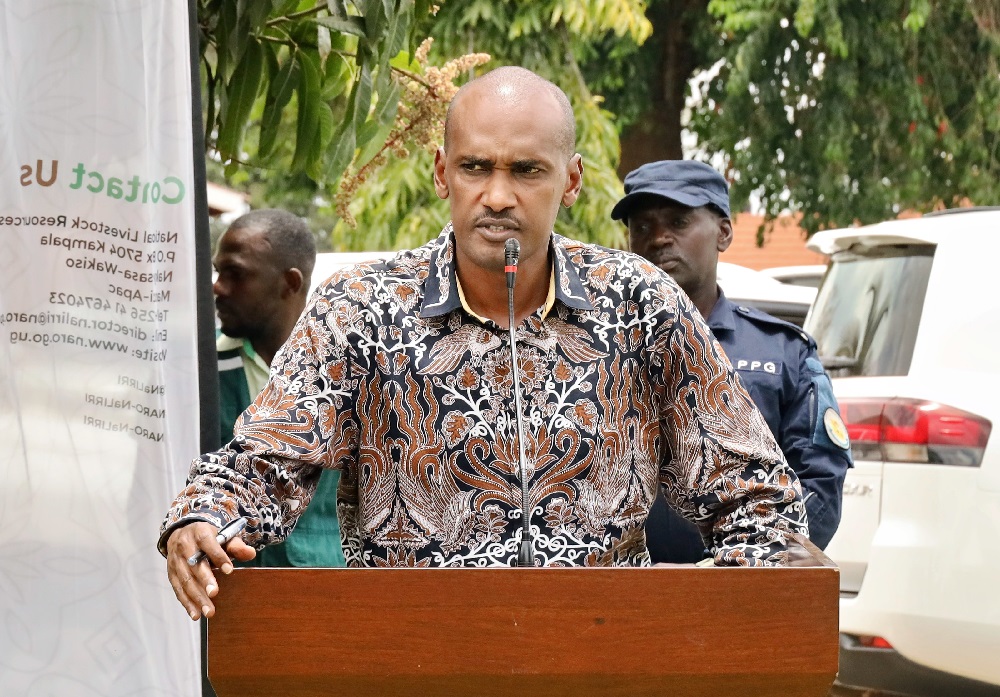
Wakiso, Uganda: The Minister for Agriculture, Animal Industry and Fisheries, Hon. Frank Tumwebaze, has urged project designers in the agriculture sector to embrace a value chain approach, warning against fragmented initiatives that fail to link production to markets.
Speaking during a World Bank Mission hosted by the National Agricultural Research Organisation (NARO) at the National Livestock Resources Research Institute (NaLIRRI) in Nakyesasa on Friday, September 26, 2025, Tumwebaze stressed that projects focusing on isolated aspects of farming undermine sustainability and farmer incomes.
“It’s dangerous to plan, say, for increased production alone without having a lens on markets. Agriculture can only be appropriately planned for with focus on complete value chains. Through this, our projects will become more impactful and farmers will find greater sense in doing agriculture,” Hon. Tumwebaze emphasized.
The Minister further stressed the need to align agricultural projects with seasonal cycles to prevent mismatches in the provision and use of inputs. He also commended the research potential at NARO, reiterating the strong support President Yoweri Museveni has for agricultural research.

The World Bank team was led by Mr. Qimiao Fan, Divisional Director for Kenya, Rwanda, Somalia, and Uganda, alongside Uganda Country Manager, Ms. Ayo Francesca.
Mr. Qimiao, who toured NARO’s research facilities, praised the organization’s contribution to agricultural transformation. “During my last meeting with His Excellency President Museveni, he asked me to return and visit NARO. Now I know why. It’s because of the wonderful work you are doing, as shown by what I have witnessed today,” he remarked.
He highlighted agriculture’s potential to create decent jobs and drive incomes, noting that while Uganda’s maize yields average 2.3 metric tons per hectare, some countries achieve 6–7 metric tons. “If we get to that level, farmers will double or triple their incomes. That’s why the World Bank has, for many years, prioritized supporting agriculture,” he said.

Mr Qimiao said the Government of Uganda was on the right course in prioritizing agriculture in its strategy to achieve tenfold growth by 2040. The strategy that emphasizes Agro-industrialization, Tourism Development, Mineral Development (including oil and gas), and Science, Technology, and Innovation seeks to increase the nation’s economy from approximately US$50 billion to US$500 billion by 2040.

Mr. Qimiao pointed to areas for continued collaboration, including climate-resilient agriculture, high-yielding seeds, irrigation, and improved access to inputs like fertilizers. He also emphasized the importance of infrastructure such as rural access roads and electricity for strengthening market linkages.
“I have been impressed by the dairy zero waste model you have shown me. That’s the kind of thing we want to build – the ability to tap into the long value chains of each product,” he added.

In his remarks, NARO Director General, Dr. Yona Baguma, outlined the organization’s strides in developing high-yielding, drought-tolerant, and disease-resistant varieties of key crops such as coffee, banana, maize, beans, rice, cassava, groundnuts, sweet potato, millet, sorghum, wheat, and potato.
These innovations, he noted, have boosted food security, enhanced resilience to climate change, supplied raw materials for agro-processing and contributed to enhancing national security.
Dr. Baguma also acknowledged the World Bank’s longstanding support through projects such as the Agricultural Research and Training Project (ARTP I & II), Agricultural Technology and Agribusiness Advisory Services (ATAAS), and the Eastern Africa Agricultural Productivity Program (EAAPP), which have helped rehabilitate public research institutes, train scientists to postgraduate levels, upgrade laboratories and equipment, and establish regional centers of excellence in cassava, dairy, rice, and wheat.
While the foundations of Uganda’s research system are strong, Dr. Baguma noted that more needs to be done to align innovations with market demands, foster private sector partnerships, and scale adoption.
He asked the World Bank to work with NARO in scaling technologies that improve productivity and competitiveness, build climate resilience, generate jobs and exports, and position Uganda as a leader in agro-industrial transformation in Africa.
If you would like your article/opinion to be published on Uganda’s most authoritative news platform, send your submission on: [email protected]. You can also follow DailyExpress on WhatsApp and on Twitter (X) for realtime updates.