
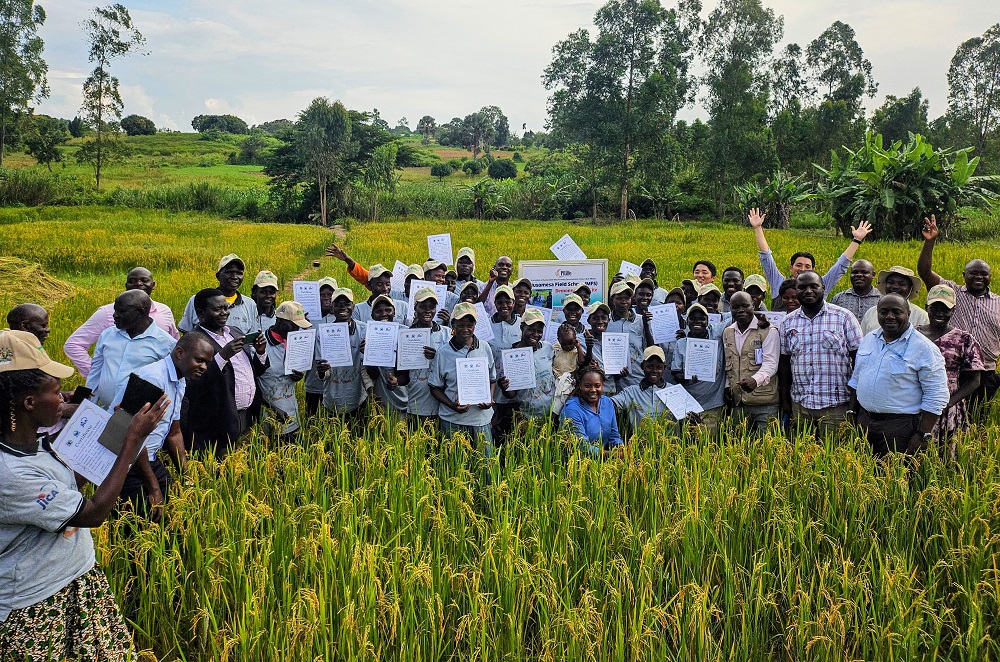
Maracha, Uganda: The Ministry of Agriculture, Animal Industry and Fisheries (MAAIF), in partnership with the National Agricultural Research Organization (NARO) and the Japan International Cooperation Agency (JICA), has trained 28 farmers from West Nile in modern rice cultivation techniques aimed at promoting sustainable rice production in the region.
Speaking during the farmers’ graduation ceremony held in Nyadri Sub-county, Maracha District, NARO’s Head of Communications, Frank Mugabi, said the training was part of a five-year initiative designed to strengthen rice production capacity and enhance food security in Northern Uganda.
“As part of our farmer-to-farmer capacity-building model, we have also trained 13 District Agricultural Officers from Koboko, Maracha, Yumbe, Nebbi, Moyo, Obongi, and Madi-Okollo in modern rice cultivation technologies,” Mugabi revealed. “The high yields registered among trained farmers demonstrate that adopting modern technologies can transform communities into food- and income-secure households.”
He explained that the project aligns with Uganda’s National Development Goals by shifting the region’s agricultural focus from traditional crops like tobacco and millet to rice, a crop now driving both food security and income growth across the West Nile sub-region.

JICA Uganda Representative Toshinori Katsumata reaffirmed Japan’s commitment to strengthening Uganda’s rice value chain through the ECO-PRiDe project, saying the agency remains dedicated to supporting agricultural transformation through technology transfer, research collaboration, and farmer training.
“Empowering smallholder farmers with practical knowledge, access to improved seed varieties, and better production methods is key to achieving sustainable food systems and rural development,” Katsumata said.

Meanwhile, Aseru Beatrice, Parish Chief of Nyadri Sub-county, noted that rice cultivation, supported under the Parish Development Model (PDM), has become one of the fastest-growing enterprises in West Nile. She said the crop’s dual value as a staple food and a cash earner is helping local farmers improve their livelihoods.
According to official statistics, Uganda’s rice production has surged from less than 300,000 metric tons to over 700,000 metric tons in the past 15 years. The country is now more than 70 per cent self-sufficient in rice production, with projections indicating Uganda could soon become a net rice exporter.
If you would like your article/opinion to be published on Uganda’s most authoritative news platform, send your submission on: [email protected]. You can also follow DailyExpress on WhatsApp and on Twitter (X) for realtime updates.