

By Oweyegha-Afunaduula
For virtually all its post–Tito Okello period, President Tibuhaburwa Museveni has dominated every sphere of human life in Uganda: education, energy, health, infrastructure, environment. He has transcended the boundary between the 20th Century and the 21st Century and the boundary between the old and new millennium. It is impossible to extricate him from any crisis, failure, or success story in any sphere of life in Uganda or in any human enterprise.
Everything has begun with him and ended with him. His centrality in the fear and silence industry in the country is recognized even by the simplest mind. Some Ugandans are awed by him while others detest him. Even some of the greatest brains and top leaders in the country have cast him almost like a god, with their own thinking and actions beginning with him and ending with him.
For President Tibuhaburwa Museveni himself, Uganda begins in 1986 when he captured the instruments of power through the barrel of the gun. Indeed, he has endeavoured to rewrite the history of Uganda, in which past leaders—whom he once referred to as swine—are excluded, as if they never existed or contributed to the social, economic, or political changes in the country, whether positive or negative.
In his social, political, economic, and military language, and in his public interactions with Ugandans and others, he prefers the possessive adjective MY to the possessive adjectives OUR, THEIR, HIS, HERS, or ITS. Consequently, he has manifested as a highly possessive person and the only thinker, even when interacting with the greatest of our minds. He refers to Uganda as my country; to Uganda’s oil as my oil; to Uganda’s Army as my army; to Uganda’s economy as my economy; and to Uganda’s gold as my gold. To the President, as far as ownership is concerned, he owns, and then others follow—if at all. Recently, he riled the world when he referred to the Indian Ocean as my ocean.
Simply put, the President is a phenomenon, although some of his enthusiasts and idolizers would be tempted to say “Yoweri Tibuhaburwa Museveni is an idea.” That is why some talk of Musevenism to advance it as a thought or system of thoughts. However, the President has shifted from one idea to another, sometimes swiftly, when he has found one idea can no longer serve his choices or interests. This has cast him as very contradictory but has ensured that he survives politically and is perceived as a mysterious man.
The President has ended up personalising not only his ruling party but the entire social, political, and economic spectra of Uganda. There are claims that most economic enterprises in Uganda belong to different members of his family or extended family. Many critical observers and thinkers interpret his recent electoral clarion call “Protecting Our Gains” to mean protecting the gains of his family and extended family within his small enclave called Uganda, which is still trapped in the abyss of underdevelopment, environmental decay and collapse, poverty, and debt—40 years into his reign.
A Person as an Idea
A person becomes an idea when their thoughts, values, or legacy live on through others, even after they are gone. Influential people in history are more than just individuals; they are concepts that shape society.
H.F. Verwoerd introduced what was called Grand Apartheid, characterised by small pockets of land called homelands outside of which people of African descent were not allowed to own or rent land. He became an idea, although with the collapse of apartheid, he seems to have faded into the basket of history. The practice of Grand Apartheid did not stand the test of time. However, President Tibuhaburwa Museveni of Uganda has been accused of introducing apartheid-like governance in the country, whereby the poor are being dispossessed of their land, displaced, and ultimately constituting a floating population not attached to land.
In this article, I want to look at Uganda’s most recognized Opposition leader currently, Kyagulanyi Ssentamu alias Bobi Wine, to establish whether he is a phenomenon or idea or both.
I have heard Kyagulanyi referring to himself as an idea rather than a person just doing politics, and asking every Ugandan that accommodates and believes in his ideas to be a Bobi Wine. However, it was not Bobi Wine who first referred to himself as an idea.

It was the late Speaker of Parliament, Jacob Oulanyah, who first referred to Bobi Wine as an idea, not a person. Almost simultaneously, the late Professor Apollo Nsibambi, a former Prime Minister of Uganda under President Tibuhaburwa Museveni, described Bobi Wine as “a young man, determined, patriotic, who is loved by the people and wants power.”
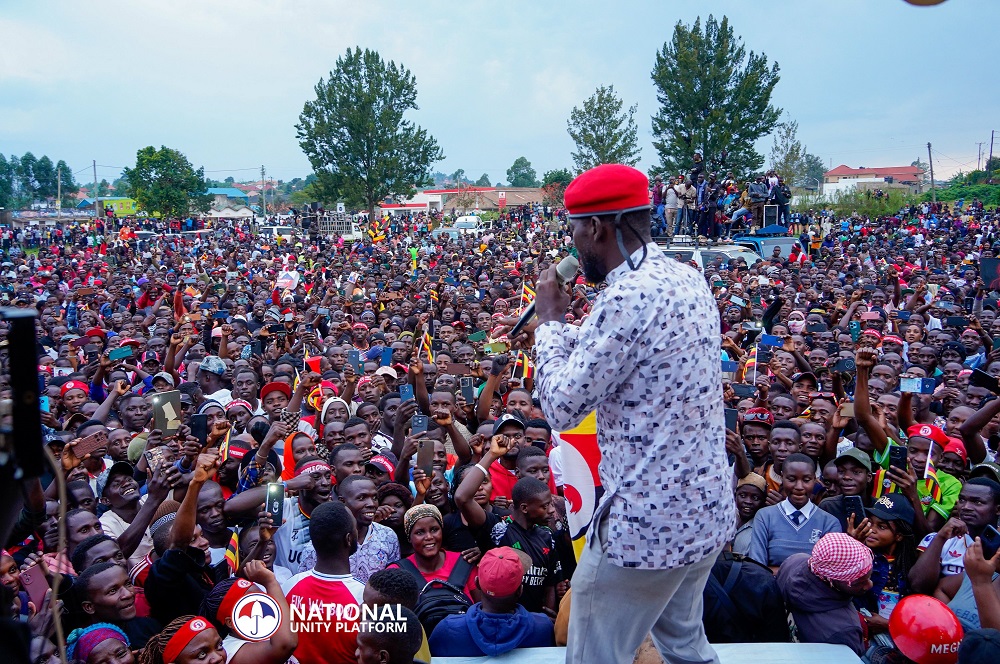
Indeed, we saw his determination, patriotism, his focus on power, and the love showered on him by the elderly, old, and young during his recent presidential campaigns in all the regions of Uganda. Modern communications technology did not hide anything, even if NRM propaganda tried to depict the opposite. Even when the police and army tried to separate the people from him—especially in Western Uganda, hitherto cast as President Tibuhaburwa Museveni’s political stronghold—his influence reverberated.
He preached unity, national security and peace, non-violence, patriotism, and hope for what he called “a new Uganda.” He talked about revival of quality education, health, agriculture, and roads, which looked poor and derelict in all the places he campaigned. He said that in the new Uganda, natural resources would benefit Ugandans first.

He decried the huge national debt incommensurate with what President Tibuhaburwa Museveni’s government boasted of as “development, transformation, and progress,” yet on the ground the opposite was true. Through modern communications technology, his campaigns revealed that Western Uganda was in many respects worse off or similar to other regions in the country. We saw how the people were drinking dirty water from dams or water pools together with cattle.
He decried the mushrooming poverty, unemployment, dispossession, and displacement of indigenous peoples through land grabbing, and the growing enslavement of Ugandans in and outside the country.
He urged his audiences not to fear people brandishing guns, ostensibly to secure his campaigns, yet they wanted to cause fear in them so that they abandoned his rallies. He even addressed the policemen and soldiers—telling them that they were part of the general tragedy of the country, and that he knew many of them were suffering as much, or even more, than the rest of Ugandans. He promised that he would improve their lot in the new Uganda.
Clearly, throughout his presidential campaigns, Kyagulanyi Ssentamu alias Bobi Wine did not only emerge as the most fearless opponent of President Tibuhaburwa Museveni, a new uniting factor, and a new nationalist, but also the new conscience of a greatly degraded nation in terms of nationhood, sovereignty, oneness, citizenship, and hope. He was, however, as expected, derided by not only the Tibuhaburwa Museveni camp of losers and winners but also the alternative opposition forces.
The question whether Kyagulanyi Ssentamu alias Bobi Wine is/was a phenomenon or an idea will be answered by time—the ultimate judge. However, in my own thinking, the politician has emerged as both a phenomenon and an idea. Nothing like it has happened during my lifetime. He could as well be not only a phenomenon but also an evolving idea not only in Uganda but also in East Africa, the Great Lakes Region, the Nile Basin, and Africa. We leave it to time.
Some people have tried to compare Kyagulanyi to Ibrahim Traoré, but the latter, like Gaddafi of Libya, has invested all power in himself and is not empowering the people. Kyagulanyi is driven by his commitment to people power, not gun power, believing that the destiny of the people should be determined by the people themselves, not one strong man.
Gaddafi gave the people everything—free fresh water, free energy, free accommodation, and even monthly allowances—but all that was not enough. People wanted freedom, justice, democracy, and human rights. Hopefully, Kyagulanyi is thinking of how he would deliver these to the people beyond the clarion call “People Power.”
For God and My Country
If you would like your article/opinion to be published on Uganda’s most authoritative news platform, send your submission on: [email protected]. You can also follow DailyExpress on WhatsApp and on Twitter (X) for realtime updates.

