By Oweyegha-Afunaduula
The other day, DailyExpress published my article, “Is Kyagulanyi Ssentamu alias Bobi Wine Evolving into a 21st Century Idea in Uganda?” It was widely circulated in and outside Uganda. However, I have yet to get a glimpse of debates based on the article.
The most serious responses I got were from South Africa–based Dr Anthony Isabirye and Karamoja–based Dr Ayub Mukisa. They both seemed to agree that Kyagulanyi Ssentamu has changed the dynamics of Ugandan politics and is no doubt a phenomenon, but has yet to evolve and manifest as an idea.
In this article, my thesis statement is: “Bobi Wine represents a new political phenomenon in Uganda, symbolizing a shift in the country’s politics and youth engagement.” I hope you will not only enjoy it but take a critical view of it and even become curious enough to give an alternative analysis.
I do not know much about Bobi Wine’s background before 1991, when I came back to the country to settle and work after being away for almost 20 years. However, I now know that Bobi Wine is 43 years old, born on February 12, 1982, in Nkozi Hospital, Uganda. He is a multifaceted personality, a politician, singer, businessman, and actor who has made a significant impact in Ugandan politics and music.
I have twins (a man and a woman) who were born in November 1980, and a man born in March 1983 in my family. Therefore, Bobi Wine would fit in very well. And just as I am encouraging his contemporaries in my family to do their best in what they love most and come to me only when they think, believe, and are convinced that my advice would add value, I would not discourage Bobi Wine from pursuing the political path he has chosen if he believes his contribution will add value to the quality and effectiveness of politics, leadership, governance and engagement of our youthful population in Uganda.
So far, he has done well to expose the arrogance, failures, and false assumptions of my generation; to make a docile, fearful population more active and ready to collectively chart a new path to the future; and to provide new answers to old and new questions of social, economic, and political growth and development.
The Making of a Populist Icon
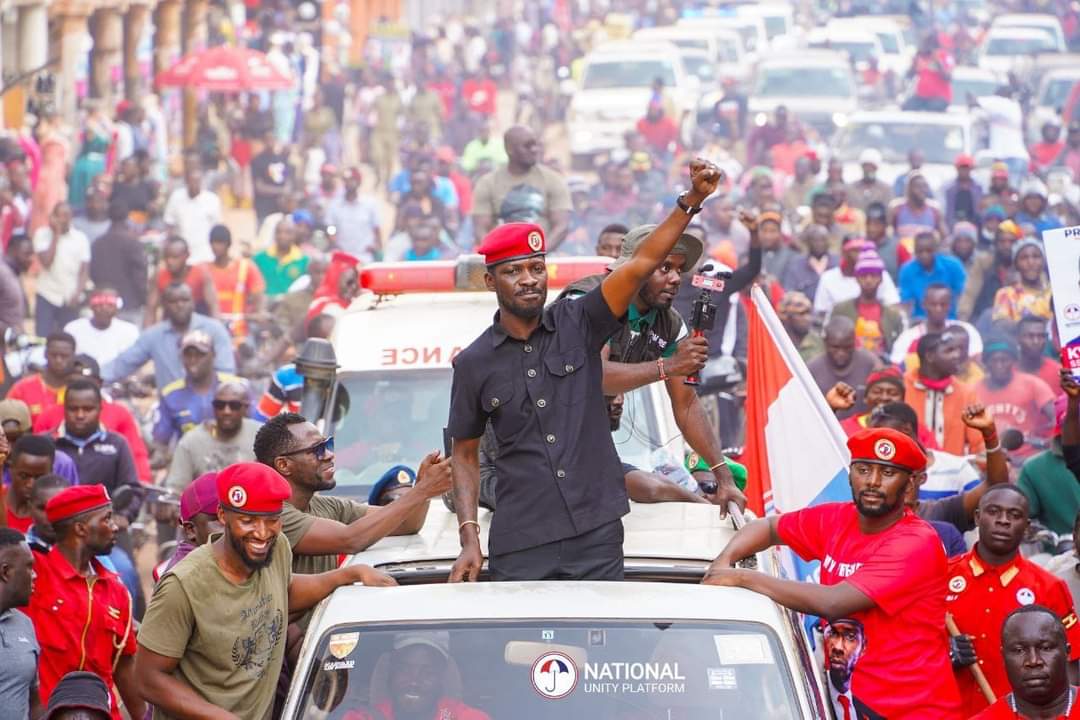
There is no doubt now, taking a cue from the current presidential campaigns in Uganda, that Bobi Wine is a populist leader par excellence. Admittedly, I have not seen in all my 76 years on Earth anyone else in Uganda who has taken advantage of the expectations of a downtrodden, conquered, and occupied people to make himself so popular in every part of Uganda that he is almost supersonically manifesting as a populist icon among a heavily youthful population.
Bobi Wine’s early life in a ghetto in Kampala and his music career played a critical role in shaping him into an influencer for change in a country that had become politically stale and stagnant under the iron rule of President Tibuhaburwa Museveni, who very early in his hold onto power preferred single-party to multiparty politics, banned political education in schools, and presided over intellectual death in universities and society, most detectable in the decay and collapse of the social space of public intellectuals.
His populist appeal is seen in his capacity to easily connect with the youth in all parts of Uganda, leveraging social media and tapping into localized grievances.
Bobi Wine’s rise as a populist leader in the 21st century has been catalyzed by his viral political messaging, effective social media presence, and crowd dynamics heavily driven by young people. Most of these are in their 20s and 30s, who have grown up under and seen only President Tibuhaburwa Museveni. They want to experience change in Uganda’s political space and are eager to engage themselves effectively in determining the destiny of their country.
They have been bombarded by well-crafted narratives that all the problems of Uganda were caused by past leaders, but have seen the country sinking further down the abyss of poverty, environmental decay, debt, hopelessness, and haplessness, as the gap between the rich and the poor grows wider — with the rich increasingly becoming either foreigners, members of one small ethnic group in power, or those connected to it.
Disrupting the Status Quo

Bobi Wine’s challenge to the National Resistance Movement’s (NRM’s) dominance of sociopolitical space and President Tibuhaburwa Museveni’s long rule has helped to bring the thinking of some older people and the majority of young people into congruence.
His message of change, anti-corruption stance, human rights advocacy, and youth empowerment resonates across all regions and social strata.
His clarion call “People Power” and glorification of the Uganda National Flag have glued the young and old together in thinking that Uganda can be a nation again and tick beyond the minute fragments of meaningless, unproductive, heavily consumptive, wasteful, and future-dampening districts.

Many see the NRM regime as having resuscitated the defunct South African apartheid-like political practice that distributed people of African descent into ecologically unproductive “homelands.” They see clearly that land in indigenous communities is being trapped by people of exogenous origin while indigenous people are being forced to move and congregate in towns as a floating population without identity or belonging.
The Power of Social Media and Celebrity Politics
Bobi Wine’s strategic use of social media to mobilize support and bypass traditional media has enabled him to reach a wider audience, publicize excesses of the NRM regime during his campaigns, and display his popularity nationally.
His celebrity status has amplified his message and attracted a diverse following.
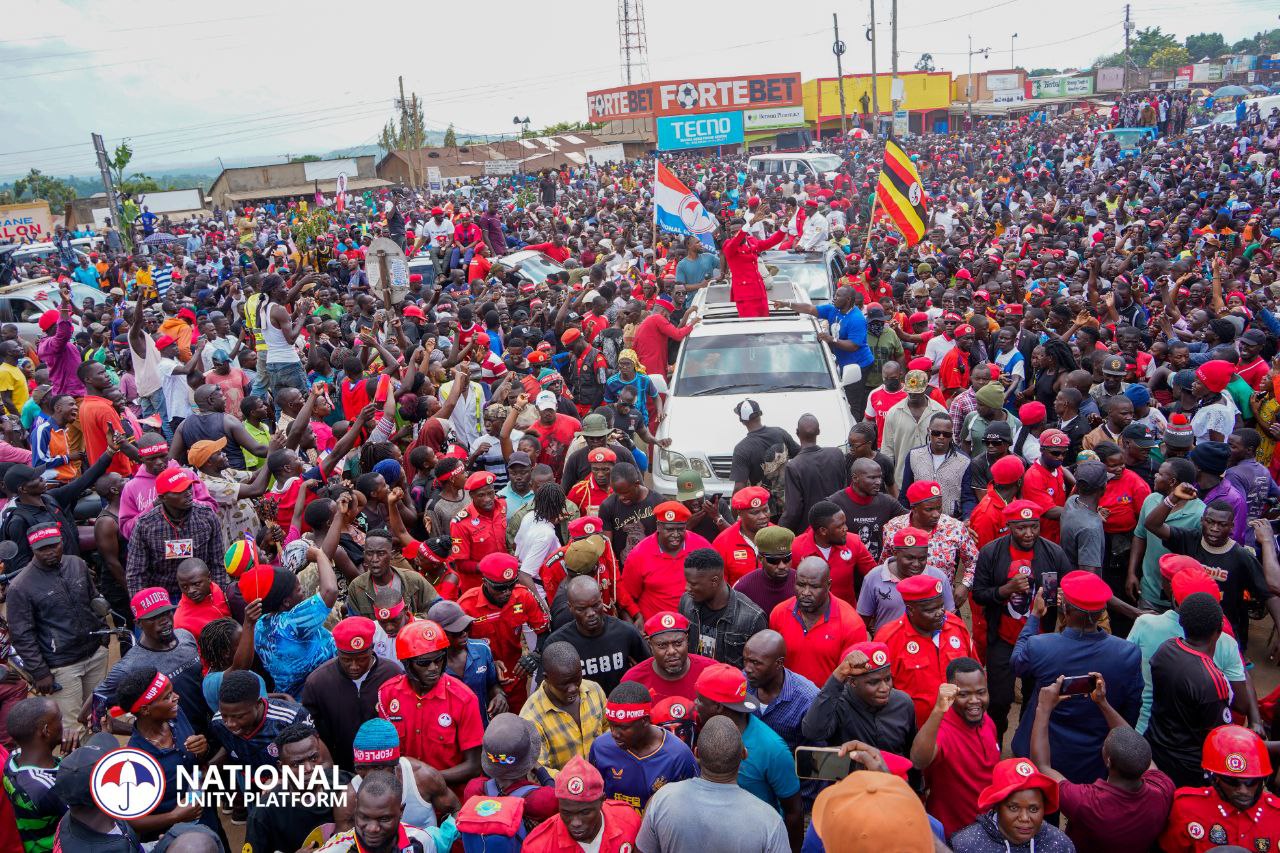
Some government leaders have reasoned that people attend his rallies not to hear what he has to say but just to see a music icon. However, anyone who has assessed Bobi Wine’s rallies can detect that his interaction with the people goes beyond celebrity appeal — it signifies a rising new-generation leader eager to communicate messages of change across the country.
Polarization and Controversy
Bobi Wine has emerged as a highly polarizing political figure — a hero to his supporters and a threat to the quasi-NRM government. This is why many of his so-called foot soldiers have been captured from the campaign trail and thrown behind bars, likely to instill fear in him, his supporters, and the general public.
Unexpectedly, of all the presidential candidates, it is Bobi Wine’s campaigns that have been heavily guarded by the military and police. This has often forced him to walk on foot through paths to reach his audiences.
No amount of provocation by security has forced Bobi Wine and his supporters to adopt violence, despite the over-policing and militarization of his campaigns.
Implications for Uganda’s Politics
Bobi Wine’s impact on Uganda’s political landscape: energizing youth, shifting allegiances, challenging the NRM, a potential for sustained mobilization, coalition-building, and institutional reform, for which examples are the famous People Power movement’s growth, opposition alliances, and civil society engagement
The writer is a Conservation Biologist at Center for Critical Thinking and Alternative Analysis
If you would like your article/opinion to be published on Uganda’s most authoritative news platform, send your submission on: [email protected]. You can also follow DailyExpress on WhatsApp and on Twitter (X) for realtime updates.