

By Oweyegha-Afunaduula
Center for Critical Thinking and Alternative Analysis
Uganda is going to the next Presidential, Parliamentary and Council elections, which the Uganda Electoral Commission has arranged to be held on 15 January 2026. These will be the 7th elections since 1996 when the President of Uganda, Yoweri Tibuhaburwa Kaguta Museveni, offered himself to electoral politics after resisting the transition from single-party politics for 10 years since he captured the instruments of power in 1986.
The next elections will supposedly be multiparty elections, as has been the case since 2006 when President Tibuhaburwa Museveni opened up to multiparty politics. However, he has not hidden his distaste for multiparty politics because it gives the impression that he is challengeable. Indeed, during his swearing-in for his 6th term as President of Uganda, he committed the next five years (2016–2021) to erasing political parties from the political landscape of Uganda, leaving only his own personalized party, the National Resistance Movement (NRM).
Nevertheless, political parties continue to persist on the political landscape of the country, with the replacement rate of active parties being high while the NRM spends a lot of time, energy, and money to cast the parties as useless and unlikely to contribute significantly to the social, economic, and political development, transformation, and progress of Uganda. The persistent narrative is that only President Tibuhaburwa Museveni and the NRM can rule Uganda to progress.
Currently, the narrative is that only President Tibuhaburwa Museveni can ensure peace and security of the country and ensure further development, transformation, and progress. Accordingly, many political parties seem to have agreed to the narrative and struck alliances with the NRM, not realizing that President Tibuhaburwa Museveni has never abandoned his determination to erase political parties from the sociopolitical landscape of the country.
There are claims that many parties are being sponsored for the 2026 elections by President Tibuhaburwa Museveni and/or his party, whose money is not easy to distinguish from public funds. The claim is that President Tibuhaburwa Museveni has been able to align most of the alternative political parties against the National Unity Platform (NUP), the largest opposition party, led by Kyagulanyi Ssentamu, alias Bobi Wine, to ensure his continued reign beyond 40 years.
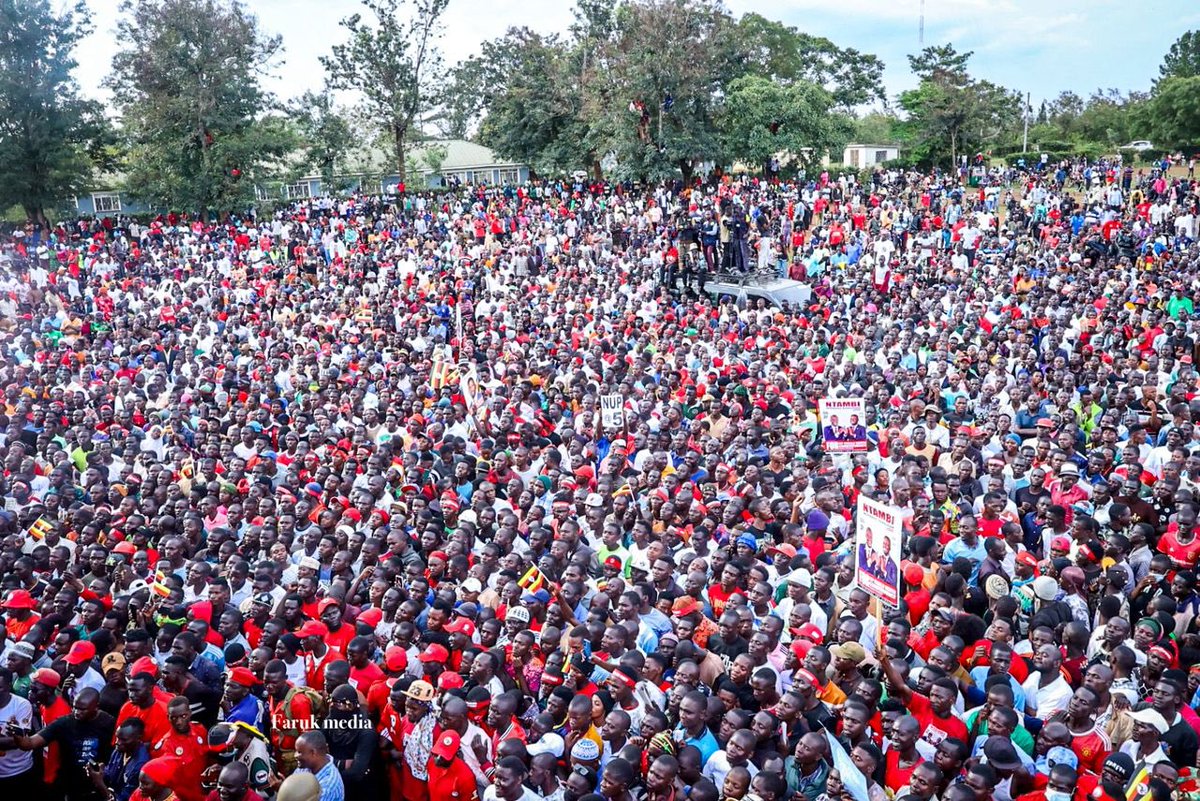
It is clear that the main political forces heading toward 2026 are the NRM and NUP. These are working hard to outsmart each other in support appeal and crowd dynamics in order to prove to the electorate that they are the ones that deserve to lead Uganda beyond 2025.
The following practices have tended to distort and reduce the value of crowds in electoral politics:
- The practice of including school children in crowds to swell crowd size has distorted and reduced the value of crowds in electoral politics.
- The practice of transporting people from one area to another has also reduced the value of crowds in electoral politics.
- The practice of paying people to attend political rallies has distorted and reduced the value of crowds in electoral politics.
- The use of the military and police to constrain people from attending particular political rallies distorts the truth about the popularity of a party.
- Members of one party putting on the uniform of another party and attending its rallies distorts and reduces the value of crowds in electoral politics.
- The practice of using Artificial Intelligence to swell numbers of people in crowds distorts and reduces the value of crowds in electoral politics.

Therefore, as we head towards 2026, we should not take crowds as an automatic indication of the support or popularity of a particular party. In any case, some people may attend a political rally because they expect money, food, or T-shirts to wear when they go home, while their minds endorse another party. Besides, many may not have registered themselves as voters, or voter registers may have been corrupted to render some or many voters unable to vote.
Let me end this cautionary article by explaining how you can distinguish an AI-created crowd from a human-constituted crowd. I had written this elsewhere, but it fits here very well too. It is absolutely important that we can tell an AI-created crowd from a human-constituted crowd so that we can reject the corruption of the electoral process and demand our genuine right to vote and decide our leaders.
AI-created Crowds: AI-created crowds are distinguished by their lack of organic interactions (i.e., they lack nuances such as body language and tone of voice); they show uniform behaviour and responses, which can be a giveaway; they are inconsistent, meaning they contain contradictions; and they depict overly promotional language or buzzwords.

Human-constituted Crowds: Human crowds exhibit diverse opinions and perspectives; respond emotionally with varying levels of engagement and enthusiasm; understand context, idioms, and sarcasm, which AI struggles to replicate; and they exhibit natural, spontaneous interactions, which AI struggles to mimic.
How to Detect AI-created Crowds
Look for unnatural language patterns, repetitive behaviour, lack of personal touches or human error; and inconsistencies in messaging or behaviour. However, keep in mind that AI technology is rapidly evolving, and distinguishing between AI-created and human-constituted crowds may become increasingly challenging.
When we reach this stage, unscrupulous politicians will do anything to give the impression that they are more popular than others, yet the opposite is true. One may even say AI is Satan’s tool of deception in modern times.
For God and My Country
If you would like your article/opinion to be published on Uganda’s most authoritative news platform, send your submission on: [email protected]. You can also follow DailyExpress on WhatsApp and on Twitter (X) for realtime updates.

