
Kotido, Uganda: Communities in Karamoja have been urged to take greater ownership of their food production systems by investing in local seed production instead of relying heavily on external suppliers, a dependency experts warn is weakening the region’s resilience to climate shocks and market disruptions.
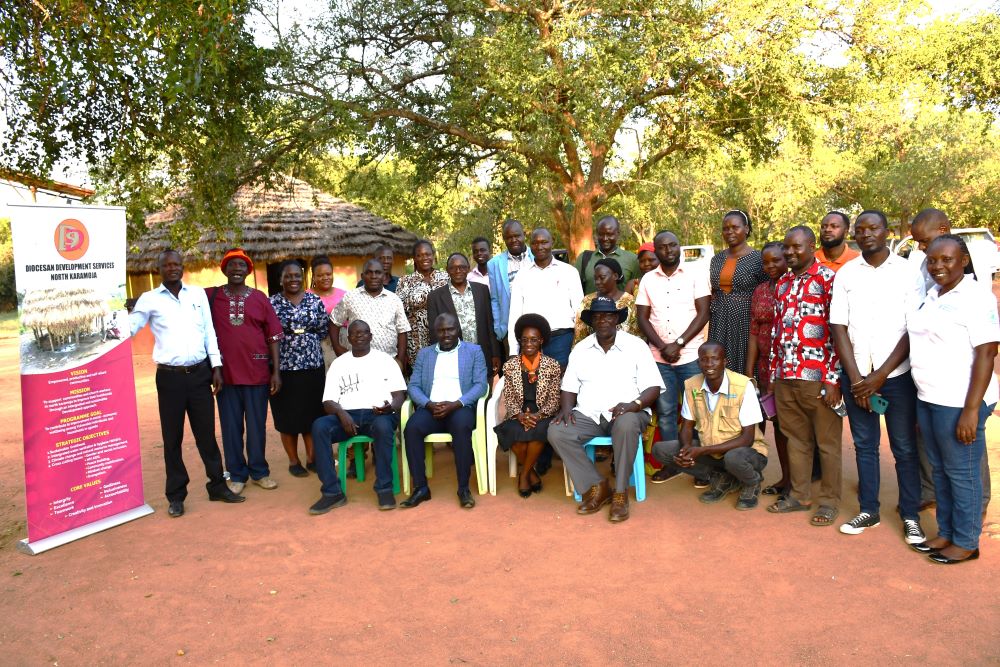
The call came from Ogwaria Moses, Project Officer for Food Security and Livelihoods, during a two-day validation workshop held in Kotido under the FAO-funded project, Improving Food Security and Resilience of Food Production Systems in Karamoja (FOSTER).
Addressing district officials, extension workers, farmer groups, NGOs, and community representatives from across North Karamoja, Ogwaria said the region must harness indigenous knowledge and climate-adapted seed varieties to secure its food future.
“If we continue to depend on outside seed suppliers, our resilience will always be fragile,” Ogwaria cautioned. “We must invest in our own seed systems, rooted in local knowledge and adapted to Karamoja’s climate.”
The workshop, convened by Diocesan Development Services – North Karamoja (DDS NK) with support from Makerere University, assessed the current state of agricultural extension and advisory services.
Experts pointed to gaps in coverage, quality, and inclusivity that leave the majority of households without timely agricultural support. District reports show that fewer than 35 percent of households currently access extension services.
Dr. Rebecca Mukebezi presented an analysis of Karamoja’s farming systems, stressing that interventions must respect cultural practices while introducing innovations to improve resilience. She emphasised that climate shocks in Karamoja “are no longer occasional, they are constant,” and urged actors to help farmers diversify and adapt.
Dr. Naris Mubangizi called for a pluralistic extension system where government and non-state actors complement each other, while Dr Prossy Isubikalu underscored the importance of participatory approaches such as Farmer Field Schools, enabling communities to “learn by doing” instead of relying solely on top-down instruction.
Farmers shared firsthand experiences of the challenges they face. Longoli Romano, a local farmer, said delayed seed deliveries continue to undermine production. “When seeds arrive late, we miss the rains and the harvest fails before it even begins. We want to be part of the solution, not just observers,” he said, urging extension workers to use tools and languages that are accessible to local communities.

The workshop also highlighted low literacy levels among farmers, limited adoption of improved technologies, and the need for practical skilling programs tailored to local realities.
DDS NK Director Canon Ijala Simon Peter said the success of extension services depends on close collaboration between government agencies, NGOs, and communities. “Extension only works when all actors move together,” he noted.
Kotido’s Deputy RDC, Magyezi John Lukooki, closed the workshop with a call for action: “We must move beyond identifying challenges to implementing solutions that empower farmers, youth, and women. The responsibility lies with all of us to ensure extension services reach every corner of Karamoja.”

Officials from the Ministry of Agriculture, Animal Industry and Fisheries reiterated the need for alignment with national frameworks. Mugume R. Stephen emphasized that extension services in Karamoja must complement the broader national policy direction to build resilience and guarantee equitable service delivery.
While Assistant Commissioner Lodingokol John called for transparent, responsive, and innovative extension models that help farmers adapt to climate change. He applauded FAO and DDS NK for their role in advancing reforms on the ground.
Beyond extension services, the workshop addressed wider challenges affecting agriculture in Karamoja, including climate change, crop diversification, market access, women’s empowerment, cross-border resource use, and agricultural skilling.
Participants agreed that without strengthening local seed systems, enabling inclusive extension services, improving market linkages, and enforcing accountability at all levels, the region’s resilience will remain fragile.
The validation meeting produced a set of key outputs, including a detailed report on current extension models, a draft strategy for reform, and an integrated Farmer Field School training manual for community-based facilitators.
As Ogwaria reminded participants, “True resilience begins with communities taking charge of their food systems”—a sentiment echoed by Deputy RDC Lukooki, who concluded, “The responsibility lies with all of us.”
If you would like your article/opinion to be published on Uganda’s most authoritative news platform, send your submission on: [email protected]. You can also follow DailyExpress on WhatsApp and on Twitter (X) for realtime updates.