
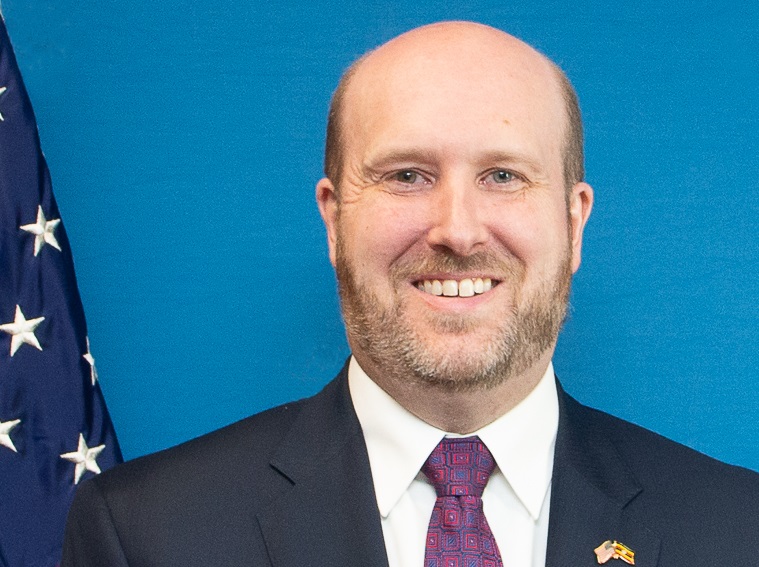
Kampala, Uganda: The United States Ambassador to Uganda, Mr William Popp, has praised a planned multi-year bilateral agreement on health financing between Uganda and the US government, describing it as a “positive change” that ushers in a new approach to health assistance under the America First Global Health strategy.
Delivering his remarks through Dr Mary Boyd, the CDC Country Director, during the Joint Review Mission (JRM) for Uganda’s health sector in Kampala, Popp highlighted two decades of US–Uganda health cooperation that have driven major gains, including a 20-year rise in life expectancy, near-perfect survival rates in recent Ebola outbreaks, and sustained progress in HIV/Aids treatment.
“The new approach, through a multi-year bilateral agreement, will ensure the support we provide to the health sector is grounded in mutual respect, mutual prosperity and national ownership. We believe it will promote efficient and country-driven systems,” he said.
Popp added that resilient health systems are the foundation of economic opportunity, private investment and long-term stability, and would in turn strengthen domestic co-investment.
Describing the US as “Uganda’s biggest ally,” the Ambassador pointed to milestones such as viral load suppression for more than one million HIV/Aids patients, a nearly 50 percent drop in maternal deaths over the past decade, and the 100 percent survival of all Ebola patients diagnosed during the 2025 outbreak.
“Our collective efforts have improved diagnostic capacity, trained health workers, strengthened disease surveillance, reinforced supply chains and advanced digital health and data systems,” Popp noted.

The ambassador said the US government will continue supporting regional referral hospitals through integrated health service delivery, including HIV/Aids programming. He reaffirmed commitments to improving the laboratory networks, supply chain resilience, digital health integration and the health workforce across facilities and communities.
A central pillar of the emerging pact is the scaling of Uganda’s Community Health Extension Workers (CHEWs). Popp revealed that more than 1,000 CHEWs have already been trained in partnership with the Ministry of Health, calling them essential to disease surveillance, epidemic control and community-level service delivery.
Digital health platforms are another cornerstone of the proposed agreement, enabling faster data-sharing to strengthen epidemic preparedness amid rising cross-border disease risks.

Ministry of Health Permanent Secretary Dr Diana Atwine confirmed that negotiations are ongoing.
“We will be able to let you know [the signing date]. We are still discussing it. We are still looking at the terms and negotiating,” she told Daily Monitor. She declined to reveal specific clauses but said data governance, funding modalities and intellectual property protections remain under careful scrutiny to safeguard Uganda’s sovereignty.
According to the draft Memorandum of Understanding, Uganda would receive expanded financial and human-resource support to build a more durable and resilient health system, while the US would curb global health threats and reduce the burden of diseases such as HIV/Aids, malaria and tuberculosis in priority countries.
However, legal and data-privacy experts have raised concerns about a clause requiring Uganda to share its health data with the US for 25 years, arguing that it poses risks to national sovereignty and privacy protections.
The discussions are unfolding against the backdrop of global reforms in health financing, with Uganda seeking greater predictability amid shifting US congressional appropriations for programmes such as PEPFAR.
If you would like your article/opinion to be published on Uganda’s most authoritative news platform, send your submission on: [email protected]. You can also follow DailyExpress on WhatsApp and on Twitter (X) for realtime updates.