
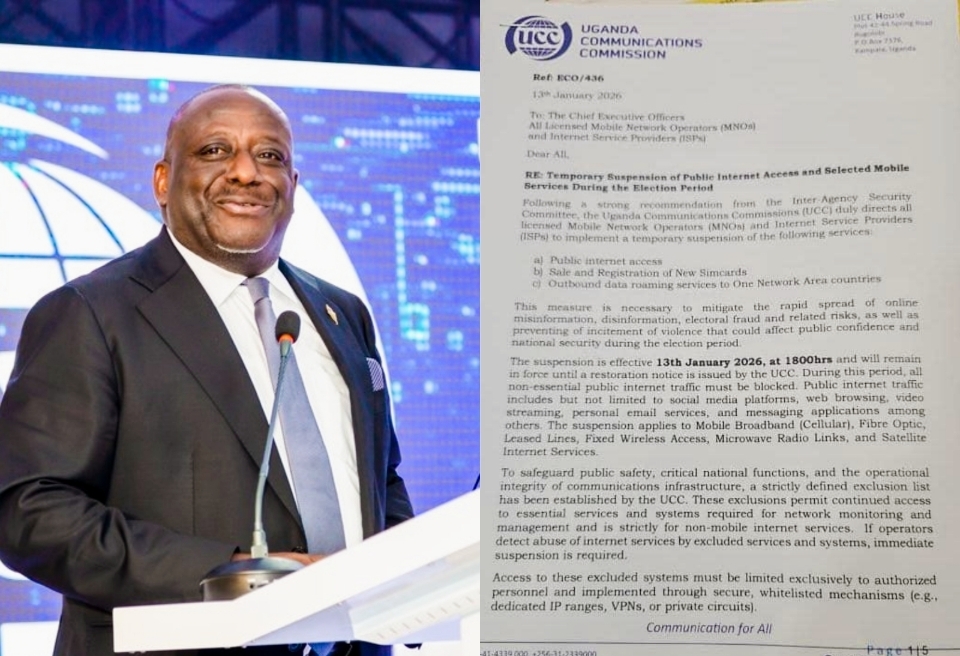
Kampala, Uganda: The Uganda Communications Commission has directed all licensed mobile network operators and service providers to temporarily suspend public internet access and selected mobile services during the election period, citing national security and public safety concerns.
In a directive dated January 13, 2026, addressed to chief executive officers of all licensed Mobile Network Operators (MNOs) and Internet Service Providers (ISPs), UCC said the decision followed a “strong recommendation” from the Inter-Agency Security Committee.
According to the notice, the suspension takes effect on January 13, 2026, at 6:00pm and will remain in force until UCC issues a formal restoration notice.
Under the directive, operators are required to suspend public internet access, sale and registration of new SIM cards and outbound data roaming services to One Network Area (ONA) countries.
UCC said the measures are intended to mitigate the rapid spread of online misinformation and disinformation, prevent electoral fraud, and curb incitement to violence that could undermine public confidence and national security during the elections.
“During this period, all non-essential public internet traffic must be blocked,” the regulator said, adding that affected services include social media platforms, web browsing, video streaming, personal email services, and messaging applications.

The suspension, according to the directives, applies across all access technologies, including mobile broadband, fibre optic networks, leased lines, fixed wireless access, microwave radio links, and satellite internet services.
However, UCC clarified that a strictly defined exclusion list has been established to allow continued access to essential services required for critical national functions, including network monitoring and management systems.

These exclusions are limited to non-mobile internet services and must be accessed only by authorised personnel through secure, whitelisted mechanisms such as dedicated IP ranges, virtual private networks (VPNs), or private circuits.
The regulator warned that any abuse of the excluded systems would result in immediate suspension.
Uganda has previously implemented similar internet restrictions during election periods, a move that often draws mixed reactions from the public, civil society groups, and the business community over its impact on communication, commerce, and access to information.
By Press time, UCC as a regulator, nor it’s Executive Direct Mr Nyombi Thembo, had come out to publicly own the circulating notice, especially after the first notice that went viral in the recent weeks was brandished to be fake and misleading.
If you would like your article/opinion to be published on Uganda’s most authoritative news platform, send your submission on: [email protected]. You can also follow DailyExpress on WhatsApp and on Twitter (X) for realtime updates.