
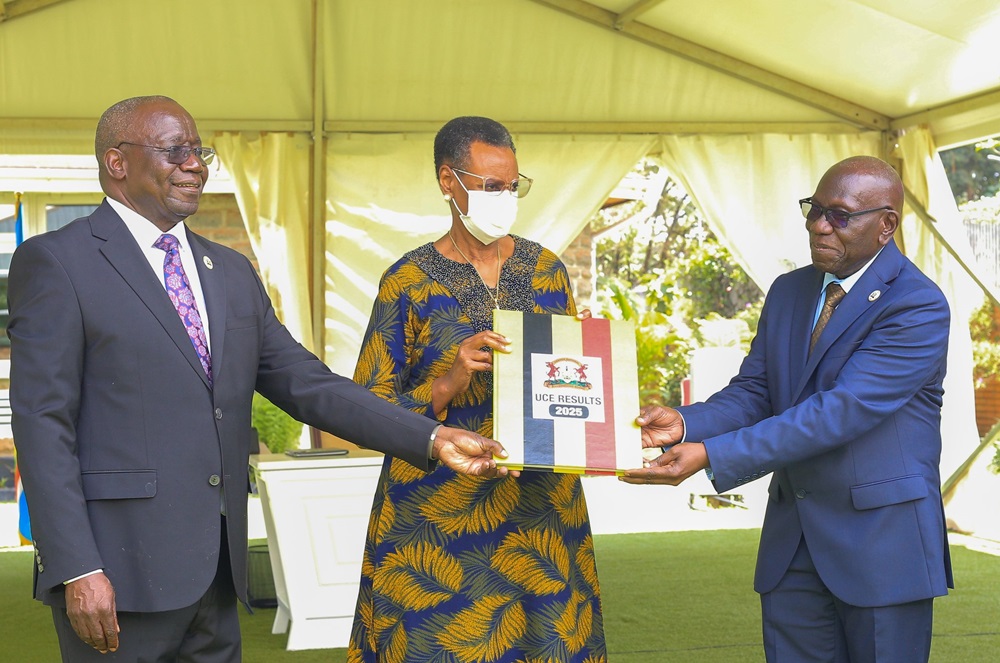
Kampala, Uganda: The Uganda National Examinations Board (UNEB) has reported a sharp containment of examination malpractice in the 2025 Uganda Certificate of Education (UCE) examinations, attributing the low incidence to the design of the new Competency-Based Curriculum (CBC).
UNEB Executive Director Dan Odongo revealed that only 63 cases of examination malpractice were recorded out of more than 429,000 candidates who sat the exams this year — a figure he described as minimal.
“Cases of examination malpractice at this level remain minimal, with only 63 cases reported,” Odongo said during the official release of the results.
Practical Papers Most Affected
According to UNEB, the few malpractice cases were predominantly detected in Mathematics and practical papers in Physics, Chemistry and Biology.
Odongo explained that investigations revealed overwhelming evidence that in some centres, candidates were provided with experimental results by teachers and merely copied them into their answer booklets.
Under the Competency-Based Assessment (CBA) framework, however, candidates are required to independently design and conduct investigations based on given scenarios and apparatus.
“Where external assistance occurred, the investigation designs produced by candidates did not correspond with the recorded results, clearly indicating malpractice,” Odongo said.
He noted that the nature and structure of CBC examination items do not easily lend themselves to cheating, since they require applied knowledge, analytical reasoning and independent problem-solving rather than rote memorisation.
Curriculum Design Limiting Cheating

Education analysts say the CBC’s emphasis on research, experimentation and scenario-based assessment makes it harder for candidates to benefit from leaked answers or copied responses.
Unlike the former content-based curriculum, which largely tested recall of facts, the CBC evaluates practical application, creativity and critical thinking — skills that are difficult to fabricate without genuine understanding.
UNEB also released findings from a post-examination feedback exercise involving 36,546 randomly selected candidates from 118 districts, 49.7% of whom were female.

Selected candidates completed a short questionnaire immediately after leaving the examination room over two weeks. The findings indicate strong confidence in the examination process, and according to UNEB, 96.3% said the examination items were within the syllabus, 74.7% found the time allocated adequate, and 88.2% reported that the questions were clearly presented.
On perceived difficulty; 4.7% described the exams as easy, 66.4% rated them as fair, while 28.8% found them difficult.
Odongo said the feedback further confirms that the CBC examination model is transparent, fair and aligned with the taught curriculum.
UNEB maintains that the low malpractice figures and structured assessment framework signal growing maturity in the implementation of the Competency-Based Curriculum.
With only 63 confirmed cases among over 429,000 candidates, the 2025 UCE cycle marks one of the cleanest examination sittings in recent years. Education authorities say the new curriculum’s design, focusing on competence rather than cramming, is steadily strengthening examination integrity across the country.
If you would like your article/opinion to be published on Uganda’s most authoritative news platform, send your submission on: [email protected]. You can also follow DailyExpress on WhatsApp and on Twitter (X) for realtime updates.