
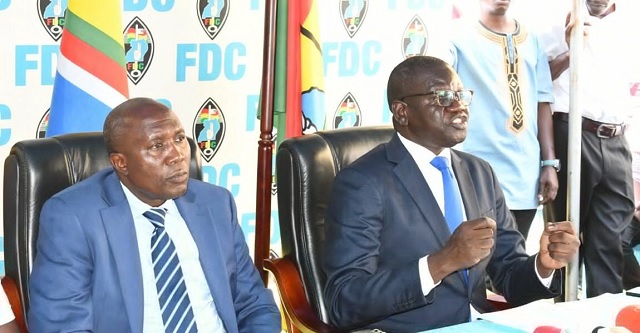
Kampala, Uganda: The Opposition Forum for Democratic Change (FDC) has said it is neither shocked nor weakened by the defection of its former Chief Whip in Parliament, Yusuf Nsibambi, to the ruling National Resistance Movement (NRM).
Nsibambi, the outgoing Mawokota South MP, officially crossed to NRM on Wednesday, weeks after losing his parliamentary seat in the January 2026 general elections. His move followed a meeting with President Yoweri Museveni at State House Entebbe, photographs of which later circulated online.
In a statement released just hours after the Mawokota legislator had publicly confirmed his exit from the embattled opposition outfit, FDC President Patrick Amuriat Oboi described the defection as disappointing but predictable.
“We take note of the decision by our former Chief Whip in Parliament, Hon. Yusuf Nsibambi, to defect to the NRM. While his action is disappointing, it is not surprising and does not in any way weaken our party or our resolve in the struggle for democratic change in Uganda,” Amuriat said.
Nsibambi was among several opposition politicians, including former Kawempe South MP Latif Ssebagala, who met Museveni after the elections. Following public scrutiny, Nsibambi admitted that his engagement with the President was not the first, revealing that he had previously held undisclosed meetings with Museveni.
But Amuriat says the FDC leadership had not been informed about Nsibambi’s engagements with State House and that the party had already initiated internal discussions over the matter.

“For some time, the party had observed concerning tendencies, including his engagement at State House without the knowledge or clearance of the party leadership, a matter that was already under consideration in line with Article 12 of the FDC Constitution,” Amuriat noted.
He added that with Nsibambi’s departure, the disciplinary process had been rendered moot. “With his departure, that internal disciplinary process is now overtaken by events, and he falls under the jurisdiction of his new political home.”

‘Party Built on Ideology, Not Individuals’
Amuriat also stressed that FDC has weathered similar defections before and remained resilient. “FDC is not built on individuals, but on ideology, structures, and the commitment of members across the country,” he said.
He also reflected on past engagements with Museveni under the Inter-Party Organisation for Dialogue (IPOD), noting that although he had previously resisted meeting the President outside transition talks, changing political realities — including concerns over election-related violence — had influenced later decisions.
Following Nsibambi’s exit, the FDC has begun internal consultations to appoint a new Chief Whip in Parliament. The development marks yet another high-profile shift in Uganda’s opposition politics, as NRM continues to attract defectors from rival parties in the aftermath of the 2026 elections.
If you would like your article/opinion to be published on Uganda’s most authoritative news platform, send your submission on: [email protected]. You can also follow DailyExpress on WhatsApp and on Twitter (X) for realtime updates.