
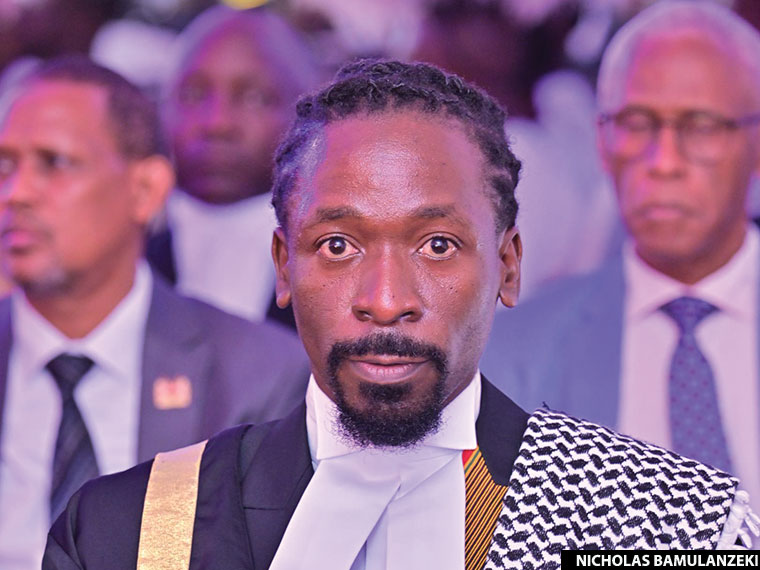
Kampala, Uganda: Uganda Law Society (ULS) President, Isaac Ssemakadde, has issued a blistering critique of Uganda’s judiciary, declaring that “justice is under persecution and therefore in hiding” as he marks the first anniversary of his forced exile.
In a statement issued Thursday marking the anniversary, the Radical New Bar (RNB) leader condemned what he says is a sustained campaign to intimidate, undermine and silence the Bar’s leadership, describing his current situation as emblematic of the shrinking civic and legal space in Uganda.
Ssemakadde warned that Uganda’s judiciary, executive and regulatory institutions have increasingly drifted from their constitutional mandates, creating an environment where dissent is cracked down on and independent voices are coerced into silence.
“Justice is not a decoration… but it is under persecution and therefore in hiding,” he said, stressing that the rule of law must transcend political pressure if Uganda’s legal order is to be protected.
He accused parts of the establishment of transforming courts and statutory bodies into extensions of political power rather than checks on it, and urged lawyers, civil society and ordinary citizens to resist a culture of fear and compliance.
How it started
Ssemakadde, who was elected ULS President in September 2024, rose to prominence for his outspoken advocacy on judicial reform, civil liberties and accountability within state institutions. However, his leadership quickly drew friction with sections of the judiciary and government, especially after he publicly criticised senior legal officials and challenged prevailing interpretations of professional neutrality.
The tensions escalated in early 2025 when a Kampala court issued an international arrest warrant for Ssemakadde on charges related to insulting the modesty of the Director of Public Prosecutions — a case his supporters described as politically motivated and emblematic of a broader campaign to muzzle independent voices.
Facing potential detention in the country’s rotten judicial system, Ssemakadde fled Uganda quietly and has since been residing abroad. Sources within the legal community say his exile stems from fears of arrest and prosecution, which they describe as part of a targeted witch-hunt against a leader who has consistently held state institutions to account.
From exile, Ssemakadde has continued to influence the local legal and political discourse. In late December 2025, he controversially issued an executive order endorsing opposition candidates for the 2026 general elections, arguing that neutrality in the current climate amounted to complicity in the erosion of constitutional governance.
This outspoken stance has drawn both support and criticism within legal circles, with some backing his bold advocacy for democratic change, while others caution that formal politicisation of the Bar could further weaken institutional cohesion.
UGANDA LAW SOCIETY
COMMUNICATION FROM THE ULS PRESIDENT ON THE FIRST ANNIVERSARY OF HIS FORCED EXILE
Nowhere to hide
Uganda Law Society, Civil society at a time of national reckoning
Uganda Law Society is now seventy years old.
Uganda itself, in its whole form, is only 125 years old.
The election of the Radical New Bar was a moment of reckoning from the national conversation.
It may come as a surprise for some to realise just how many of the leading personalities in the construction of the NRM dictatorship have been lawyers. This tells us that to study Law is not to understand it, and that to understand it is not to believe in it. To be-wigged bootlickers like this (and the lawyers who follow them) being an expert in the law is mistaken to mean being very good at manipulating and playing it.
Justice is not a decoration, or some fancy idea we turn to when we want to show that we are “educated”. Justice, as a concept, long predates any concept of education. It is one of the oldest of all human values created as part of the building blocks to what we call being civilised, that is: being able to live in harmony with others.
After the initial act of coming together into groups was born of the need for security. Once together, humans consolidate that security by developing collective means of production, especially of food.

Once power centres, or social classes emerge, basically an elite versus the rest of society, then whatever justice system that was created becomes a battleground between the interests of the community as a whole, and the dominant elite. This is an old story. Therefore, the practice of Justice is an ever-developing open-ended struggle to keep it faithful to its founding principles, and not become simply a tool for power to control the population by mediating their disputes in its interests, and also distributing punishment among them.
Justice is therefore a very deep-seated and respected aspect of the human instinct, and an organic part of civilisational culture. It is a human instinct that develops into a complex system with its own lessons, rules and principles.
Sometimes power tries to be dominant by getting rid of the culture and conventions of Justice altogether, as they are obstacles to its complete dominance. However, such arrangements do not last long and lead to societal collapse, as we saw with the implosion of the regime of General Idi Amin. Power therefore normally seeks to hold on the outward appearances of a system, while undermining, corrupting and destroying it from within.
This is where our regime lawyers, qualified on paper, but disqualified on morals, come in. The outward appearances, in terms of the official dress code, the titles, the official ceremonies, speeches, the perks and privileges are kept in place, but the spirit and original intention of justice as a system is under increasing threat of eradication.

We now have wigs sitting on empty heads, and gavels being wielded as hammers against the common people.
Independence was a struggle for power. The final decades of colonialism were a time of the colonial power trying to leave with the best possible terms for itself to preserve itself afterwards. One method was to make concessions to the African nationalists, especially the more elites among them. This could explain why organisations like Uganda Law Society were created, after nearly six decades of the colony operating courts without one. Since all practicing law had been basically training within a modification of the overall British legal education and practice system, this could have continued, and to some extent, it did.
Whatever power the new African governments acquired after independence has placed them where the colonists used to be; you have immediate power of a largely poor and exploited population that wants to develop itself. To do that, it needs order, representation, security and above all, Justice to guarantee the fair distribution of those things.
Uganda has never managed to deliver those things to its people. In the seventy years since the creation of the ULS, the Ugandan people have experienced five dictatorships, multiple mass killings, only ONE free and fair election (1961 which DP won making Ben Kiwanuka the first Prime Minister under self-government), three wars, and the mass giveaway of their national assets. In that time, the justice system has always been under persecution and therefore on the retreat, or in hiding.
The deception of the 1986 change of power was to present itself as a historical solution to all these accumulated problems. In fact, what it did was to use the illusion of constitutionalism to create and expand space in which perks, privileges, jobs and careers for political and potentially political elites could be created. Space was also created to facilitate how other elites could safely and consistently access donor money through the hawking of our peoples’ problems globally.
We were fooled into believing these things would bring change. Instead, the stage was set for mass opportunism, as elites rushed to make themselves the voice of various disadvantaged groups, and then work with power to keep that leadership.
This is where the Radical New Bar comes in. We are young Africans concerned with the future of our society. Changing the culture of civil society leadership at the Bar is a start. But what we have done here, and continue to do, which everyone has seen, is something that must be done all across Ugandan civil society. Break the chains of fear, opportunism and compliance. Destroy the cosy arrangements people – like the so-called women lawyers’ movements – have made with the dictators. Make your organisation reflect the needs of the population, and create other organisations to do that.
Radical New Bar is not an end; it is a beginning.
What we are ending is the seventy years of compromise, collaboration and disgrace.
END
Broader Context: Witch-Hunt Claims
The Uganda Law Society itself has described ongoing pressure from some state actors as tantamount to a “witch-hunt” against its leader and other outspoken lawyers advocating for judicial reform and rule of law, particularly employees and leaders challenging perceived bias and systemic shortcomings in the justice system.
Critics say the prolonged disputes between the ULS leadership and state institutions reflect deeper fractures in Uganda’s political and legal landscape, where professional bodies face increasing scrutiny and, they argue, punitive action when they confront entrenched interests.
If you would like your article/opinion to be published on Uganda’s most authoritative news platform, send your submission on: [email protected]. You can also follow DailyExpress on WhatsApp and on Twitter (X) for realtime updates.