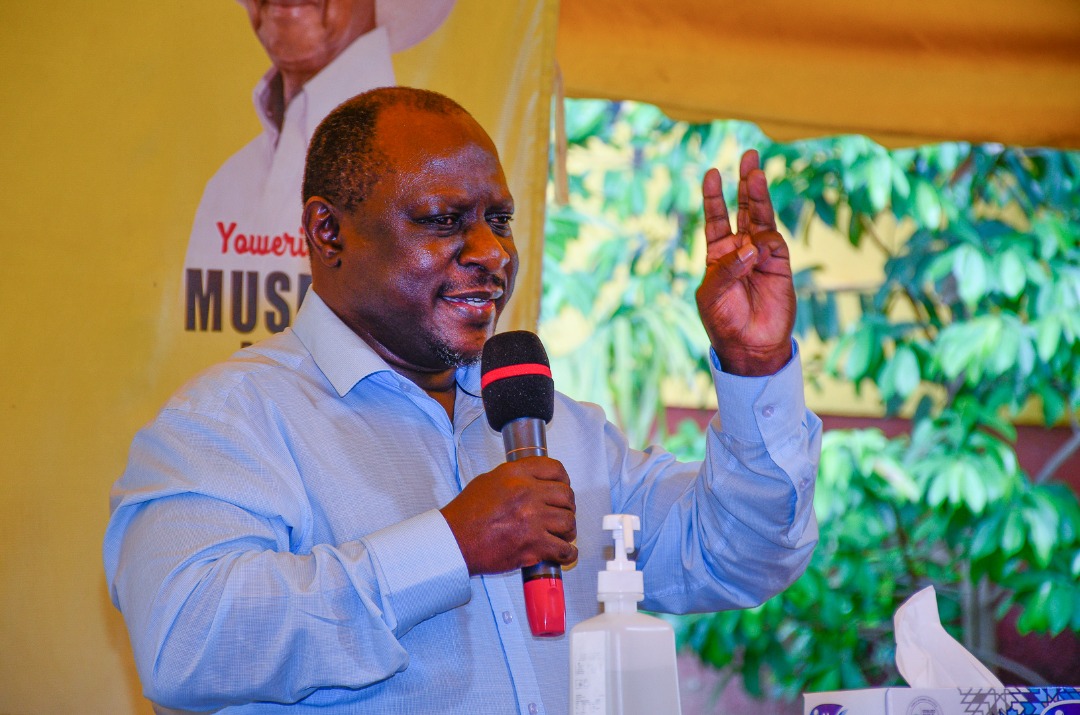
By Kenneth David Mafabi
Discussing national strategic challenges in the aftermath of elections, we once again share our thoughts on the “Challenge of Take-Off”. We need to find the fundamentals in this sometimes rudderless conversation. Here goes.
“The work of Adam Smith, especially his seminal 786-page; The Nature and Causes of the Wealth of Nations, 1776, was (still is) foundational to the work of several generations of political economists and scholars – including Karl Marx.
Marx, however, in Chapter 26 of his Das Kapital Volume One: A Critique of Political Economy, 1867, sharply disagreed with Smith on the source of National Accumulation and Saving. We discuss the sharp disagreement and a lot more in our Mwangaza Thematic Area Two, Liberating Theory of Political Economy. For now, we leave you with brief excerpts from Marx on the subject of the Primitive (Original) Accumulation of Capital.
The whole movement, therefore, seems to turn in a vicious circle, out of which we can only get by supposing a primitive accumulation (previous accumulation of Adam Smith) preceding capitalistic accumulation; an accumulation not the result of the capitalistic mode of production, but its starting point
This primitive accumulation plays in Political Economy about the same part as original sin in theology. Adam bit the apple, and thereupon sin fell on the human race.
Its origin is supposed to be explained when it is told as an anecdote of the past. In times long gone by, there were two sorts of people: One, the diligent, intelligent and, above all, frugal elite; the other, lazy rascals, spending their substance and more, in riotous living. Thus, it came to pass that the former sort accumulated wealth and the latter sort had at last nothing to sell except their own skins. Such insipid childishness is preached to us every day in the defence of property…!!
In actual history, it is notorious that conquest, enslavement, robbery, murder, briefly force play the great part… As a matter of fact, the methods of primitive accumulation are anything but idyllic.”economic life largely defines politics (although politics in turn impacts how the economy develops). We cannot, for example, have a fully integrated national society without building an integrated internal market for agriculture, industry and services. We cannot build new national values without progressively weakening rural localism and provincialism, which are produced and reproduced by peasant subsistence existence … economics and politics are the two sides of the same coin.
In examining the ‘Challenge of Take-Off, the discipline of ‘Political Economy’, and the tools of analysis it avails are very important for a greater appreciation of the interplay of politics and economics in society. A common-sense overview of the essentials of Political Economy enables better approciation of the ‘Challenge of Take-Off, by all patriots.
Political Economy can be very simply understood as the study of how a country is managed or governed, taking into account both political and economic factors. Mother Nature provides numerous examples of the phenomenon of take-off. For example, relatively small bodies neighbouring more massive bodies have to gain what is referred to as escape velocity in order to escape the gravitational pull of
the bigger bodies, i.e., to take off. To escape from Earth’s gravitational pull and take off into space, space vehicles powered by multiple-stage rockets have to harness the escape velocity of 11.20km/s (40,320km/hour).

Take-off, in that sense, involves three elements: Existing inhibiting factors; harnessing the ability and energy to overcome the inhibiting factors; progress and/or movement to a new trajectory. For our immediate purposes, ‘take-off refers to a qualitative leap away from our condition of backwardness in our enclave economy, to modernity. “Take-off’ refers to a qualitative leap to, first, middle-income status within the next few years, and ultimately first-world status.
In 1960, American economist Walt Whitman Rostow published an important model of stages of growth, which could provide a useful checklist (alongside others and many other indicators) for assessing progress to take-off to modernity and first world status.
Prof. Rostow’s model suggested the following stages: Traditional Society – an agricultural economy of mainly subsistence farming; pre-conditions for Take-Off-Agriculture becomes more mechanised and more output is traded; Take-Off-Manufacturing industry assumes greater importance, although the number of industries remains small. Political and social institutions start to develop; Drive to Maturity – Industry becomes more diverse, growth spreads; Age of Mass Consumption – Output levels grow, enabling increased consumer expenditure growth is sustained by the expansion of a middle class of
consumers.

Alongside Rostow, we have borrowed from Karl Marx in delineating objectively defining parameters of national economic management and socio-economic transformation.
In the second volume of Das Kapital, Marx distinguishes between what he calls ‘simple reproduction’ on the one hand and ‘expanded (or enlarged) reproduction’ on the other. With simple reproduction, no economic growth occurs, while in the case of expanded reproduction, more is produced than is needed to maintain the economy at the given level, making economic growth possible. This is a clear defining parameter or strategic imperative: National saving (national accumulation) and re-investment in production (expanded reproduction) is a sine qua non for achieving sustained economic growth.
Another defining parameter is as regards the division of all production of society into what Marx called ‘two great sections’ – the two departments of social production. These are the ‘means of production’ (Department I) and the ‘means of consumption’ (Department II).
The defining parameter or strategic imperative here is that, expanded or enlarged production aside (economic growth), Department I (as described above), must produce means of production sufficient for its own needs and at the same time produce means of production sufficient for the needs of Department II, dealing with the production of means of consumption!
In modern society, this is a sine qua non for the qualitative leap from backwardness to modernity and transformation! If the political class and intelligentsia do not take off time to acquaint themselves with the ‘Challenge of Take-Off and all its ramifications, they wittingly or unwittingly delay our people’s historical struggle for all- round transformation. This is especially critical as we move deeper into the Knowledge Economy.
The writer is a Senior Presidential Advisor/Political Affairs (Special Duties) State House, ([email protected])
If you would like your article/opinion to be published on Uganda’s most authoritative news platform, send your submission on: [email protected]. You can also follow DailyExpress on WhatsApp and on Twitter (X) for realtime updates.