
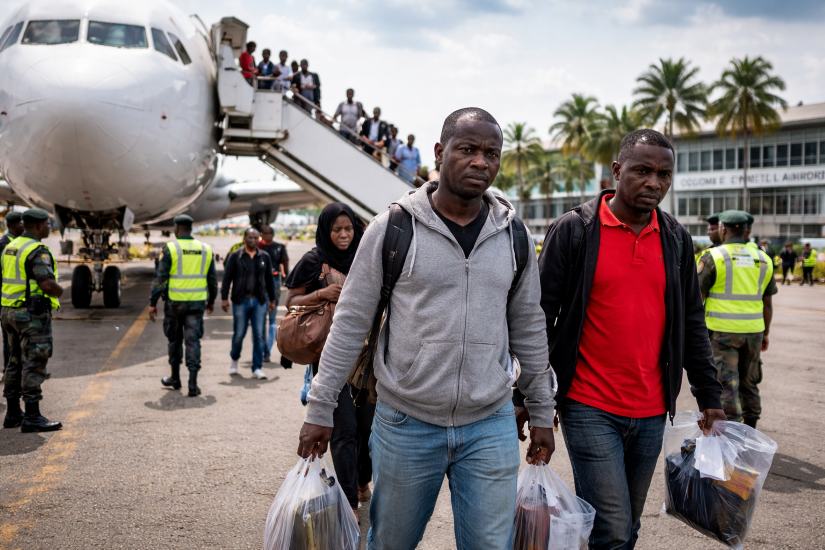
Kampala, Uganda: Uganda has confirmed receiving the first batch of eight deportees from the United States under a controversial “Safe Third Country” arrangement, despite legal and human rights concerns raised by activists.
The group, which arrived at Entebbe International Airport on Wednesday, April 1, 2026, comprises third-country nationals of African origin whose asylum claims in the US were rejected.
The development comes barely a day after the Uganda Law Society (ULS), together with the East Africa Law Society, announced on Thursday that they had gone to court to challenge the deportation, which they called “an undignified, harrowing and dehumanising process”.
“We have approached the Courts of Law in Uganda and the region, seeking bespoke reliefs designed to arrest this patent international illegality,” Asiimwe Anthony, the vice president of the Uganda Law Society, wrote in a statement.
However, the Ministry of Foreign Affairs Permanent Secretary, Mr Vincent Bagiire Waiswa, defended the arrangement, saying it complies with both domestic and international law. “The Agreement conforms to Uganda’s national laws and international obligations… it is in respect of third country nationals… of African origin who may not be granted asylum in the USA,” he said.
Bagiire emphasized that the principle of non-refoulement, prohibiting the return of individuals to countries where they may face harm, remains central to the agreement.
According to government, Uganda agreed in July 2025 to selectively process such deportees, excluding minors and criminals, while prioritising African nationals. “All eight deportees had their cases reviewed and approved by a US immigration judge before arrival,” Bagiire added, noting their protection requests will now be handled in Uganda.
However, the ULS has escalated the matter to court, arguing that the agreement lacks transparency, parliamentary approval, and a clear legal framework.
Law Society’s Asiimwe warned that Uganda risks becoming a “dumping ground” for migrants rejected elsewhere. He argued that no law or policy governs the reception and processing of third-country deportees, raising concerns about sovereignty, due process, and human rights protections.
ULS further cited reports that deportations were being carried out through covert arrangements, including privately chartered flights landing in Uganda without public scrutiny.
The deportees were “effectively dumped in Uganda through an undignified, harrowing and dehumanizing process,” the law society said in a statement, adding that they arrived on a private charter flight.

The society is now seeking judicial intervention to halt further deportations pending legal review.
The deportations are part of U.S. President Donald Trump’s crackdown on immigration as he seeks to deter migrants from entering the United States illegally and to deport those who already have done so, especially those with criminal records and including those who cannot easily be deported to their home country.
A Global Policy With Local Fallout
The Uganda deal is part of a broader US policy under Donald Trump involving “third-country removals,” where migrants are deported to countries other than their origin.
The US has signed similar arrangements with countries including Rwanda, South Sudan, Eswatini, and Honduras.

The policy is aimed at accelerating deportations, particularly for migrants whose home countries refuse repatriation or those deemed difficult to process.
However, it has faced fierce criticism globally, with human rights organisations warning it shifts the burden of migration enforcement to developing nations. Critics argue such agreements risk violating international protections and could expose deportees to unsafe conditions.
Museveni’s Backing Fuels Debate
The issue has further stirred debate following remarks by President Yoweri Museveni earlier this year praising the US deportation programme. “I like Mr Trump… thank you so much for chasing those wanderers,” Museveni said during a campaign rally in Arua in January.
His comments, coupled with Uganda’s acceptance of deportees, have intensified public discourse on migration, sovereignty, and national priorities.
The arrival of the deportees has sparked mixed reactions among Ugandans.
Supporters view the arrangement as a form of international cooperation and shared responsibility, while critics question Uganda’s capacity to absorb foreign migrants amid domestic economic and social pressures.
Critics have also questioned whether the countries receiving US deportees are adequately safe. In the past, the US has criticised Uganda for “significant human rights abuses”, citing reports of extrajudicial killings, life-threatening prison conditions, and torture and other degrading treatment from government agencies.
With the ULS court challenge now underway, the fate of the deportation deal hangs in the balance. The case is expected to test Uganda’s legal frameworks, international obligations, and diplomatic positioning in an increasingly contentious global migration landscape.
If you would like your article/opinion to be published on Uganda’s most authoritative news platform, send your submission on: [email protected]. You can also follow DailyExpress on WhatsApp and on Twitter (X) for realtime updates.