Kampala: The Government of Uganda has defended plans to adopt the National Identification Number (NIN) as the primary tax identification number for individuals, saying the move will strengthen tax administration, improve taxpayer records and increase domestic revenue mobilisation.
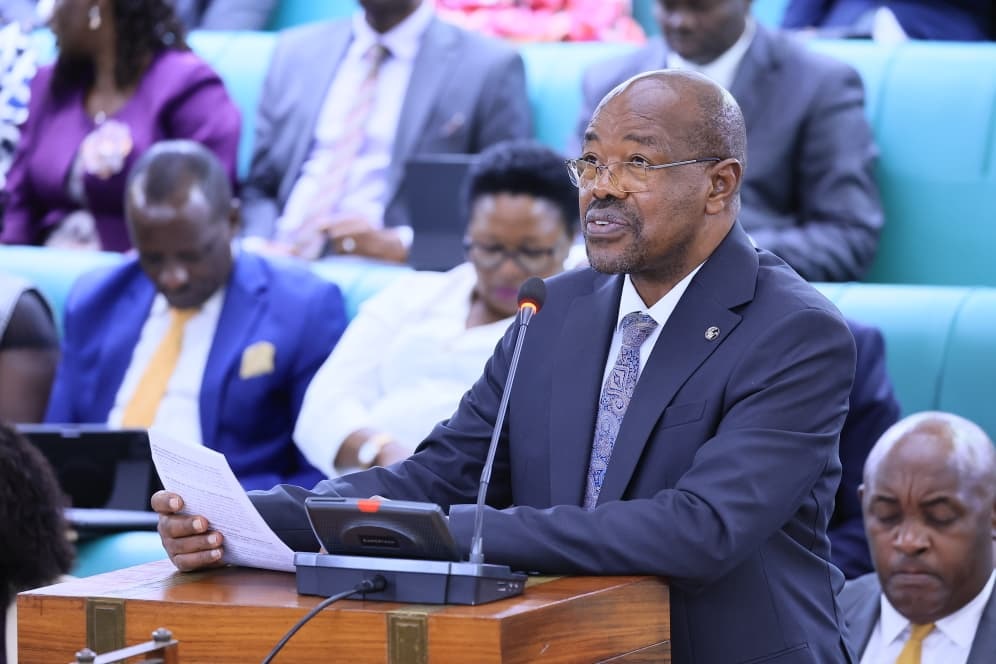
Minister of State for Finance, Planning and Economic Development (Planning), Amos Lugoloobi, told Parliament on Thursday, October 15, 2026, that integrating the two systems would establish a more reliable and unified mechanism for identifying individual taxpayers.
“The broader objective is not simply to replace one number with another, but to improve the integrity of taxpayer identification, broaden the tax base and strengthen domestic revenue mobilisation,” Mr Lugoloobi said while presenting a statement on the proposed integration.
The sitting was chaired by Speaker Jacob Markson Oboth.
The minister said Uganda has 5.7 million registered taxpayers, including 5.4 million individuals. However, only 3.3 million are active, leaving approximately 2.1 million inactive on the tax register.
The government believes that improving taxpayer identification and encouraging eligible individuals to meet their obligations could increase revenue collections.
Lugoloobi cited a potential Shs420 billion in additional revenue, but cautioned that the figure was an illustration of possible collections rather than a new tax imposed on everyone with a national identification number.
“The Shs420 billion is an indicative illustration of the potential revenue that could be mobilised if eligible persons comply with their tax obligations. It is not a tax imposed on every person who possesses a NIN,” he said.

The reform is intended to address weaknesses arising from the separate Tax Identification Number (TIN) and NIN systems, which government says have contributed to duplicate records, inconsistencies and the registration of taxpayers under different particulars.
According to Lugoloobi, the Uganda Revenue Authority (URA) identified 191,813 duplicate records and 51,993 mutations in its taxpayer register during the 2025/2026 financial year.
He said progress had been made towards matching existing taxpayer records with national identification data. By September 30, 2026, a total of 2,130,814 individual taxpayer records had been matched with NINs out of 5,405,148, representing about 39 per cent.
The integration is expected to make it easier for URA to identify taxpayers, reconcile records and detect inconsistencies that could undermine revenue collection.
However, the proposal has raised questions about how government intends to accommodate citizens who lack national identification documents and whether the projected revenue gains can be realised when a substantial proportion of registered taxpayers remain inactive.
The Leader of the Opposition, Joel Ssenyonyi, questioned the readiness of the system to accommodate Ugandans who are not registered with the National Identification and Registration Authority (NIRA).
“About 10.4 million Ugandans are not registered by NIRA, so there is a lacuna during the migration because they do not exist in the system. How will you address that?” Mr Ssenyonyi asked.
He warned that the absence of identification records for a substantial number of citizens could create gaps in the transition and called on government to explain how such individuals would be accommodated.
Ssenyonyi also challenged the assumption that integrating the identification systems would automatically increase revenue, pointing to the large number of inactive taxpayers already on the register.
“Sixty per cent of the people on the tax register are inactive, so the claim that tax inflows will increase is not necessarily true. We would want to know the plans around those who are inactive,” he said.

His concerns shift the debate beyond the technical integration of identification records to the more difficult task of getting eligible taxpayers to comply with their obligations.
The opposition leader also raised concerns about the handling of personal information under the proposed arrangement, citing Section 29 of the Data Protection and Privacy Act, which requires entities collecting and processing personal data to register with the National Information Technology Authority–Uganda (NITA-U).
The concerns place data protection among the issues government will need to address as it links information held by different public institutions.
Under the proposed framework, the NIN will apply to individual taxpayers, while companies and other registered organisations will use the Entity Registration Number issued by the Uganda Registration Services Bureau, subject to the necessary approvals.
Foreign taxpayers will be identified through applicable documents, including Alien Identification Numbers, while diplomats will use identification numbers issued through the Ministry of Foreign Affairs. Government is also expected to develop separate arrangements for refugees.
Despite the concerns, some legislators backed the reform, arguing that a unified identification system could improve accountability and reduce inefficiencies in tax administration.
Ndorwa County West MP Eliab Naturinda cited Ghana and Rwanda as examples of countries that had undertaken similar transitions, urging government to move from preparation to implementation.
“Ghana transitioned in 2021 and Rwanda transitioned effective 2025. Government spent money on benchmarking and sent staff and even MPs to those countries. We should now implement,” Mr Naturinda said.
Rukiga County MP Patrick Katabaazi also supported the principle of adopting a uniform taxpayer identity but pointed to operational weaknesses at NIRA that could complicate implementation.
He cited staffing shortages at the authority, which he said had contributed to approximately 5.6 million national identity cards remaining uncollected.
If you would like your article/opinion to be published on Uganda’s most authoritative news platform, send your submission on: [email protected]. You can also follow DailyExpress on WhatsApp and on Twitter (X) for realtime updates.