

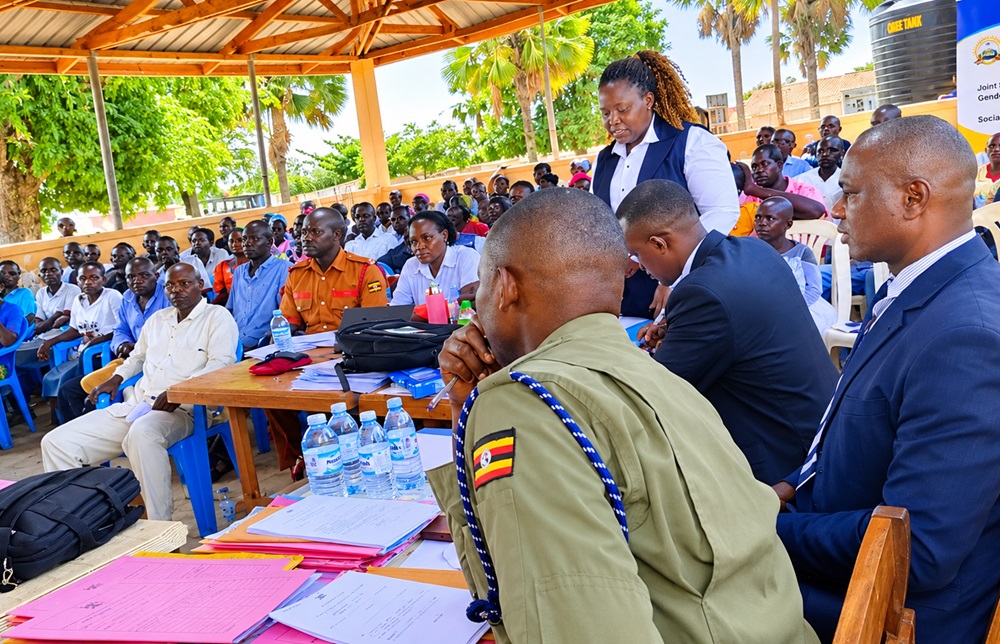
In Summary: The Uganda Law Society’s Legal Aid Project has reported the conclusion of nine cases during a mobile court session in Obongi District, as part of wider efforts to bring judicial services closer to refugees and vulnerable communities. The initiatives seek to reduce the cost and distance associated with accessing justice, address case backlogs and improve legal awareness among refugees and host communities.
Obongi, Uganda — The Uganda Law Society (ULS), through its Legal Aid Project, has concluded nine cases during a mobile court session in Obongi District, taking judicial services closer to refugees and other vulnerable members of the community who often face difficulties accessing formal court facilities.
The cases, handled with the support of officers from the Legal Aid Project’s Moyo Clinic, involved defilement, domestic violence, cattle theft and attempted aggravated defilement. Beyond the court proceedings, the exercise included community sensitisation sessions aimed at helping refugees understand the judicial process and their responsibilities when pursuing justice.
“9 cases have been successfully concluded by our Moyo clinic officers during a Mobile Court Session in Obongi District. The cases involved defilement, domestic violence, cattle theft, and attempted aggravated defilement,” Legal Aid posted via their official Handle.
“Beyond hearing cases, the session, through sensitization, equipped refugees with vital knowledge on the importance of following up on their cases, attending court hearings and actively participating in judicial proceedings.”
The Obongi intervention follows a four-day mobile court exercise scheduled for October 26–29, 2026, at Palorinya Refugee Settlement, organised through collaboration involving the Uganda Law Society, the Uganda Network on Law, Ethics and HIV/AIDS (UGANET), the Judiciary and other justice-sector stakeholders.
Ahead of the proceedings, UGANET and ULS conducted a sensitisation session at Moyo Government Prison to explain the purpose of the mobile court, plea bargaining and reconciliation.
Inmates interested in plea bargaining were also given an opportunity to hold individual consultations with defence counsel to explore possible terms and sentences before presenting agreed arrangements to court for consideration.
In a separate update on the Palorinya exercise, the Legal Aid Project reported that its Moyo Clinic team handled 15 cases. Of these, six resulted in convictions, three were dismissed for want of prosecution, one accused person was acquitted, while five remained ongoing.
The exercise was supported by the United Nations High Commissioner for Refugees (UNHCR), in partnership with the Judiciary and UGANET.
ULS expands mobile court support in West Nile
The Obongi exercise is part of a wider pattern of mobile court participation by the Legal Aid Project, particularly in West Nile, where refugee settlements and host communities face geographical and financial barriers to accessing conventional court services.
On October 21, 2026, the project’s Arua Clinic team participated in a mobile court session at Koboko Government Prison, where 17 cases were concluded.
According to the Legal Aid Project, four inmates were sentenced to community service, two received cautions, while 11 received custodial sentences ranging from one to 12 months.
The proceedings were presided over by Magistrate Grade One Atuheire Precious Namara of Maracha Court, with support from the Uganda Police Force, Uganda Prisons Service and the Office of the Director of Public Prosecutions.
LAP said the outcomes took into account the circumstances of the individual cases and the time accused persons had already spent on remand. The use of community service and shorter custodial sentences in appropriate cases was intended to support rehabilitation and reduce pressure on prison facilities. Sotwe
Earlier in October, the Legal Aid Project’s Arua Clinic officers also participated in four mobile court sessions organised by the Judiciary at Arua Main Prison on October 13 and 14.
The sessions formed part of a plea-bargaining exercise during which 151 cases were concluded. Of these, 84 convicts received community service sentences, while 67 received custodial sentences. The maximum sentence reported during the exercise was 20 years for aggravated defilement.

The sessions were presided over by Resident Judge Harriet Grace Magara, Chief Magistrate Conrad Oroya Obol and Magistrates Hellen Amweno, William Mwonge and Christine Imalingat.
The Legal Aid Project said the exercise facilitated faster resolution of cases, helped reduce the backlog and contributed to prison decongestion through the use of community service sentences where appropriate. Sotwe
The project’s Moyo Clinic has also been involved in prison monitoring and legal awareness activities in the region.
In October 2026, the team, together with representatives from UNHCR, UGANET and other justice-sector stakeholders, conducted an inspection at Moyo Government Prison, where 178 inmates received guidance on access to legal representation and the possibility of applying for bail where legally applicable.
The engagement also provided an opportunity for inmates to raise concerns affecting their access to justice and welfare.
In another intervention, the Moyo team secured the release of Maraka Lucy, a single mother of four, from Moyo Government Prison on October 22, after she had been held on remand over a charge of being in possession of government stores.
Mobile court interventions and reported outcomes
The following figures provide a snapshot of recent and historical interventions. They should not be added together as a single ULS total because they involve different dates, locations, partners and types of activities.
| Location | Period | Reported activity |
|---|---|---|
| Palorinya, Obongi | October 26–29, 2026 | 15 cases handled by Moyo Clinic team; six convictions, three dismissals, one acquittal and five ongoing |
| Obongi District | Recent session | Nine cases reported as concluded by Moyo Clinic officers |
| Koboko Government Prison | October 21, 2026 | 17 cases concluded, including community service, cautions and custodial sentences |
| Arua Main Prison | October 13–14, 2026 | 151 cases concluded during four Judiciary mobile court sessions with ULS Arua Clinic participation |
| Bidibidi, Yumbe | 2017/2018 reporting period | ULS legal representation and legal awareness activities documented in refugee-hosting areas |
| Nakivale, Isingiro | Pilot launched April 2013 | Mobile court scheme introduced by UNHCR and government to improve access to justice |
ULS legal aid mandate and partnerships
The Legal Aid Project is an initiative of the Uganda Law Society established in 1992 to provide legal services to indigent, marginalised and vulnerable people who may not afford private legal representation. Its work includes legal advice, court representation, mediation, counselling, referrals and community sensitisation on legal rights and responsibilities.
The project’s current programme, supported through the International Development Law Organization (IDLO), is titled Enhancing Access to Quality and Sustainable Legal Aid Services for the Marginalized and Vulnerable Communities in Uganda.
If you would like your article/opinion to be published on Uganda’s most authoritative news platform, send your submission on: [email protected]. You can also follow DailyExpress on WhatsApp and on Twitter (X) for realtime updates.


