
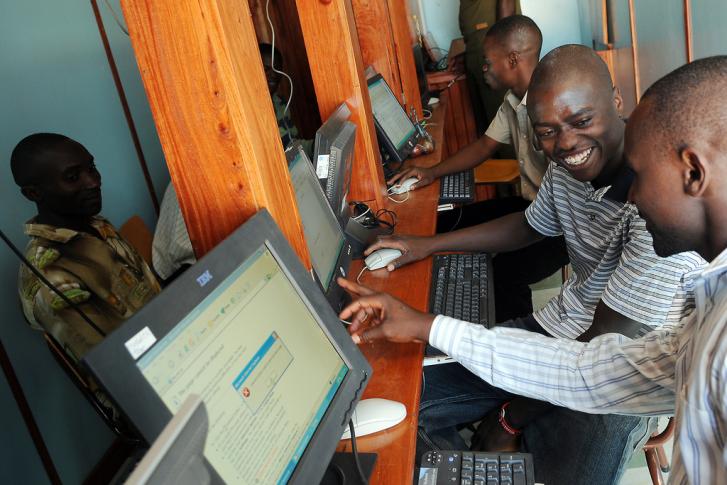
There was a time when accessing the internet in Uganda required a journey. You would leave home, walk or board a taxi to the nearest internet café, find an available computer, buy a few minutes or an hour of browsing time, and hope the connection was fast enough to complete whatever had brought you there.
For many Ugandans, the internet café was not just a business. It was a gateway to the world.
It was where university students searched for academic materials, job seekers submitted applications, young people created email addresses, entrepreneurs researched business opportunities and friends discovered the excitement of social media.
In Kampala, places such as Wandegeya, Makerere, Kikuubo, Nakawa and the city centre once had internet cafés serving people who had neither computers nor internet connections at home. Similar businesses emerged around universities, trading centres and district headquarters.
A visit to a cybercafé was almost a routine activity. You could find someone typing a university assignment, another downloading music, someone else checking a Yahoo Mail account, and a job seeker carefully preparing a curriculum vitae.
Today, that familiar scene is becoming increasingly difficult to find.
The question is not whether internet cafés have lost their former prominence. They clearly have. The more interesting question is whether their decline was inevitable, whether their owners saw the warning signs early enough, and whether Uganda’s digital revolution has completely made them unnecessary.
I believe we saw it coming, although perhaps not everyone understood how quickly it would happen.
From a room full of computers to the phone in your pocket
The decline of traditional internet cafés did not happen overnight. It was the result of several technological and economic changes that gradually made the old model less attractive.
First came the expansion of mobile telecommunications and internet-enabled modems. People no longer needed to sit in a café to access the internet. They could purchase a modem, connect it to a computer and browse from home or the office.
Then came the smartphone revolution. Suddenly, the computer that once occupied an entire desk was being replaced by a device small enough to fit in a pocket. A person could check emails, browse websites, communicate with friends, read the news and download documents without leaving home.
The arrival of affordable smartphones made the transformation even more pronounced. What had once been an expensive technological privilege became increasingly accessible to ordinary consumers.
Mobile internet bundles also changed consumer behaviour. Instead of paying a café attendant for a fixed browsing session, users could purchase data and decide when, where and how to access the internet.
Convenience became the new currency. A student no longer needed to trek to Wandegeya to check examination results. A trader in Owino Market could communicate with suppliers through WhatsApp. A journalist could follow breaking news while travelling. A farmer could access weather information or communicate with buyers without necessarily visiting a cybercafé.
The internet had moved from a destination to a companion.
The numbers tell a remarkable story
Uganda’s telecommunications statistics provide a useful picture of how dramatically the digital environment has changed. According to the Uganda Communications Commission (UCC), the country had more than five million internet users by June 2014, compared with approximately 1.5 million in 2012.
More revealing was how people accessed the internet. The figures cited in a Daily Monitor report published in April 2015 indicated that approximately 4.1 million people accessed the internet through mobile devices, compared with about 106,900 using fixed internet devices.
That was an early warning that the centre of gravity was shifting away from fixed access.
Fast-forward to September 2025, and UCC figures show that Uganda had 45.7 million active mobile subscriptions, 17 million active mobile internet subscriptions, 35.6 million active mobile money subscriptions and approximately 19 million smartphones.
These figures are not a direct count of unique individuals, because one person may own multiple SIM cards or devices. Nevertheless, they demonstrate the scale of the country’s mobile communications ecosystem.
DataReportal’s Digital 2026 Uganda report, using figures for October 2025, estimated that 11.4 million individuals were using the internet, representing approximately 22 per cent of the population. It also reported 40.9 million cellular mobile connections.
The distinction between mobile subscriptions and individual internet users is important. They measure different things, but together they demonstrate how deeply mobile technology has entered Uganda’s communications landscape.
The wider African picture is equally significant.
The GSMA’s Mobile Economy Africa 2026 report estimates that mobile technologies and services contributed approximately $240 billion to Africa’s economy in 2025, equivalent to 7.8 per cent of the continent’s gross domestic product.
The organisation also reports that almost one billion people in Africa were still not using mobile internet despite the availability of network coverage. This demonstrates that the expansion of mobile connectivity has been substantial, but access remains unequal.
The evidence points to a profound change: the internet is no longer primarily something people visit. Increasingly, it is something they carry.
The cybercafé owner who failed to see the change
Imagine a business owner called Mr Kato, who invested his savings in a small internet café near a university. At the beginning, business was excellent. Students came in throughout the day to research assignments, communicate with lecturers, download notes and access their emails.
He invested in more computers, improved his furniture and hired attendants to manage the growing number of customers.
But gradually, things changed.
Students started buying smartphones. Some acquired laptops and internet modems. Others began sharing mobile data through their phones. The number of customers paying for browsing time declined, while the cost of electricity, rent, internet subscriptions and equipment maintenance remained.
Mr Kato reduced his hourly charges to attract customers. Unfortunately, cheaper browsing sessions did not necessarily translate into enough business to sustain his investment. He eventually began offering printing, photocopying, document typing and passport photograph services to keep the business alive.
Mr Kato is an illustrative character, but his experience reflects a challenge that many traditional internet café operators have had to confront. Their business model was built around selling access to the internet. Technology gradually made that access available elsewhere, often at a lower cost and with greater convenience.
This is the difficult lesson of technological disruption: sometimes a business does not lose customers because its service has become useless, but because customers have found a different way to obtain the same service.
We did not just abandon cybercafés, we changed our habits
The decline of internet cafés also reflects a broader transformation in consumer behaviour.
Think about how we communicate today. A decade or two ago, someone might visit a cybercafé to open an email account, send a message or check social media. Today, WhatsApp notifications arrive throughout the day. Emails are accessible through mobile applications. News updates appear on phones, and video calls connect families across continents.
Even financial transactions have changed. Mobile money has reduced the need for many people to visit banking halls for routine transfers and payments. Digital platforms have made it possible to pay bills, purchase services and conduct business from almost anywhere with connectivity.
The same transformation is happening in education, entertainment, journalism and commerce. The smartphone has become a communication device, camera, television, music player, office assistant, banking interface and research tool.
For younger Ugandans, the idea of paying someone to use a computer for thirty minutes may seem almost unfamiliar. Their relationship with the internet is fundamentally different from that of people who first encountered it through cybercafés.
Yet we should not confuse familiarity with universal access. Not everyone owns a smartphone. Not everyone can afford regular data bundles. Not every household has reliable electricity, and not everyone possesses the digital skills required to use online services effectively.
The disappearance of the cybercafé as a dominant business model does not mean that every Ugandan has become digitally connected.
Perhaps one of the biggest questions is whether traditional internet cafés could have survived by changing their business models.
Some operators recognised the warning signs and diversified into printing, photocopying, scanning, typing, graphic design, document preparation and online application services. That was a sensible response.
Others could have moved further into specialised services such as digital training, computer literacy programmes, professional document processing, online registration assistance, business support and technology access for people without personal computers.

There remains a market for these services.
Consider a young person applying for a scholarship, preparing a professional CV, submitting a complicated online application or scanning and uploading several documents. A smartphone may be sufficient for some tasks, but not necessarily for all of them.
A computer with a large screen, a printer, a scanner and someone who understands the process can still make a difference. This suggests that the opportunity was not necessarily to preserve the old internet café, but to transform it into a modern digital service centre.
The businesses that understood this distinction had a better chance of adapting than those that continued to depend entirely on hourly browsing charges.
The hidden cost of losing public computer access
As we celebrate the convenience of mobile internet, we must also examine what society may lose when public computer access disappears. A smartphone is not a complete substitute for a computer.
Writing a lengthy research paper, preparing a professional presentation, analysing spreadsheets, editing complex documents or completing certain online applications can be considerably easier on a desktop or laptop.
Students from households that cannot afford computers may still need access to shared facilities. Small businesses may require scanning, printing and document-processing services. Job seekers may need assistance navigating online recruitment platforms.
There is also the issue of digital literacy. Owning a smartphone does not automatically make someone digitally competent. A person may know how to use WhatsApp, watch TikTok videos and browse Facebook but struggle to create a professional document, identify a fraudulent website, use a spreadsheet or protect personal information online.
Public access centres can help bridge this gap if they are properly equipped and staffed. Uganda must therefore be careful not to equate the decline of traditional internet cafés with the disappearance of the need for accessible computer facilities.
The digital revolution still has unfinished business
Uganda has made significant progress in expanding telecommunications infrastructure, but the country still faces challenges involving affordability, meaningful internet access and digital skills.
The UCC’s 2024 Annual Communications Sector Report, released in December 2025, highlighted the need to bridge both connectivity and usage gaps. Similarly, the GSMA’s 2026 findings on Africa show that widespread network coverage does not automatically translate into internet adoption. Device affordability, digital literacy and access to relevant content remain important barriers.
This should concern policymakers, telecommunications companies, educators and private investors. If the internet is becoming essential for education, employment, commerce and access to public services, then digital access cannot remain a privilege enjoyed mainly by those who can afford smartphones and data.
There is a need for affordable public Wi-Fi, community digital centres, computer laboratories, reliable connectivity in schools and practical digital literacy programmes.
Such facilities should not be designed as nostalgic replacements for the cybercafés of the past. They should respond to the demands of a modern digital economy.
The future may not belong to internet cafés, but it still needs them in a different form
I do not believe Uganda needs to bring back the traditional cybercafé exactly as we knew it. The market has changed, technology has advanced, and consumers have developed different expectations. However, I believe there is room for a new generation of digital access centres.
Imagine a modern facility in a trading centre such as Iganga, Masaka, Gulu or Mbarara, equipped with reliable computers, high-speed internet, printing and scanning services, professional document support and digital skills training.
Such a centre could help students, entrepreneurs, job seekers and small business owners access services that are difficult to manage on a smartphone. It could also provide affordable computer access to people who do not own laptops or desktop computers. The opportunity is to move beyond selling browsing time and towards selling solutions.
That is where the future of public digital access may lie.
So, who saw it coming?
Perhaps the warning signs were there all along. The first internet modems, cheaper smartphones, expanding mobile networks and falling data costs were all pointing towards a future in which people would no longer need to travel to a particular building to access the internet.
But technological disruption often moves faster than business adaptation. The cybercafé was once a symbol of modernity. It introduced millions to a world of information, communication and opportunity. It helped a generation discover email, online research, digital applications and social networking.
Its decline should not be dismissed as the failure of an outdated business. It should be understood as part of a much bigger story about how technology changes societies and how businesses must continuously reinvent themselves to survive.
The lesson for today’s entrepreneurs is simple: do not build a business around the convenience of today without asking what tomorrow’s technology might make possible.
The lesson for government is equally important: expanding connectivity must go hand in hand with ensuring that people can afford it, understand it and use it productively.
And for those of us who remember queuing for a computer, carefully watching the minutes on the screen and rushing to print an email before our browsing time expired, the disappearance of the internet café is a reminder of just how far we have travelled. We once went looking for the internet. Today, it follows us everywhere.
The author is the General Manager Editorial at DailyExpress