
In Summary: Uganda’s flagship oil and gas projects have attracted more than $14 billion in investment, while Ugandans account for 85 per cent of the sector’s 22,234 workers as of June 30, 2026. Local firms have also secured $2.3 billion in approved Tier One contracts, representing 30 per cent of the total, according to the Petroleum Authority of Uganda (PAU).
Kampala, Uganda — Uganda’s oil and gas sector has attracted investments exceeding $14 billion in its flagship projects and employed 18,958 Ugandans, as the country advances preparations for commercial petroleum production.
The figures were disclosed by the Acting Executive Director of the Petroleum Authority of Uganda (PAU), Michael Otonga Ochan, during the Fourth Annual National Conference for Civil Society Organisations (CSOs) and Non-Governmental Organisations (NGOs) working in the oil and gas sector.
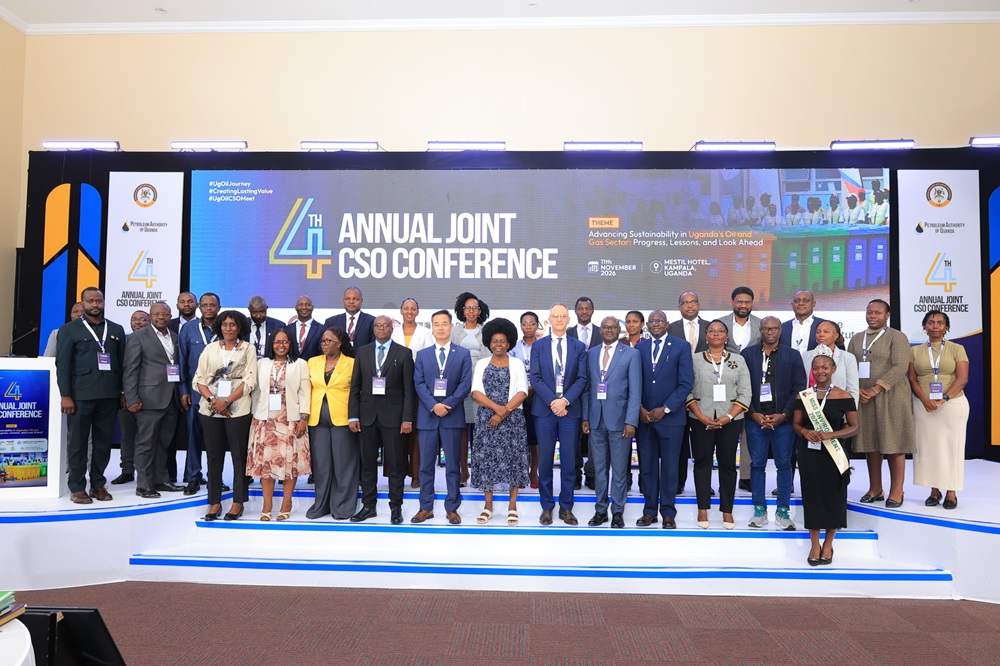
The conference was held on Wednesday, November 11, 2026, at Mestil Hotel in Kampala, bringing together government officials, licensed oil companies, civil society organisations, development partners and other stakeholders to discuss sustainability and the country’s transition towards petroleum production.
Ochan said that by June 30, 2026, the sector had employed 22,234 people, of whom 18,958 were Ugandans, representing 85 per cent of the workforce. He also revealed that the cumulative value of approved Tier One contracts had reached $7.6 billion, with Ugandan companies securing contracts worth $2.3 billion, equivalent to 30 per cent of the total.
He said the figures demonstrate the sector’s contribution to employment creation, enterprise development, skills transfer and increased participation of Ugandans in the petroleum industry.
According to Ochan, the next phase of petroleum production and commercialisation presents further opportunities for local businesses and workers as the country prepares for first oil.
He noted that since the announcement of the Final Investment Decision (FID) in February 2022, Uganda’s petroleum sector had made significant progress, supported by investments that have stimulated economic activity across several sectors.
Over the past 11 years, he said, PAU had established regulatory frameworks and systems to guide petroleum operations, strengthened technical monitoring and compliance, and overseen the transition from exploration to the development and construction of major petroleum infrastructure.
The Authority has also prioritised national content, environmental protection, occupational health and safety, and the participation of Ugandans in the sector.
As Uganda approaches first oil, Ochan said PAU’s regulatory focus would increasingly centre on ensuring safe and efficient operations, maximising recovery of petroleum resources, protecting the environment and ensuring that the sector contributes meaningfully to national development.
On sustainability, he identified three interconnected priorities: economic sustainability through employment, skills development, infrastructure and economic diversification; environmental and social sustainability through biodiversity conservation, emissions management, climate resilience and livelihood restoration; and governance and accountability through effective regulation, transparency and responsible resource management.

Ochan called for stronger collaboration between Government, industry, civil society and development partners, saying constructive dialogue and meaningful stakeholder participation were essential to building trust and addressing concerns surrounding petroleum development.
Reflecting on previous editions of the annual conference, he said the engagements had generated recommendations on strengthening coordination among civil society organisations, capacity building, information sharing, youth participation and evidence-based advocacy.
He urged stakeholders to assess the implementation of earlier recommendations and ensure that conference discussions translate into practical actions that improve the sustainable management of Uganda’s petroleum resources.
Citing the Uganda SDG Progress Assessment 2026, Ochan said the country’s SDG Index had improved from 51.5 in 2015 to 55.84 in 2025, with 28 per cent of assessed targets on track. He called for petroleum resources to be harnessed to accelerate socio-economic transformation, industrialisation, energy access and improved livelihoods while safeguarding the environment.
Ochan reaffirmed PAU’s commitment to continued engagement with civil society and other stakeholders, saying Uganda’s petroleum resources must create lasting value for present and future generations.
The conference was held under the theme, “Advancing Sustainability in Uganda’s Oil and Gas Sector: Progress, Lessons, and Look Ahead.”
If you would like your article/opinion to be published on Uganda’s most authoritative news platform, send your submission on: [email protected]. You can also follow DailyExpress on WhatsApp and on Twitter (X) for realtime updates.