

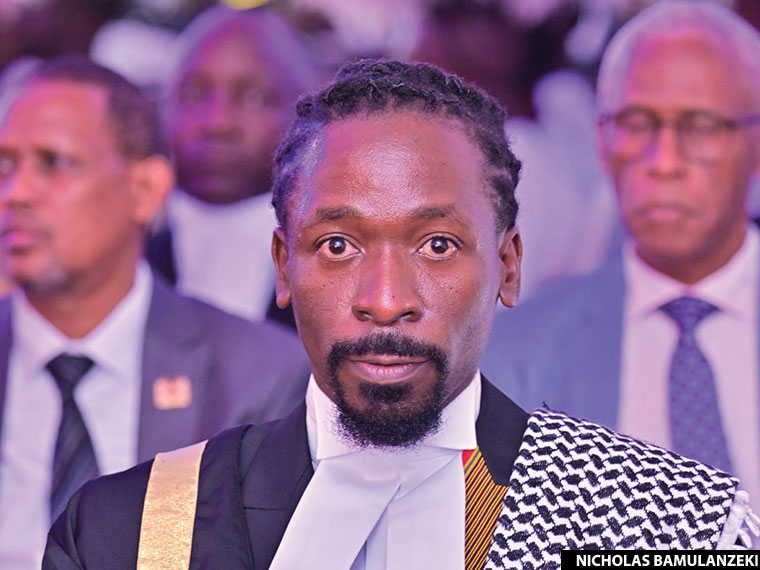
In Summary: Through his lawyers, Ssemakadde argues that recent Constitutional Court decisions have undermined the legal framework used to prosecute him, potentially opening a path for his return to Uganda if the court grants the requested relief.
Kampala, Uganda — Uganda Law Society (ULS) President Isaac Kimaze Ssemakadde, SC, has asked the Buganda Road Chief Magistrate’s Court to quash the international arrest warrant issued against him and terminate the criminal case that has kept him outside Uganda for more than 20 months.
In an urgent application dated November 11, 2026, Ssemakadde, through his lawyers from Mukiibi and Kyeyune Advocates, asked Chief Magistrate Ritah Neumbe Kidasa to invoke section 11(2) of the Magistrates Courts Act to set aside the warrant issued on March 19, 2025, and discharge Ssemakadde from Criminal Case No. KLA-00-CR-CO-913 of 2024.
The application follows a November 4 Constitutional Court judgment that declared several provisions governing private prosecutions under the Magistrates Courts Act unconstitutional, alongside findings concerning provisions of the Penal Code Act on indecent assault and insulting the modesty of a woman.
Ssemakadde’s lawyers argue that the developments fundamentally affect the legal basis of the prosecution initiated against him by private prosecutors Joshua Byamazima and Tonny Tumukunde.
The application highlighted three principal remedies sought from the court: quashing the March 19, 2025 warrant addressed to police in Uganda and Interpol, terminating the underlying criminal proceedings, and discharging Ssemakadde forthwith.
The lawyers say the matter requires urgent consideration because of what they describe as continuing and irreparable harm to their client. “These harms are continuing and, in material respects, irreparable. Time is therefore of the essence,” reads in part, the application.
Constitutional Court ruling gives application fresh momentum
At the centre of Ssemakadde’s latest legal move is the Constitutional Court decision in Kalali Steven and Others v Attorney General, Consolidated Constitutional Petitions Nos. 3 and 8 of 2025, delivered on November 4, 2026.
The five-member panel, led by Justice Cheborion Barishaki, declared sections 42(1)(c), (2), (3), (4), (5) and (6) of the Magistrates Courts Act unconstitutional to the extent that they permitted a magistrate to undertake preliminary consultation, assess complaints and participate in charge preparation before presiding over the same case.
The court found that combining those functions undermined the right to a fair hearing before an independent and impartial tribunal. The ruling, however, did not abolish private prosecutions altogether. Instead, it required a separation of preliminary screening and trial functions to safeguard judicial independence.
Ssemakadde’s lawyers now contend that the proceedings against him were initiated under the very framework declared constitutionally defective.
In one of the strongest passages in the application, the lawyers argue that the charge, proceedings and arrest warrant were all products of an unconstitutional procedure.
“The charge, the process that followed, and the warrant of arrest of 19 March 2025 were all products of that unconstitutional procedure. Proceedings founded on a constitutionally void framework are a nullity,” they state.
The lawyers further invoke the legal principle associated with the landmark case Macfoy v United Africa Co. Ltd, arguing that proceedings founded on an invalid legal process cannot stand.
It is on this ground that they want the Chief Magistrate to invoke section 11(2) of the Magistrates Courts Act, which provides the court with the power to recognise the alleged nullity and bring the proceedings to an end.
The application also relies on the Constitutional Court’s interpretation of section 115(3) of the Penal Code Act, which criminalised acts described as insulting the modesty of a woman. The lawyers argue that the provision’s failure to clearly define what constitutes an insult to modesty makes it uncertain and constitutionally problematic.
They cite the Constitutional Court’s finding in the Kalali judgment that the undefined terms in the provision raised concerns under the constitutional principle of legality, which requires criminal offences to be clearly defined so that citizens can know what conduct is prohibited.
The petition argues that the court’s directions on the provision leave it unenforceable in its present form until the required legislative amendment is made.
The lawyers also rely on Alternative Digitalk Limited and Others v Attorney General, [2026] UGCC 3, delivered on March 17, 2026. In that case, the Constitutional Court declared sections 162 and 163 of the Penal Code Act on criminal libel unconstitutional and addressed the use of criminal sanctions against expression.
The petition further cites Principle 22 of the African Commission on Human and Peoples’ Rights Declaration of Principles on Freedom of Expression and Access to Information in Africa, alongside the African Court’s decision in Lohé Issa Konaté v Burkina Faso.
Ssemakadde’s lawyers argue that criminal proceedings should not be used to shield public officials from criticism and that disputes over reputation should ordinarily be addressed through civil remedies where applicable.
“The present private prosecution, directed at speech concerning a high-ranking public officer, falls squarely within the category of measures that both the Constitutional Court and the African Court have held to be incompatible with Uganda’s international obligations.”
How the case pushed Ssemakadde outside Uganda
The dispute in mention dates back to November 18, 2024, when Ssemakadde, then newly elected Uganda Law Society president, addressed members of the People’s Freedom Front (PFF) at a symposium on the state of the rule of law, constitutionalism and human rights at Katonga Road in Kampala.
During the address, he made remarks about then Director of Public Prosecutions Jane Frances Abodo that prompted two lawyers, Joshua Byamazima and Tonny Tumukunde, to initiate a private prosecution against him.

The lawyers filed their complaint in November 2024, accusing him of insulting the modesty of a woman contrary to section 115(3) of the Penal Code Act, allegations which arose from statements made during the public gathering and captured in a video recording.
On February 24, 2025, Buganda Road Chief Magistrate’s Court issued an arrest warrant after he failed to appear for a scheduled hearing. A further international warrant was issued on March 19, 2025, directing police in Uganda and Interpol to apprehend him and bring him before court.
The warrant came amid a separate legal battle involving Ssemakadde’s conviction for contempt of court. In February 2025, he was sentenced to two years in prison following proceedings arising from his criticism of judicial officers.
Ssemakadde has since remained outside Uganda. His lawyers describe his situation as effective exile, arguing that the threat of arrest has prevented him from returning home and fully discharging his professional and institutional responsibilities.
In April 2025, the High Court temporarily halted execution of the arrest warrant pending determination of proceedings before it, providing him with interim relief. However, the latest application seeks to have the warrant and the underlying criminal case permanently set aside.
The lawyers argue that as Uganda Law Society president and a practising advocate, Ssemakadde has been unable to discharge his professional and institutional duties fully.
“Prolonged separation from family has caused profound personal hardship,” the application says on his family life, further arguing that the Interpol dimension of the warrant has restricted his international movement and exposed him to the risk of detention abroad.
Will the petition open the door for Ssemakadde’s return?
A favourable decision from the Chief Magistrate could significantly change Ssemakadde’s legal position and remove the warrant and criminal case that have been central to his inability to return to Uganda.
If the court grants the requested orders, the international warrant issued in connection with the alleged offence would be quashed, the proceedings in Criminal Case No. KLA-00-CR-CO-913 of 2024 would be terminated, and he would be discharged from that particular case.
That would remove a major legal obstacle to his return, although it would not automatically resolve every outstanding legal matter against him. The separate two-year contempt-of-court sentence remains a significant issue.
Ssemakadde has challenged that conviction, and the outcome of the related appeal will be important in determining whether he can return without facing the prospect of imprisonment.
In his November 5 reaction to the Constitutional Court ruling, Ssemakadde described the decision as a major step towards his return, while urging the Judiciary to hear his appeal against the separate contempt conviction.
If you would like your article/opinion to be published on Uganda’s most authoritative news platform, send your submission on: [email protected]. You can also follow DailyExpress on WhatsApp and on Twitter (X) for realtime updates.


