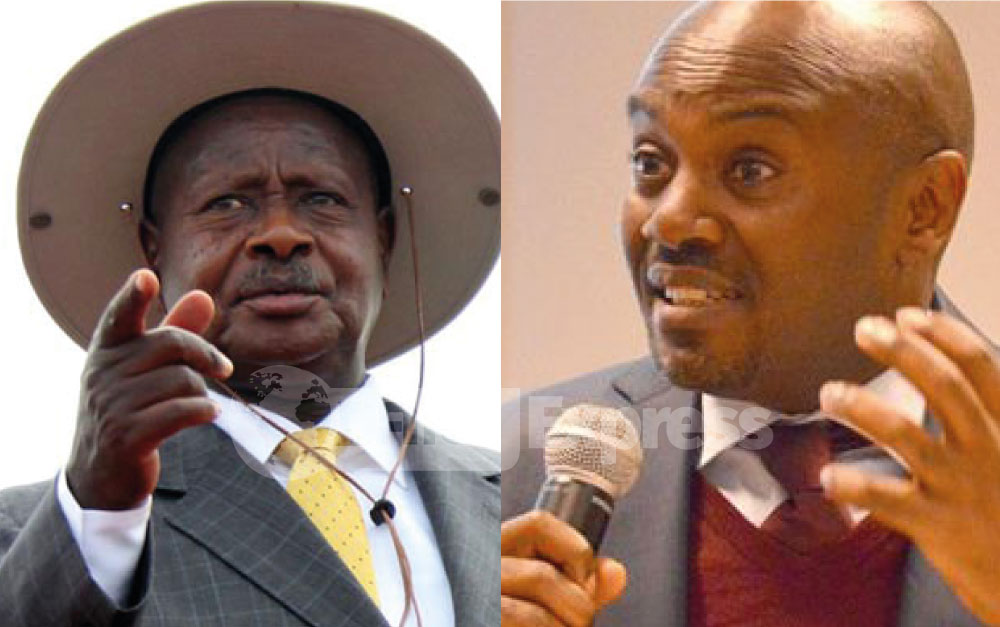
ANDREW M. MWENDA | I was on a flight to Beijing when President Yoweri Museveni published his “missive” against my criticism of his policies supporting private businesspersons with government money. When I got off the flight, I was inundated with calls from many people afraid that I was in danger. Many were surprised that I was laughing with joy about the president’s letter. It was obvious these people do not know our president. Museveni is a ferocious intellectual able to hold his own in a policy debate. If he were as angry at me as the callers imagined, he would have sent a team from the police or SFC to apprehend me. The fact that he chose to write back was evidence that he disagreed with me but recognized that this is a difference of opinion worthy of a debate, not a shooting match or jailing response. I was actually happy that I had sparked off a serious policy debate on infant industry promotion because it is my pet subject.
The interesting thing is that the president and I agree in principle on his overall policy direction of infant industry development through an activist state helping private companies. The only place we disagree is on the choice of partners Uganda has selected. Where I went wrong, and to this I apologize to him without any reservations, is saying his decisions [that I disagree with] are because of his age. In fact, I personally should have been the last person to make such an argument for two reasons.
First, I detest ad hominem arguments. I should have focused on the merits and demerits of his decisions, not the age at which he made them. Besides, these decisions are not new, nor is my criticism. I disagreed with him in 2003 when he supported Tri Star Apparels to do garments for export to the USA under AGOA. It failed. And I also opposed him when he supported BIDCO in 2004. It succeeded. This is not to claim a draw. Indeed, I later got convinced that the president was right even where the businesses he supported didn’t succeed. And here is how.
In February 2008, while attending a TED conference in Monterey, California, I met an interesting venture capitalist from the Silicon Valley. I had appeared at a panel discussion with Sergei Brin, the cofounder of Google, and I had criticized Western media for their misrepresentation of Africa. I had argued that Africa has tremendous potential for investors, but Western media were reporting only negative stuff. For some reason, this venture capitalist (name withheld at his request) and I struck a very good friendship. We had long conversations for three days of the conference. He picked a keen interest in me and my ideas about Africa. We kept in regular contact.
In mid-2008, he visited Uganda at my request and brought alongside him other venture capitalists and equity fund managers from America. He also brought with him the Google founders, Sergei Brin and Larry Page, at the time the youngest billionaires in the world. We went to Para Lodge for two days. In September of that year, Lehman Brothers, a New York investment bank, collapsed, sending the global economy into a tailspin. Investors in rich countries began looking for new areas of investment.
So in early 2009, my venture capitalist friend organized a conference in New York about investment opportunities in Africa. He invited equity fund managers, venture capitalists and other billionaires to this conference and invited me as the keynote speaker. I sat at a table next to Bill Gates, Larry Page and Sergei Brin. During my keynote speech, I criticized state intervention to support private businesses, saying it doesn’t work. I gave examples of five projects Museveni had funded and which had failed. It was music to my audience, who cheered in loud admiration.

Mr Mwenda, thank you for declaring me incapable of judging right
When I went back to the table, Bill Gates thanked me for “the good speech”. Then he said he disagreed with me. I had met Gates at a 2007 TED conference where I had criticized foreign aid. That day he had invited me to dinner and told me it was not good for me (an African) to criticize “them” (Western philanthropists) who were trying to do good in Africa. “It is very discouraging for us,” he said, “when leading intellectuals like yourself (sic) from Africa pour dust on our efforts.” I told him that my criticism was about government-to-government aid, not private philanthropy. A relationship was born between us. The next year he invited me to be a keynote speaker at a Bill and Melinda Gates Foundation conference in Windhoek, Namibia, about the differences in outcomes between private philanthropy and government-to-government aid.
It is in this context that Bill Gates spoke to me in New York. He said I was wrong to criticize Museveni for giving money to private business startups. He argued that the biggest constraint to business development in Africa is the absence of risk capital.” He said if an American had a good business idea, there would be many sources of risk capital. He said that in Africa, because such private risk capital is missing, the state has to intervene and become the source.
“The success rate of such risk capital is very low,” he said and turned to our mutual friend, the venture capitalist, and asked the exact number. Our mutual friend said 8%: “On average, only one in 13 projects succeeds.” He added that a 20% success rate is considered AAA performance and is rarely heard of.
You see, Bill Gates said to me, “You have mentioned only 5 projects your president supported, and they failed. I am sure there are those he supported that have succeeded. Your argument suffers from survivorship bias in reverse. It is therefore possible that he has a success rate higher than private venture capitalists here in America, who have the best human resources in the world.” I listened in silence. It was a powerful indictment of my argument coming from the then richest man in the world.
Later while back in Uganda, I narrated this story to the president. It may have given him even more confidence at such undertakings. I also became less inclined to oppose state support to startups. Last week, before he wrote his missive, I promised the president that I would not write about Magoola and others anymore. I won’t break that promise. What I can say here is that I am not against such selective allocation of state support to private businesses for purposes of industrialization. My criticism was not on the policy but the partners he selected.
So this brings me to my second mistake, which is a legitimate criticism the president raised: why judge people without talking to them, visiting their factories and getting to hear their side of the story? The president made a very valid point. I have not visited and interviewed Senfuka and Magoola, and yet I called them conmen and witch doctors. As a journalist who believes in the principle of fairness and balance, and as a person who believes in the principle of natural justice (do not judge a person without hearing their side of the story), again, I was professionally and personally wrong and unfair to the people I criticized.

So I want to apologize to the President and also to Magoola and Senfuka. I was unfair to them when I called them conmen and witch doctors. It is utterly unjustified to insult someone that way. In fact that framing undermines the policy argument I was making. Besides, I always advise young people that we can disagree without being disagreeable. I feel bad that I wrote in such a bad language, like a NUP activist rather than a journalist and an intellectual that I aspire to be.
However, I’ve talked to Amina of Atiak and her brilliant son, Mahmoud, and listened to both carefully about their sugar plantation and factory. I had planned to visit the factory and plantation but never got around to doing so. Now I will do that. I have also visited the Ntungamo factory and talked to the man behind it, Nelson Tugume, at length. I’ve known Tugume since he was a young and impassioned pan-Africanist promoting his “Inspire Africa” idea.
When I return to Uganda, I will reach out to both Magoola and Senfuka and apologize to them and also visit their plants. I will also look for and interview people Senfuka has healed. I have listened to several testimonies of people who accuse him of ruining them or their loved ones. I will try to be as open-minded as possible.
I have read a brilliant defense of the president by my friend, Ellison Karuhanga (Kaguta, Mwenda and the brutal truth about nation building). I will respond to him in detail in the next column. The point I want to stress is that most governments have pursued such interventionist policies and come to grief – from India to Brazil. Yet others have pursued them with stunning success – from South Korea to Taiwan and now China. What I can say here is that government intervention to support the private sector in industrialization must be guided by three factors. And these are the lessons we learn from the successful experiences.
First, there needs to be a clear government policy on those economic sectors which the state has decided to give priority as the basis of our industrial transformation. I do not see that in Uganda today. We are funding sugar, coffee, textiles, pharmaceuticals, electric vehicles, construction, hotels, food processing, etc. What are these priority sectors that can give Uganda what Albert Hischman called a multidimensional conspiracy in favor of development? If everything is a priority, as Uganda is doing today, then nothing is a priority.
Second, the selective allocation of such state benefits should be institutionalized, with clear criteria for qualifications to benefit. It should not be based on one’s private and personal access to the president. There needs to be an institution that receives applications and assesses them and qualifies them for such allocation of state grants, cheap loans, tax exemptions, state subsidies, etc. We are trying to do this with the MK Fund, a very small fund. But if someone had a great idea and needed risk capital from the state in Uganda, where do they go? Please note that I am not removing political considerations in such decisions. I am aware that governments are always keen not to place resources in the hands of those who may use them against incumbents. But if I were an NRM supporter with a great business idea, where do I go to get it funded?
Third, there should be clearly defined performance targets with mechanisms to monitor and ensure that such targets are met. If a beneficiary is not meeting agreed targets, the benefits are withdrawn. This is the only way to ensure performance. It is also the lesson we learn from successful countries like South Korea and Taiwan, Japan and now China. Otherwise, state support can easily turn into a never-ending cash line where the private investor has little incentive to build capacity, expand scale, increase efficiencies, lower unit costs and become globally competitive.
If you would like your article/opinion to be published on Uganda’s most authoritative news platform, send your submission on: [email protected]. You can also follow DailyExpress on WhatsApp and on Twitter (X) for realtime updates.