
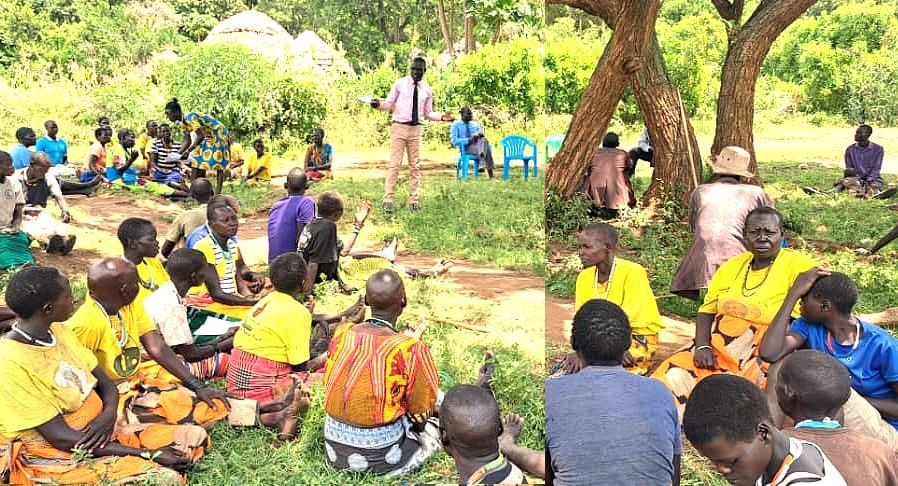
Karenga, Uganda: Residents, local leaders and government officials in Karenga District have called for urgent and coordinated action to address rising teenage pregnancies and child marriages, warning that the growing crisis is denying many girls the opportunity to complete their education and realise their full potential.
The appeal was made during a community Baraza organised by Reproductive Health Uganda (RHU) on July 22, 2026, in Loruma Ward, Kangole Parish, where parents, young people, local leaders, government officials and development partners met to discuss challenges affecting adolescent girls and vulnerable households.
The dialogue was held under the Strengthening Community-Based Climate Adaptation in Uganda and Sudan (STRENGTH) Project, funded by DFPA. Although the project focuses on strengthening community resilience to climate change, participants highlighted the growing link between environmental pressures, poverty and social challenges affecting women and children.
Community members identified poverty, food insecurity, school dropouts, peer pressure, weak parental supervision and alcohol abuse as some of the leading causes of teenage pregnancies and child marriages in the district.
Residents also linked the problem to climate-related challenges, explaining that frequent human-wildlife conflicts force many parents to spend long hours guarding crops, leaving children unsupervised and more vulnerable to exploitation, abuse and early pregnancies.
Participants further expressed concern over the long distances girls travel to fetch water, saying isolated routes and overcrowded water points expose them to harassment and other forms of violence.
RHU interventions praised

Local councillor Napeyok Paska Faith commended RHU for strengthening community awareness through continuous dialogues and sensitisation programmes. She said the Barazas have equipped leaders with the knowledge and confidence needed to mobilise communities against teenage pregnancy and child marriage.
“Since RHU started conducting awareness sessions, community Barazas and dialogues, we have been able to understand these challenges better and encourage parents and young people to take action. At first, some people rejected my efforts to educate teenagers, but the knowledge and confidence I gained from these sessions motivated me to continue organising awareness activities,” she said.
Faith urged parents to play a more active role in protecting children and ensuring girls remain in school.
Leaders call for stronger community involvement
Senior Development Officer Abotto Moses emphasised that sustainable solutions require stronger collaboration between families, local leaders, government institutions and development partners.
He said community participation remains essential in addressing social challenges while helping households build resilience against the impacts of climate change.
Health Assistant Achoro Gabriel used the dialogue to educate residents on reproductive health, hygiene and sanitation, encouraging both parents and young people to seek accurate information and utilise available health services.
He noted that awareness and early intervention remain critical in preventing adolescent pregnancies and other reproductive health challenges.

Meanwhile, District Probation Officer Francis Lodungu urged residents to promptly report cases of child abuse, defilement, child marriage and teenage pregnancy through local leaders, Community Development Officers, the Probation Office and the Uganda Police Force.
He stressed that protecting children is a shared responsibility requiring active involvement from families, schools, communities and government agencies.
At the close of the Baraza, participants agreed on several measures aimed at strengthening child protection across Karenga District.
The resolutions include enhancing parental responsibility, improving school retention for girls, strengthening village-level child protection structures, promoting timely reporting of child abuse cases and expanding community awareness campaigns on reproductive health, positive parenting and children’s rights.
Stakeholders also committed to organising broader engagements involving political, cultural and technical leaders to sustain momentum in addressing teenage pregnancy and child marriage.
Organisers said the dialogue demonstrated the value of community-led engagement in addressing challenges affecting women and children, particularly in areas experiencing the combined effects of climate change, poverty and limited access to essential services.
They expressed optimism that stronger collaboration among communities, government agencies and development partners would help create a safer environment where girls are protected, remain in school and achieve their full potential.
The STRENGTH (Strengthening Community-Based Climate Adaptation in Uganda and Sudan) Project seeks to improve community resilience to climate change while supporting vulnerable populations through community engagement, awareness and locally driven solutions. Reproductive Health Uganda has been implementing community dialogues across project areas to strengthen child protection, reproductive health awareness and social resilience.
If you would like your article/opinion to be published on Uganda’s most authoritative news platform, send your submission on: [email protected]. You can also follow DailyExpress on WhatsApp and on Twitter (X) for realtime updates.