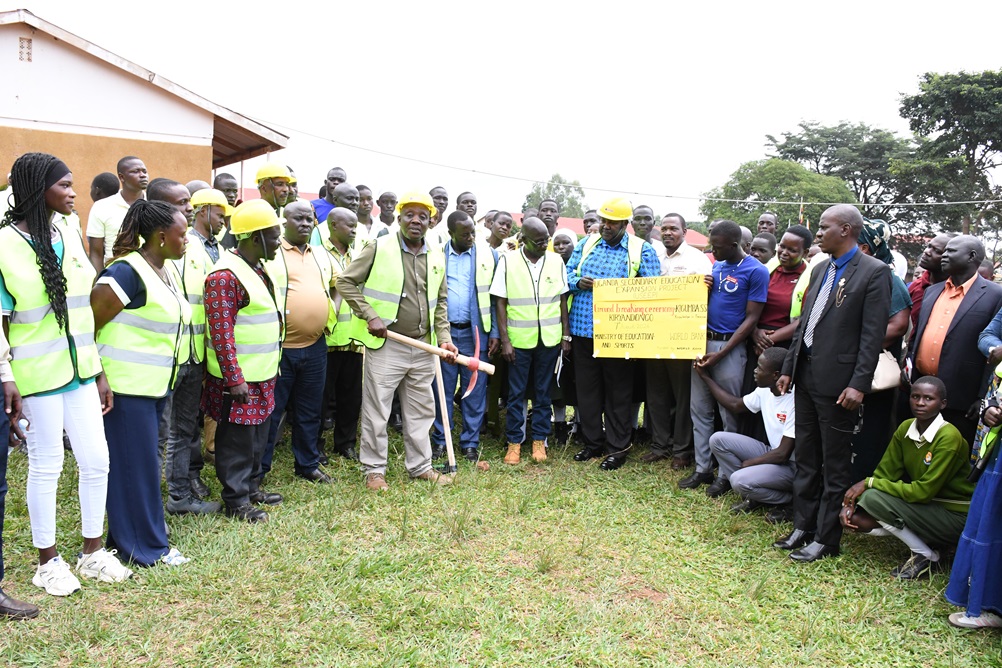
Kiryandongo, Uganda: The Government has launched the construction of a Shs1.047 billion classroom project at Kigumba Secondary School in Kiryandongo District, a major infrastructure investment expected to ease overcrowding, improve sanitation and enhance learning conditions for more than 1,400 students.
The project, being implemented under the Uganda Secondary Education Expansion Project (USEEP), will deliver eight new classrooms, 15 VIP latrine stances and an incinerator within six months.
Education officials, district leaders and community members described the project as a significant milestone in strengthening access to quality secondary education in Kiryandongo.
Established in 1989 as a community school before being government-coded in 1996, Kigumba Secondary School has experienced steady enrolment growth under the Universal Secondary Education (USE) programme.
The school currently has 1,201 USE students and 204 private students, but operates with only 13 classrooms, 18 VIP latrine stances and 28 government-paid teachers, a situation that has resulted in overcrowded classrooms and strained sanitation facilities.
Headteacher Moses Mayanja welcomed the investment, describing it as a timely intervention that will significantly improve the school’s learning environment. “The new classrooms will greatly improve the learning environment and contribute to better academic performance.”
He thanked President Yoweri Museveni and the Ministry of Education and Sports for prioritising infrastructure development at the school.
Mayanja also commended Kiryandongo District for supporting the school through the provision of desks and the construction of a deep borehole during the previous financial year, initiatives that have improved classroom learning and access to safe water.

Despite the ongoing developments, he appealed for continued government support, noting that enrolment continues to increase under the USE programme.
More teachers, library and ICT lab needed
Board of Governors Chairperson Julius Balikagira said the additional classrooms would substantially reduce congestion but stressed that infrastructure alone would not address all the school’s challenges.
“As enrolment continues to rise, government should allocate more teachers to match the growing number of learners,” Balikagira said.
He also highlighted the lack of a library, Information and Communication Technology (ICT) laboratory and administration block, saying the facilities are essential for delivering quality education and preparing learners for the modern workforce.
Kiryandongo Chief Administrative Officer Anselm Kyaligonza reaffirmed the district’s commitment to ensuring the successful implementation of the project.
He urged the contractor, Robich Engineering Services Ltd, to complete the works within the six-month contractual period while maintaining high construction standards.
“Government expects quality workmanship and value for money from every public investment,” Kyaligonza said. He also called upon surrounding communities to take ownership of the project by monitoring construction activities and safeguarding public property.
“This is a community project. Protect it and ensure it is delivered to the required standards,” he urged.

The Ministry of Education and Sports said the Kigumba project is being implemented using a Community-Driven Development (CDD) model aimed at strengthening transparency, accountability and local ownership.
Project Manager Eng. Patrick Bongomin explained that the approach mirrors the implementation model previously used under the Development Response to Displacement Impacts Project (DRDIP).
Under the arrangement, Community Project Management Committees and Community Procurement Committees have been established to participate in project supervision and oversight.
Bongomin said the model empowers communities to directly monitor implementation while protecting public investments through increased accountability.
He, however, cautioned committee members against mismanagement of project resources and urged them to strictly comply with government procurement and financial accountability guidelines.
RDC warns against interference
Deputy Resident District Commissioner Jonathan Akweteireho welcomed the project but warned against alleged attempts by some Ministry of Education officials to interfere with decisions made by community oversight committees.
He said such actions could undermine transparency and compromise successful implementation if not addressed.
Akweteireho described the school’s existing infrastructure as inadequate for the current student population, noting that the new facilities would significantly improve both the school’s appearance and the quality of education.
The classroom expansion forms part of government’s broader efforts under the Uganda Secondary Education Expansion Project to improve access to quality secondary education through increased classroom space, improved sanitation facilities and enhanced learning environments in schools experiencing rapid enrolment growth.
If you would like your article/opinion to be published on Uganda’s most authoritative news platform, send your submission on: [email protected]. You can also follow DailyExpress on WhatsApp and on Twitter (X) for realtime updates.