
Kibale, Uganda: Deep inside Kibale National Park, silence moved differently. It was the kind of silence that made every cracking branch, every distant bird call and every rustling leaf sound amplified beneath the thick green canopy of one of Africa’s richest tropical forests.
Then suddenly, the pant-hoots began. The loud calls echoed through the towering trees like signals bouncing from one invisible corner of the forest to another. Our guides instantly slowed down, their eyes fixed toward the treetops. “We are now close,” one whispered calmly.
For a moment, the entire forest felt alive.
Our day had started hours earlier with a briefing from John Justice Tibesigwa at the park headquarters, where he guided everyone through what to expect during the chimpanzee tracking experience, including the much-publicised reports of alleged “civil wars” among chimpanzees that recently attracted international attention.
Soon after the briefing and an exclusive interview with DailyExpress, we set off for the Kanyanchu Visitor Centre, the main trailhead for chimpanzee trekking in Kibale Forest National Park and the heartbeat of one of Uganda’s most sought-after tourism activities.
At the centre, conservation officers, rangers and guides moved with practiced calmness, preparing tourists for the journey into the forest.
We came to learn that tourists who visit this centre are mainly introduced to the Kanyantare chimpanzee community, a habituated group led by an alpha male called Rukara – translated as “Black” in Runyakitara, a name inspired by the darkening fur and skin that comes with age.
Our guides for the day, Jane Mutahinga and Richard Alicwamu, carried the confidence of people who seemed to know the forest like a second home. From chimpanzee social structures to feeding habits and territorial behaviour, their knowledge flowed effortlessly to our mutual benefit.
After another briefing on the dos and don’ts of chimp trekking, we finally stepped into the forest at about 11:30 am, armed with backpacks, cameras, bottled water and face masks; mandatory because chimpanzees can catch diseases from humans due to their close genetic relationship with mankind.
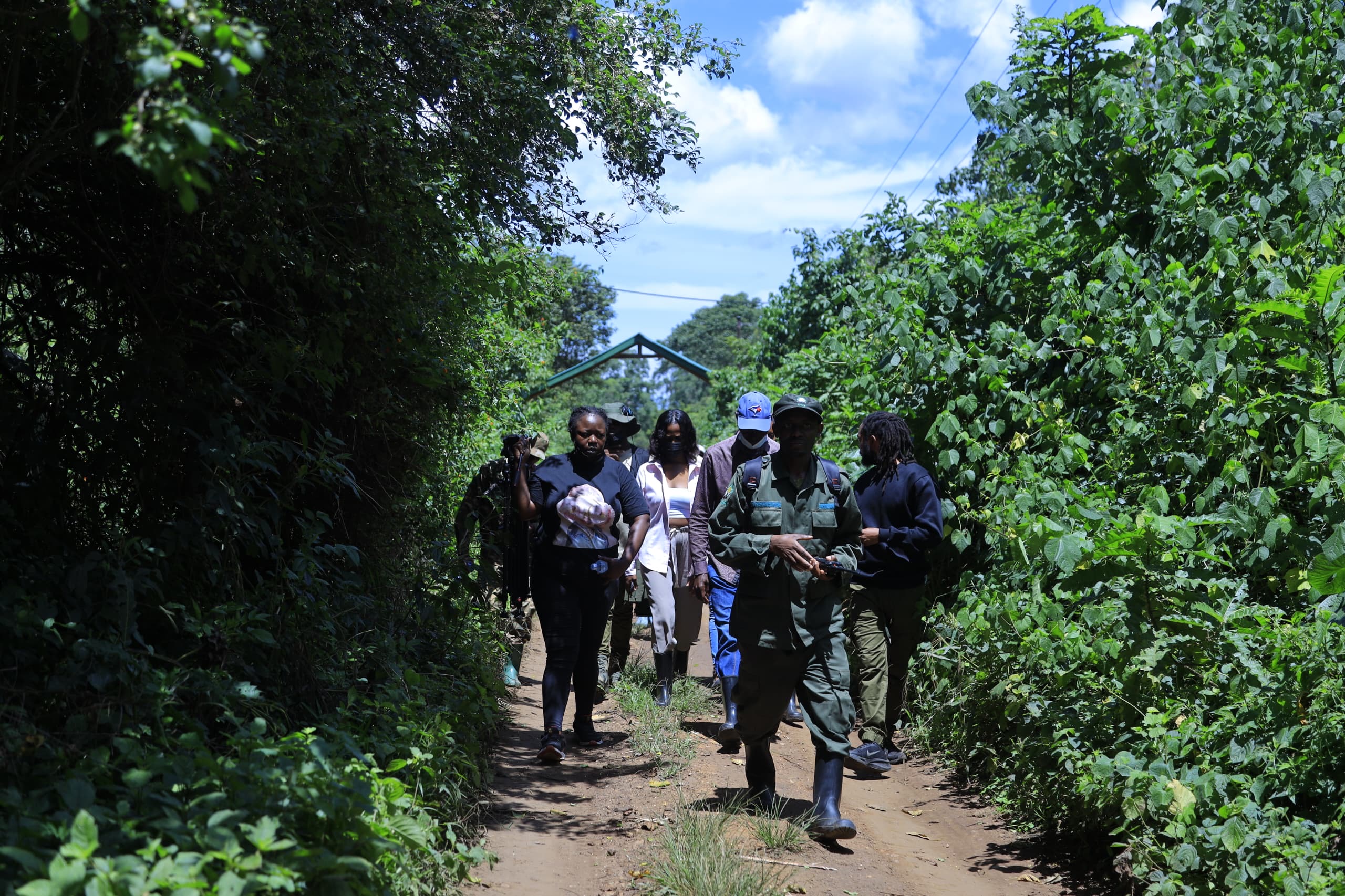
Barely 20 minutes into the trek, exhaustion had already started creeping in.
The steep terrain, thick vegetation and endless winding trails made every step feel heavier than the last. At one point, the thought of retreating quietly crossed my mind, but the determination to finally meet what guides repeatedly described as “our closest relatives” kept the feet moving.
As we pushed deeper into the forest, the soundtrack of Kibale slowly unfolded around us.
Crickets hissed from hidden corners of the undergrowth. Birds sang from unseen perches high above the canopy. Leaves crackled beneath our boots. Occasionally, strange movements from distant branches forced everyone to pause and look upward in anticipation.
The guides repeatedly reminded us to keep our conversations low. “Too much noise distracts you,” Richard warned. “You might miss the experience.”
And they were right.
After several kilometres of trekking through the forest, the atmosphere suddenly shifted. The distant pant-hoots and pant-grunts grew louder and clearer, echoing from somewhere not far ahead.

Guess what? the chimpanzees were close.
As we carefully descended a forest slope shortly after 1:30 pm, the treetops suddenly began shaking violently from left to right.
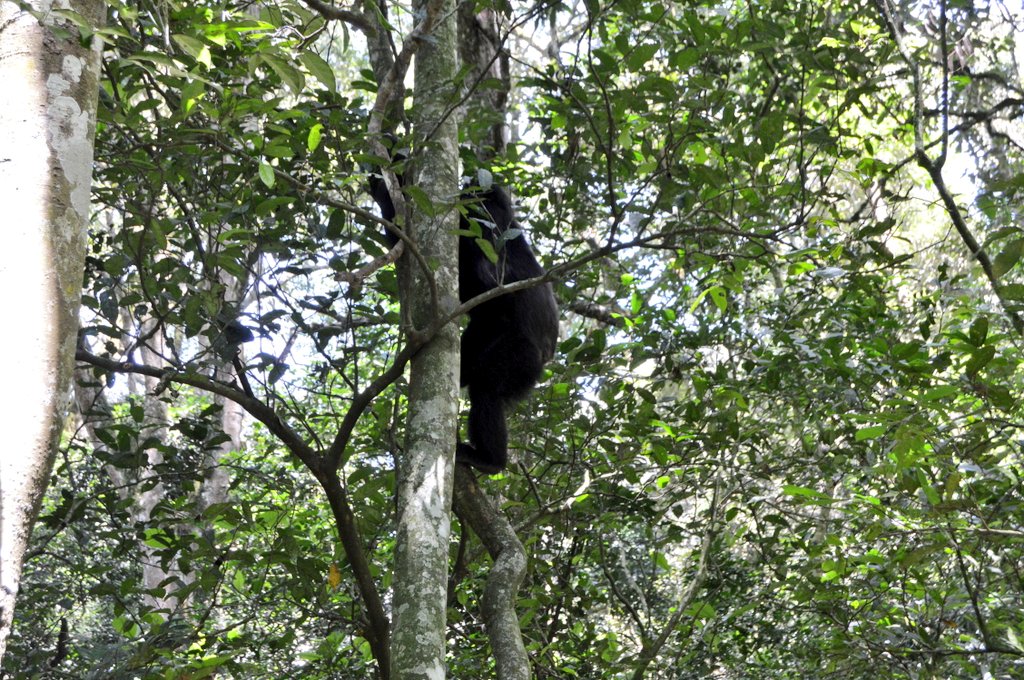
Then came the first sighting. The Chimpanzees swung effortlessly from branch to branch high above the canopy, their dark bodies slicing through shafts of sunlight piercing through the forest ceiling. Every head in the group tilted upward in unison, cameras rising instinctively toward the trees.
But before we could fully process the spectacle overhead, movement on the ground froze us in place.
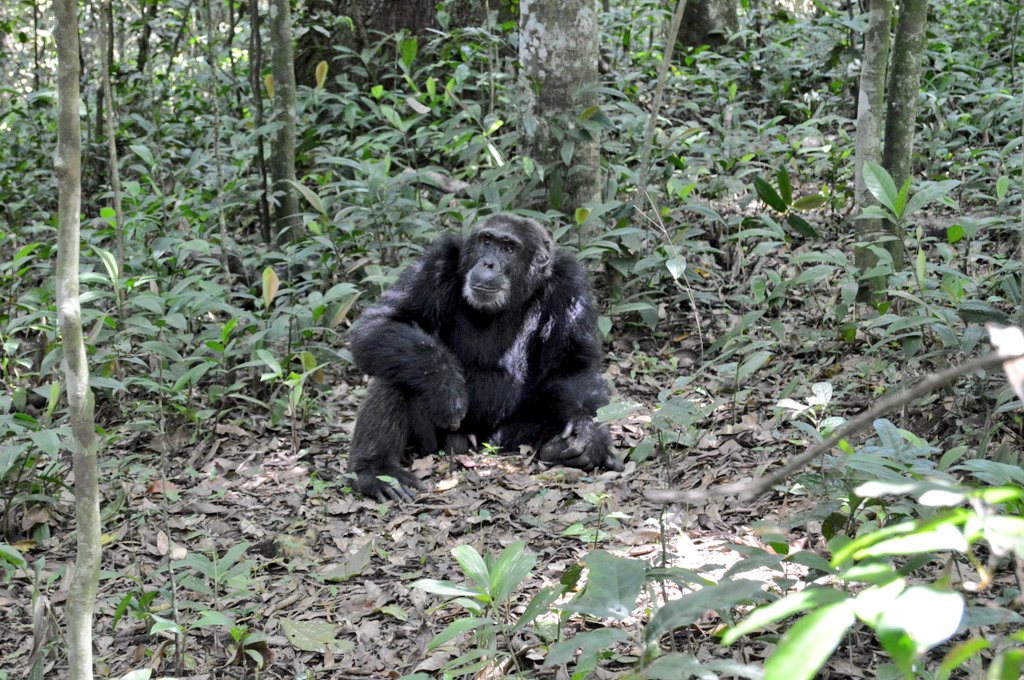
Less than five metres away stood another chimpanzee calmly staring back at us. Unbothered. Relaxed. and almost human.
The chimp barely reacted to the crowd of excited tourists surrounding him, perhaps a result of years of habituation that has allowed these primates to grow accustomed to carefully managed human presence.
Nobody dared move too close.
But within seconds, the silence exploded into a frenzy of camera shutters clicking from every direction as the chimp casually made his way toward nearby branches before disappearing back into the forest party above.
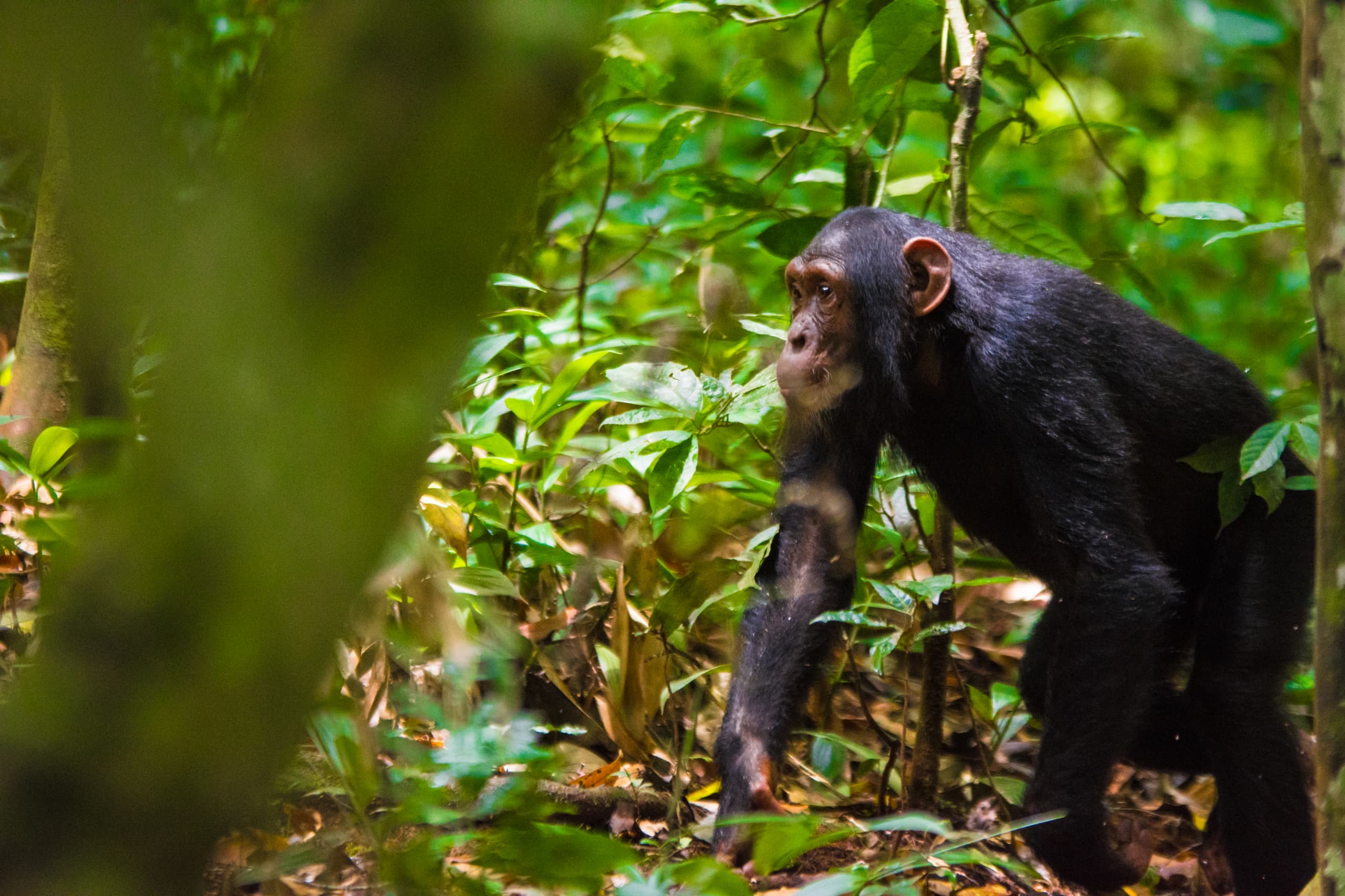
One of the most exhilarating moments came when the chimpanzees began producing deep pant-grunt calls while violently beating the giant roots of trees with their paws.
The sound rolled through the forest floor like distant war drums.
Our guide Richard explained that such sounds are often used for communication within the community, mobilizing members to gather either for movement, feeding or social interaction.
A few kilometres deeper into the forest, we arrived at what guides described as one of the community’s gathering points.
Chimpanzees appeared from nearly every direction.
Some sat silently on branches overhead, observing visitors below. Others moved lazily through the canopy while juveniles playfully swung between trees with astonishing ease.
The atmosphere felt less like observing wildlife and more like briefly stepping into another civilization hidden beneath the forest canopy.
As tourists quietly watched, chewed candies and snapped photographs, one figure appeared to command unusual attention from the rest of the group; Rukara, the alpha male and undisputed “president” of the Kanyantare community.
According to Richard (our ranger-guide), chimpanzee communities operate under highly organized social structures similar in some ways to human societies.
“Chimpanzees have got a very complex social dynamic way of behaviours,” he explained during the trek. “A group of chimpanzees is called a community, and these guys live in a defined territory headed by the alpha male.”
Richard explained that alpha males lead border patrols aimed at protecting territory from rival chimp communities, often moving in single-file formations with high-ranking males at the front while females and juveniles remain behind.
“If two communities meet, it becomes a very brutal fight which is called inter-community aggression,” he said.
The explanation closely ties into the internationally reported claims of a so-called “chimpanzee civil war” in Kibale Forest; descriptions that park authorities and researchers insist have largely been misunderstood.
Speaking to DailyExpress earlier, Chief Warden Tibesigwa clarified that the conflicts are a natural part of chimpanzee social behaviour and not an extraordinary crisis threatening the species.
“These conflicts happen over territory, food, water and mating rights,” he explained. “It is part of nature and survival.”
Tibesigwa noted that despite reports of conflict, Kibale’s chimpanzee population continues to grow.
The last major census conducted around 2019 recorded about 1,001 chimpanzees within the park, while newer figures indicate an increase of nearly 400 more chimpanzees in recent years. Tourism numbers have also steadily risen.
According to park statistics, Kibale received about 17,000 tourists in the 2022/2023 financial year, increasing to 19,660 in 2023/2024 before rising again to 20,773 visitors in the 2024/2025 financial year.
For researchers studying chimpanzees daily, the so-called “civil war” is instead viewed as a complex transition of power and territorial separation.
Dr Kobusingye Margaret Abwooli, a researcher with the Kibale Chimpanzee Project, explained that what many outsiders interpret as warfare is often the gradual formation of independent communities. “For us, we see a transition of power,” she said.
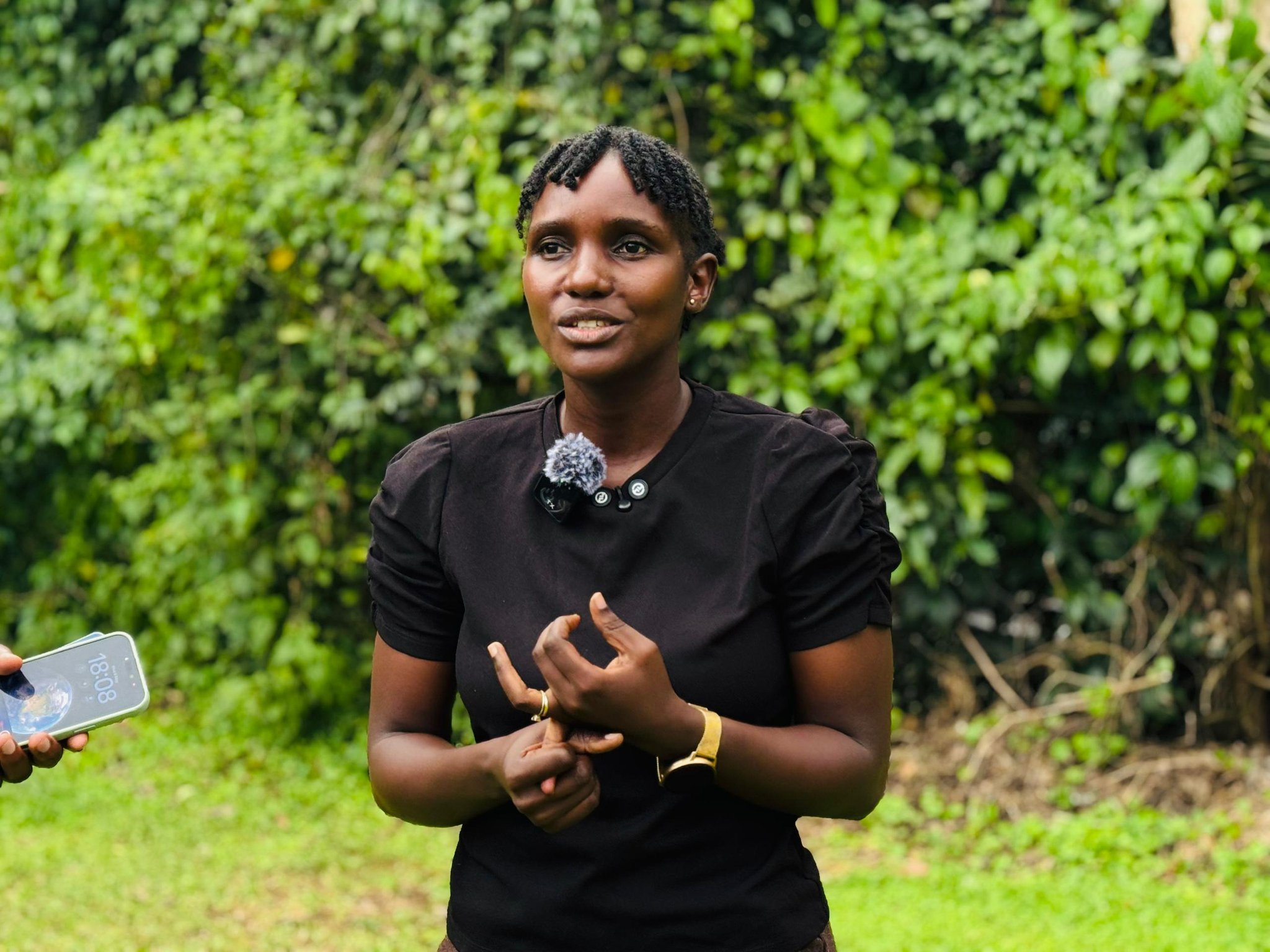
Dr Kobusingye explained that divisions within the famous Ngogo chimpanzee community gradually emerged after disease outbreaks and years of territorial separation, eventually leading to the formation of independent groups with different alpha males and territories.
But beyond aggression and territorial politics, researchers say chimpanzees also display remarkable emotional and social intelligence. “One of the interesting things about them is the kind of bond they create through grooming,” she explained.
“Upcoming sub-adult males know that when the time comes to take over the alpha-ship, they will need allies to back them.”
Dr Kobusingye added that chimpanzees hunt other primates, share meat to strengthen social bonds and display surprisingly organized mating systems controlled largely by alpha males.
Another striking sight within the forest, she said, is watching mothers carry infants on their bellies while simultaneously carrying older juveniles on their backs.
As the afternoon stretched toward 3 pm, our group slowly began the long trek back toward the visitor centre. The forest no longer felt intimidating, instead, it felt strangely familiar.
Somewhere above the canopy, distant chimp calls still echoed through the trees while branches swayed gently in the afternoon wind.
And despite the sensational headlines surrounding alleged “chimp wars and power struggles,” nothing during the hours spent inside Kibale suggested chaos or collapse.
What emerged instead was the portrait of an incredibly organized primate society; one shaped by alliances, hierarchy, competition, survival and family bonds that often mirror human communities in unsettling ways.
Perhaps that is what makes the Kibale experience unforgettable.
Not simply because tourists get close to chimpanzees, but because somewhere between the pant-hoots, the swinging branches and the silent stares from the treetops, visitors begin seeing reflections of themselves inside the forest.
This story was made possible through a media expedition organized and facilitated by the Uganda Wildlife Authority (UWA) into Kibale National Park to explore and better understand the realities behind the widely reported chimpanzee “civil war” narratives.
If you would like your article/opinion to be published on Uganda’s most authoritative news platform, send your submission on: [email protected]. You can also follow DailyExpress on WhatsApp and on Twitter (X) for realtime updates.