
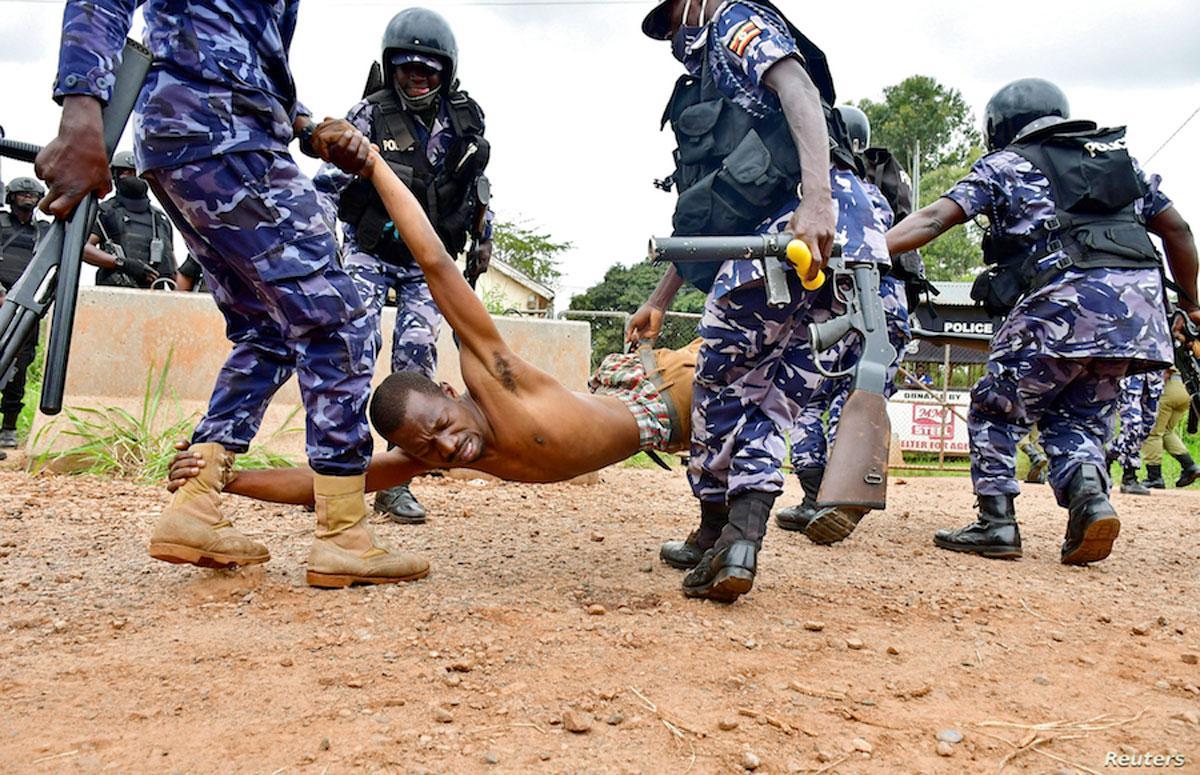
Kampala, Uganda: The Uganda Law Society (ULS) has declared a legal battle at the Supreme Court following a landmark Constitutional Court ruling that struck down provisions of the Human Rights (Enforcement) Act, which required courts to automatically acquit accused persons whenever their non-derogable rights, including freedom from torture, had been violated.
In a statement issued Tuesday, June 02, just hours after the ruling had been made public, ULS President Isaac Ssemakadde condemned the judgment in Faruku Muhamed & Others v Attorney General, describing it as a major setback for constitutionalism, human rights protection and the rule of law.
The Constitutional Court, in a unanimous decision delivered on June 2 by Justices Oscar Kihika, Margaret Tibulya, Moses Kazibwe Kawumi, Asa Mugenyi and Musa Ssekaana, declared Section 11(2)(a), (b) and (c) of the Human Rights (Enforcement) Act unconstitutional.
The impugned provision required judges and magistrates to nullify criminal proceedings and acquit accused persons whenever it was established that their non-derogable rights had been violated.
The petition arose from Constitutional Petition No. 17 of 2024 filed by advocates Faruku Muhamed, Musinguzi John and Bunyasin Ibrahim, alongside Constitutional Reference No. 2 of 2024 stemming from proceedings involving Busiki County MP Paul Akamba. Akamba had alleged that he was abducted, detained incommunicado and tortured by security operatives after being granted bail in corruption-related proceedings.
In its ruling, the Constitutional Court held that the automatic acquittal mechanism denied victims of crime their right to be heard and undermined access to justice. The judges further found that the provision improperly allowed accused persons to be acquitted without a trial on the substantive charges before the court.

A major aspect of the judgment was the court’s finding that victims of crime also enjoy a constitutional right to a fair hearing under Article 28(1) of the Constitution.
“The right to a fair hearing applies to ‘a person’ rather than exclusively to an accused,” the judges held while concluding that victims are entitled to participate in criminal proceedings as rights holders whose interests must be protected.
The court subsequently declared that victims’ right to a fair hearing, though not expressly listed among fundamental rights under Chapter Four, is preserved under Article 45 of the Constitution and must be protected in all criminal proceedings.
However, the Uganda Law Society says the ruling weakens protections against torture and risks encouraging impunity among state actors.
“The exclusionary rule in Section 11(2) is not a mere procedural technicality. It is a foundational safeguard. Evidence or proceedings tainted by torture are inherently unreliable. Coerced confessions distort truth-seeking and poison the administration of justice,” ULS said.
The lawyers’ body argued that by striking down automatic nullification of proceedings arising from violations of non-derogable rights, the court had reduced deterrence against torture and unlawful conduct by security agencies.
ULS further faulted the court for what it described as a failure to adequately consider Uganda’s constitutional history, particularly recommendations from the Said Commission, Oder Commission and Odoki Commission, all of which documented widespread abuses that informed the robust human rights protections embedded in the 1995 Constitution.
The society also accused the bench, including newly appointed Deputy Chief Justice Moses Kazibwe Kawumi, of prioritising completion of criminal prosecutions over the absolute protection of constitutional rights.

In response, the Constitutional Court maintained that the protection of non-derogable rights remains absolute but held that violations should be addressed through constitutional and statutory remedies rather than by automatically terminating criminal proceedings.
The judges noted that Uganda’s legal framework already provides mechanisms such as constitutional petitions, habeas corpus applications, judicial review proceedings and enforcement actions for victims of rights violations.
The court also reaffirmed that evidence obtained through torture remains inadmissible in criminal proceedings and that accused persons retain full constitutional protections against coercion and self-incrimination.
Significantly, the judges distinguished the celebrated Kizza Besigye & Others v Attorney General case, which had been relied upon by supporters of Section 11(2). The court held that the Besigye decision arose from extraordinary circumstances involving violent re-arrests, prolonged unlawful detention, executive interference and what the court described at the time as “tainted proceedings” that made a fair trial impossible.
According to the judges, those exceptional circumstances could not be used to justify a blanket rule requiring automatic acquittal in every case where rights violations are alleged.
The ULS has now resolved to coordinate an appeal to the Supreme Court through a special committee and seek orders preserving the operation of Section 11(2) pending the determination of the appeal.
The society also announced plans to petition regional and international human rights bodies, including the East African Court of Justice, the African Commission on Human and Peoples’ Rights and United Nations mechanisms dealing with torture and fair trial rights.
The appeal is expected to set up one of the most consequential constitutional battles in recent years, with the Supreme Court likely to determine the balance between protecting victims of crime, safeguarding fair trial rights and enforcing Uganda’s absolute prohibition against torture.
If you would like your article/opinion to be published on Uganda’s most authoritative news platform, send your submission on: [email protected]. You can also follow DailyExpress on WhatsApp and on Twitter (X) for realtime updates.