
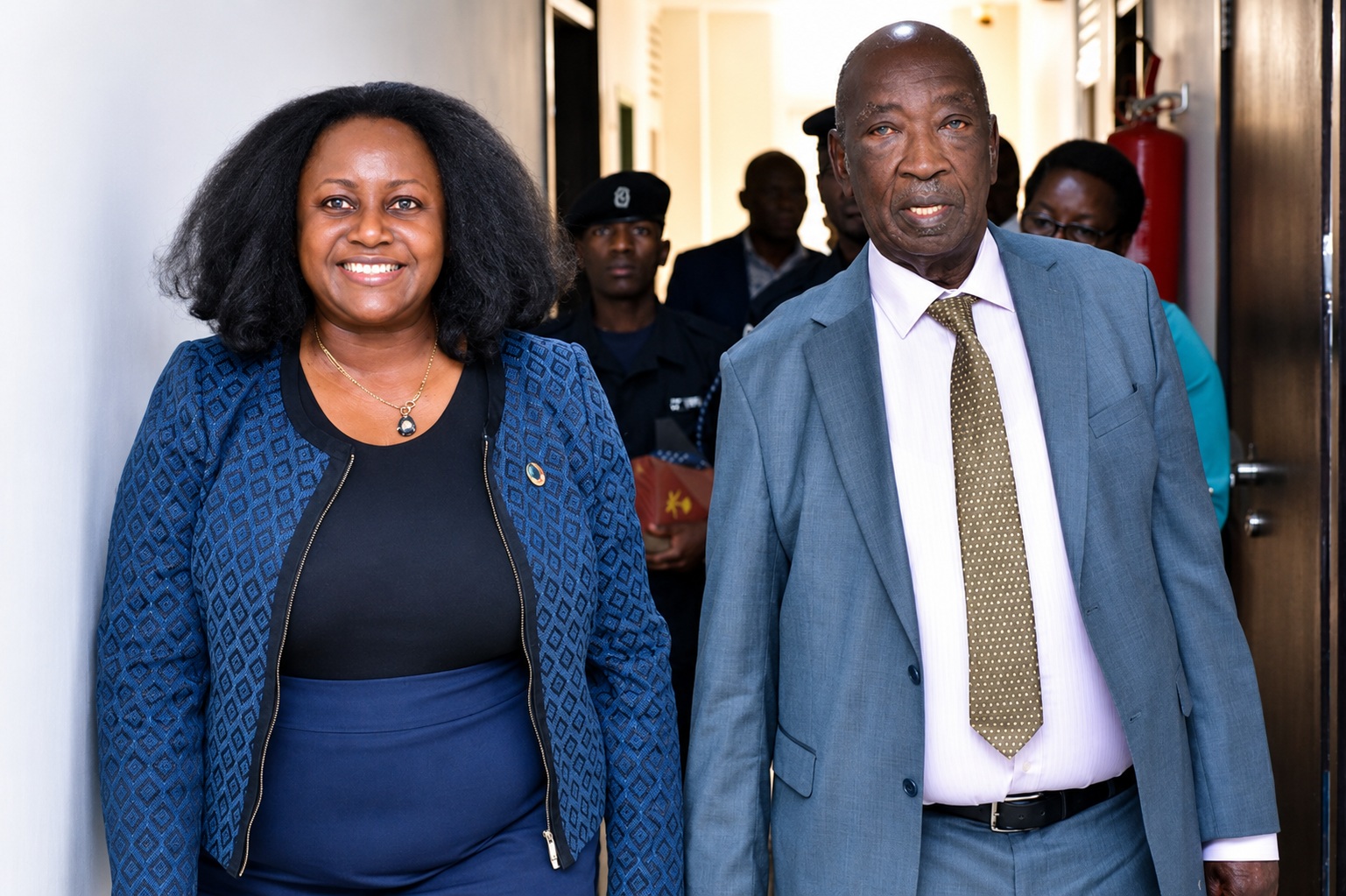
Kampala, Uganda: Embattled former Trade Ministry Permanent Secretary, Mrs Geraldine Ssali Busuulwa and her co-accused are set to return to the Anti-Corruption Division of the High Court after the Constitutional Court struck down a controversial provision of the Human Rights (Enforcement) Act that had been relied upon to challenge criminal prosecutions on grounds of violations of non-derogable rights.
In a landmark judgment delivered on June 2, a panel of five Constitutional Court judges; Justices Oscar Kihika, Margaret Tibulya, Moses Kazibwe Kawumi, Asa Mugenyi and Musa Ssekaana, declared Section 11(2)(a), (b) and (c) of the Human Rights (Enforcement) Act unconstitutional.
The provision had required courts to nullify criminal proceedings and automatically acquit accused persons whenever their non-derogable rights, including protection from torture and inhuman treatment, were found to have been violated.
The ruling arose from Constitutional Petition No.17 of 2024 filed by Faruku Muhamed and others, as well as Constitutional Reference No.2 of 2024 stemming from proceedings involving former Busiki County MP Paul Akamba, one of the accused persons in the Buyaka Growers Cooperative Society compensation case.
Akamba had argued that security operatives tortured and unlawfully detained him following his arrest, and that under Section 11(2), the alleged violation entitled him to an automatic acquittal and termination of criminal proceedings against him.
However, the Constitutional Court rejected that interpretation, holding that the law improperly allowed accused persons to escape trial without any judicial examination of the substantive criminal charges against them.

“The Constitution is unequivocal that an acquittal may only ensue upon the conclusion of a trial in which the court has received, scrutinised and evaluated the evidence,” the judges ruled.
The court further held that automatic acquittals denied victims and the public their constitutional interest in having criminal allegations fully adjudicated.
“Any statutory provision that has the effect of denying victims of crime an opportunity to be heard, or that undermines their legitimate interests in the adjudicative process, must be scrutinised with the highest level of constitutional vigilance,” the judgment states.
In a significant interpretation of Article 28 of the Constitution, the judges also ruled that the right to a fair hearing is not reserved exclusively for accused persons.
“The right to a fair hearing is not confined solely to accused persons. Article 28(1) expressly guarantees a fair hearing to ‘a person’ and not merely to ‘an accused’,” the court held.
The judges nonetheless emphasized that violations of non-derogable rights remain serious constitutional breaches but said affected persons have alternative remedies, including constitutional petitions, judicial review, habeas corpus proceedings, compensation claims and other enforcement mechanisms.
Impact on Buyaka Compensation Case
The ruling is expected to have immediate implications for the high-profile corruption case involving Ssali and her co-accused, which had effectively stalled pending the Constitutional Court’s determination of Akamba’s challenge.

The accused include Ssali, Igara East MP Michael Mawanda, Elgon County MP Ignatius Wamakuyu Mudimi, lawyer Julius Taitankoko Kirya, Principal Cooperative Officer Edgar Leonard Kavundira and former Busiki County MP Paul Akamba.
They face various charges including corruption, abuse of office, causing financial loss, money laundering, receiving stolen property and conspiracy to defraud the government.
Prosecutors allege that during the 2021/22 financial year, Ssali irregularly introduced Buyaka Growers Cooperative Society Limited onto a list of entities eligible for government war-loss compensation despite the cooperative not appearing in the approved supplementary budget.
The State further alleges that she authorised payments amounting to Shs3.8 billion to Kirya & Co Advocates on behalf of the cooperative in contravention of Treasury Instructions, 2017.
According to the prosecution, the accused persons conspired between 2019 and 2023 to fraudulently divert more than Shs3.4 billion earmarked for compensating cooperatives that lost property during the 1981–1986 liberation war and subsequent insurgencies.
Last week, Anti-Corruption Court Judge Jane Okuo Kajuga adjourned the case after state prosecutors failed to appear, citing attendance at a national prosecution symposium.
With the Constitutional Court having now settled the legal questions surrounding Section 11(2) of the Human Rights (Enforcement) Act, the focus shifts back to the Anti-Corruption Division, where prosecutors are expected to proceed with presenting evidence in one of Uganda’s most closely watched corruption prosecutions.
If you would like your article/opinion to be published on Uganda’s most authoritative news platform, send your submission on: [email protected]. You can also follow DailyExpress on WhatsApp and on Twitter (X) for realtime updates.