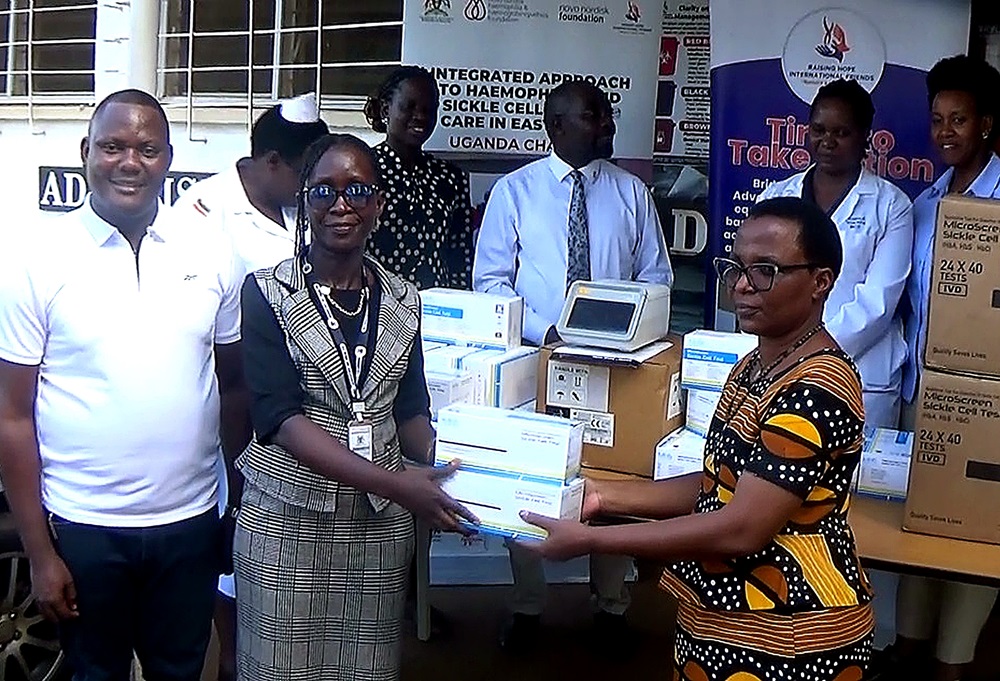
Iganga, Uganda: Efforts to combat sickle cell disease in Eastern Uganda have received a major boost after Iganga General Hospital acquired a new rapid testing machine capable of diagnosing patients within hours, ending years of delays caused by reliance on laboratories in Kampala.
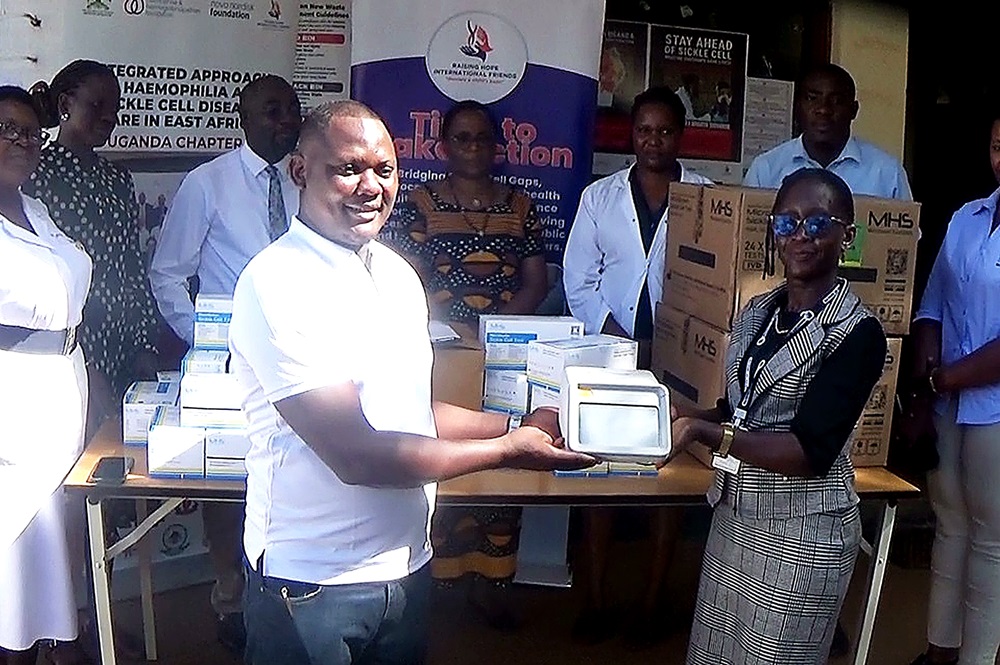
The point-of-care sickle cell testing machine, valued at approximately Shs13.5 million ($3,600), was donated by Raising Hope International Friends and officially handed over this week to the Ministry of Health, district health officials, and hospital management.
Health experts say the machine could significantly improve early diagnosis and treatment in a region carrying one of the highest sickle cell burdens in Uganda.
The development comes as health authorities reveal alarming statistics showing that one in every four people in Eastern and Northern Uganda carries the sickle cell trait, almost double the national average.
Deputy District Health Officer Dr. Karim Muluya Mwebaze said Iganga District currently has more than 1,300 registered sickle cell patients receiving care, although officials believe the actual number is much higher due to underdiagnosis.
For years, health workers were forced to collect blood samples from suspected patients and transport them to Kampala for confirmation testing, a process that often took weeks before results were returned.
“Samples from only symptomatic patients were taken to the Ministry of Health in Kampala and results would take long,” Dr. Muluya explained. “That delay weakened patients before treatment. Now babies can be tested immediately after birth and start medication without waiting.”

Medical experts emphasize that early diagnosis is critical in managing sickle cell disease, particularly among newborns and young children who face increased risks of severe infections, anemia, stroke, and other life-threatening complications.
Ministry of Health Sickle Cell Focal Person Dr. Miriam Ajambo described the new machine as a vital intervention in a region facing a growing public health challenge.
While Uganda’s national sickle cell trait prevalence stands at about 13 percent, Dr. Ajambo said the figure rises dramatically to 25 percent across Eastern and Northern Uganda. “The region stands at 25 percent of persons with sickle cell trait, which is high risk to produce babies with the disease,” she warned.
She urged young people and couples planning marriage to undergo screening before starting families. “If both parents carry the trait, there is a high possibility of producing children born with sickle cell disease. Testing before marriage helps people make informed decisions,” Dr. Ajambo said.
According to health experts, sickle cell disease is an inherited blood disorder that affects the shape and function of red blood cells, reducing their ability to transport oxygen effectively throughout the body.
Uganda remains one of the countries most affected by the disease in sub-Saharan Africa, with thousands of babies born annually carrying the condition.
Without proper diagnosis and treatment, many children with sickle cell disease die before reaching adulthood.
Raising Hope International Friends Executive Director Isaac Okello said the organization donated the machine to bridge diagnostic gaps and ensure timely treatment for vulnerable patients.

“This machine produces results within hours. A child born today can be tested and immediately enrolled into treatment programmes without waiting for Kampala laboratory results,” Okello said.
He revealed that the organization plans to provide additional rapid testing kits to health facilities across Iganga District to further improve access to screening services.
The move is expected to reduce transport costs for patients and ease pressure on referral hospitals.
Iganga Assistant Resident District Commissioner Caroline Kiwala welcomed the donation, describing it as a timely intervention that could save lives.
She encouraged residents to embrace modern medical services and take advantage of the free testing opportunities now available at public health facilities. “We want people to use these services instead of relying on traditional remedies that delay proper diagnosis and treatment,” Kiwala said.
The donation comes ahead of the national commemoration of World Sickle Cell Day, which Uganda will mark in Jinja City on June 19.
The Ministry of Health plans to use the event to intensify awareness campaigns targeting health workers, parents, schools, religious leaders and communities on prevention, testing and management of the disease.
Health officials say increased public awareness, premarital screening, early diagnosis and improved treatment remain among the most effective strategies for reducing the burden of sickle cell disease in Uganda.
For families across Eastern Uganda, the arrival of the new machine represents more than just technology. It offers faster diagnosis, earlier treatment and renewed hope in the fight against one of the region’s most persistent inherited diseases.
If you would like your article/opinion to be published on Uganda’s most authoritative news platform, send your submission on: [email protected]. You can also follow DailyExpress on WhatsApp and on Twitter (X) for realtime updates.