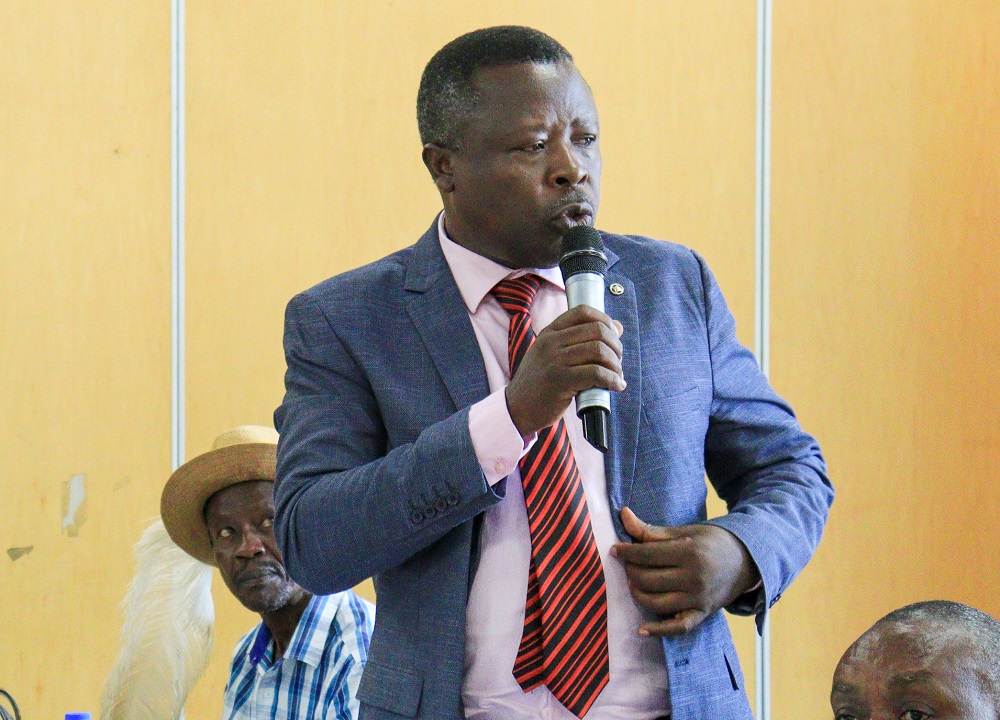
By Steven Masiga
There is a story of an old woman who secretly believed in both God and Satan. While still alive, she would light two candles, one for God and the other for Satan. Her basic philosophy was simple: if she died, at least one of them would accept her. Unfortunately, when she died, both God and Satan questioned her loyalty, and neither accepted her into his fold. This story should teach our region serious lessons.
When His Highness the Umukuka of Bugisu was identified by his community and disagreements later arose over his legitimacy, Section 16(1) of the Institution of Traditional or Cultural Leaders Act was invoked to resolve the impasse. This extinguished the cultural chaos, and the Umukuka of Bugisu was subsequently gazetted by the Government of Uganda in line with the relevant statutory provisions.
Consequently, those who became disillusioned with the outcome of the mediation process petitioned the courts. Court-led mediation efforts are still ongoing, and if the parties remain patient, the court will eventually pronounce itself on the matter.
Just like the old woman in the story above, the very people who petitioned the court, where litigation is proceeding smoothly, have abandoned the judicial process and are now moving through the community organising the election of another cultural leader. This development has disturbed judicial officers in Bugisu and beyond.
A conservative interpretation of the Constitution of Uganda, particularly Article 246, reveals that without this constitutional provision, Bugisu and many other regions would not have recognised cultural leaders today. What is created by law can only be taken away by law.
A scholarly analysis of Uganda’s constitutional history shows that cultural institutions were recognised under the 1962 Independence Constitution before later developments culminated in the 1967 Constitution, under which traditional and cultural leaders were effectively stripped of their official legal status. Government directed Parliament to organise terminal benefits and wind up their official roles.
The 1967 Constitution officially removed the legal recognition of cultural and traditional leaders. Their status was only restored under the 1995 Constitution, followed by enabling legislation, particularly the Institution of Traditional or Cultural Leaders Act, 2011.

I have noted with sadness that some sections of our people in Bugisu continue to disregard the Constitution of Uganda and the laws governing the restoration and operation of traditional and cultural institutions.
Strictly speaking, under the current legal framework in Uganda, no individual can legitimately become a cultural or traditional leader outside the provisions of the laws that restored these institutions. In Bugisu, one of the greatest historical challenges has been that a few elders created their own procedures and attempted to elect cultural leaders using self-made rules rather than state laws or established customs and traditions. Indeed, Bugisu has no settled customary practice governing the installation of a cultural leader.
When the current Umukuka was elected in accordance with the spirit of these laws, several competing claimants emerged. The dispute was addressed under the Institution of Traditional or Cultural Leaders Act, particularly Sections 16(1) and 16(2), which provide for mediation. Some individuals rejected the mediation outcome, resulting in the numerous court petitions currently before the judiciary.
Those who dragged the Government to court challenging the gazettement of the Umukuka under the provisions of Article 50(2) of the Constitution, which allows aggrieved persons to institute proceedings against the State, should remain patient and wait for the courts to determine the matter.
Civil procedure provides several legal remedies through which an aggrieved party may compel government to perform obligations imposed upon it by law. Historically, however, proceedings against the Crown were difficult because of the long-standing legal doctrine that Rex non potest peccare — “the King can do no wrong.”
The Uganda Gazette of the 1920s, which served as the official publication of the Uganda Protectorate Government, contained legislation, government notices and official declarations affirming that the region in which we live is called Bugisu.
A recent example relates to the DNA tests conducted on children claiming to belong to my late friend, Prince Paul Job Kafeero. Out of 25 individuals tested, only four were confirmed to be his biological children, and even two of those remain disputed.
It therefore follows that Bugisu cannot be inhabited by one uniform community alone. Within Bugisu live the Shana, the Babukusu, the Sor and several other groups that settled in the region as early as the mid-1800s. Even within individual families, questions of parentage sometimes arise. If absolute uniformity can be difficult within a household, how much more complex is it for an entire community?

Bugisu, as a historical entity, was incorporated into the Uganda Protectorate through the 1902 Orders in Council, which extended British administration into Eastern Uganda. In 1923, Bugisu became an independent district, and by 1913, indigenous Bugisu chiefs had gradually replaced Baganda chiefs in administering the region.
Bugisu, as a historical region, carries far greater historical significance than the term “Bamasaba”, which, in my view, does not appear anywhere in our traditional folklore as the name of the region.
Some elders in Bugisu possess limited knowledge of the anthropological origins of our community and instead focus solely on contemporary developments under the National Resistance Movement government. Yet Bugisu possesses a rich medieval history that should not be ignored. Rather than confining ourselves to today’s leadership disputes, we should trace our history back to the 14th century and ask broader historical questions, including whether our ancestors arrived already circumcised or adopted circumcision after settling here.
Whereas Buganda may rely on long-established customs and traditions to determine succession to its kingship, Bugisu, in the absence of settled customary procedures, must rely on Uganda’s statutory laws to determine cultural leadership. Where no recognised customary practice exists, statutory law should guide the community.
I have observed several groups planning to disrupt the activities of the reigning Umukuka. If these actions are not addressed early, they could result in unnecessary loss of life. Several individuals with questionable criminal backgrounds have reportedly been recruited into these formations, and the consequences could be unfortunate.
Many of these individuals have no lawful role in determining how an Umukuka is chosen. Some have reportedly received funding from politicians and other interested persons to foment chaos. As a cultural institution, we reject such actions and condemn those behind these schemes.
As the spokesperson of the Bugisu Cultural Institution, my appeal is simple: let all those involved follow the law in resolving disputes instead of resorting to unsanctioned means.
The writer is the Spokesperson of the Bugisu Cultural Institution.
If you would like your article/opinion to be published on Uganda’s most authoritative news platform, send your submission on: [email protected]. You can also follow DailyExpress on WhatsApp and on Twitter (X) for realtime updates.