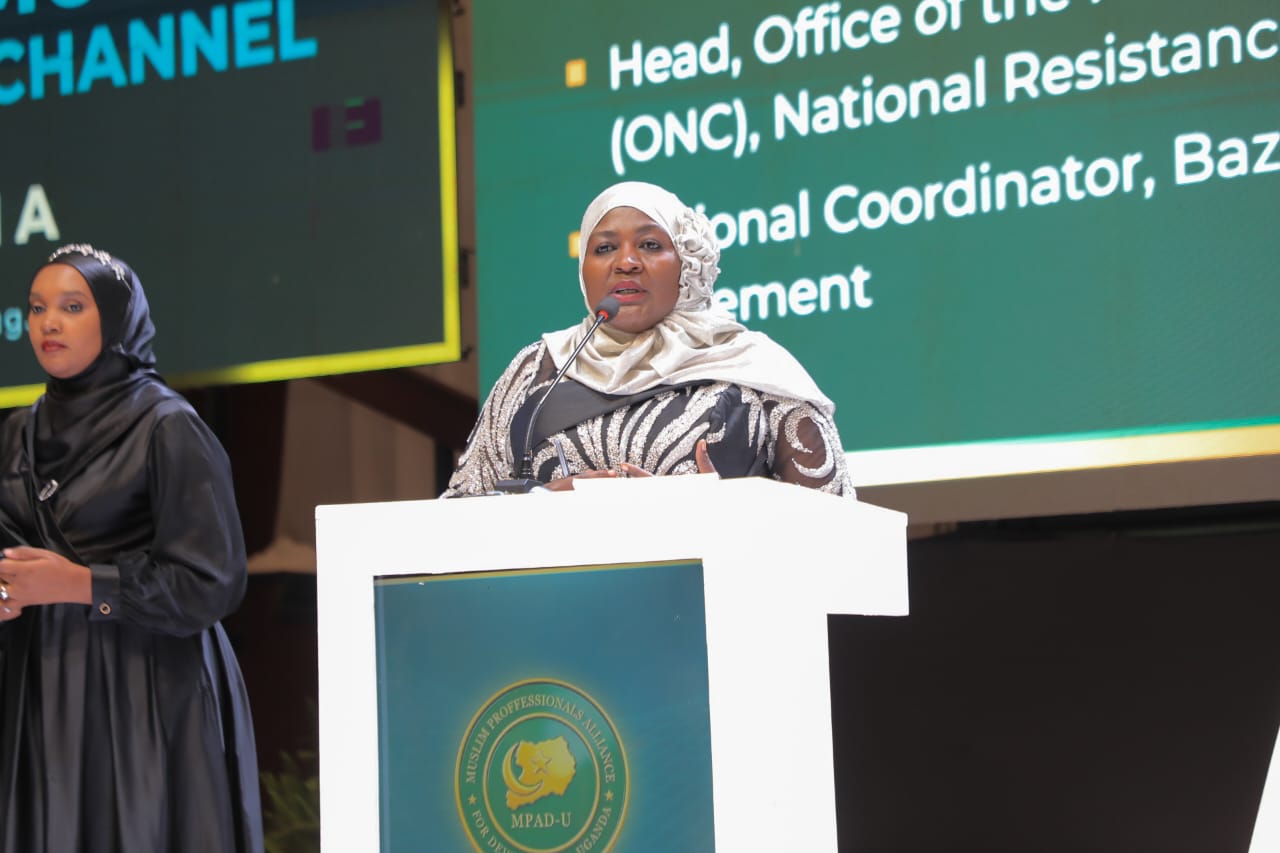
In Summary: Hajjat Hadijah Namyalo Uzeiye has urged Muslim professionals to reject greed, sectarian divisions and leadership struggles as they build the Muslim Professionals Alliance for Development – Uganda (MPAD-U). The alliance’s 2027–2029 roadmap targets more than 1,500 paid-up members and a wider reach of at least 10,000 people by 2029, with planned initiatives in mentorship, business incubation, policy advocacy, medical camps and pro bono legal services.
Kampala, Uganda — The Senior Presidential Advisor on Political Affairs and Head of the Office of the NRM National Chairman, Hajjat Hadijah Namyalo Uzeiye, has cautioned Muslim professionals against greed, internal rivalries and sectarian divisions, warning that such tendencies could undermine a new alliance established to mobilise their expertise for Uganda’s development.
Namyalo, who chaired the organising committee of the Muslim Professionals Alliance for Development – Uganda (MPAD-U), said the organisation should not become another platform consumed by leadership struggles and the pursuit of personal financial interests, but should instead provide a common ground for professionals to serve the wider Muslim community.
Addressing participants at the alliance’s inaugural launch at Serena Hotel in Kampala on Saturday, November 28, she said the initiative had been developed to bring together Muslim professionals across different disciplines and backgrounds, including young people and experienced practitioners who could contribute to the organisation’s growth.

“What has failed most of the organisations is greed and having a high urge for money. If we really need to move on, I urge the Almighty Allah to give us the positive heart to eradicate it, to say no, so that we create growth,” Namyalo said.
She argued that professional competence should be the basis for participation in the alliance, rather than the religious groupings or backgrounds to which members belonged. “Muslim professionals is not about where you come from. It’s about the capacity to uplift the well-being of others,” she added.

Namyalo challenged members to put the past behind them and reject the perception that Muslim organisations are inevitably characterised by internal conflict. “Let us finally lay to rest the past, the false narrative that Muslims are defined by internal struggle or internal war. When a Muslim starts it, it is the status for the entire Ummah,” she said.
She added that the responsibility to change that narrative rested with those who had come together to establish MPAD-U. “No one is going to go back to do it better other than us,” she said, urging members to build an organisation whose impact would be felt beyond the current generation.
The Chief Muzzukulu said the initiative had evolved from efforts to organise young Muslim professionals into a wider association that would also accommodate established professionals and experienced members of the community.
She said the alliance should look beyond networking among its members and create opportunities for young people, support those who were unemployed and help build a stronger skills base.
Turn individual success into shared strength
The Third Deputy Prime Minister and Minister without Portfolio, Rt. Hon. Rukia Isanga Nakadama, who presided over the launch as Chief Guest, challenged Muslim professionals to move beyond individual achievements and use their collective knowledge, networks and resources to contribute to Uganda’s social and economic transformation.
She said Muslim Ugandans had distinguished themselves in medicine, law, engineering, banking, education, scholarship and entrepreneurship, but their achievements needed to be brought together through organised platforms capable of delivering wider benefits.
“What we need now is to turn those individual successes into shared strength,” Nakadama said. She argued that professional associations gave members an opportunity to combine their different areas of expertise, engage government and influence decisions that affect their communities. “That is how professionals engage government, and that is how results are achieved.”
Nakadama said the alliance had been established at a time when Uganda was pursuing an ambitious economic transformation agenda, including the target of growing the economy from about $50 billion to $500 billion by 2040.
She identified agro-industrialisation, tourism, mineral-based development, oil and gas, and science, technology and innovation as sectors in which professionals could apply their expertise to accelerate growth.
She said many Ugandan entrepreneurs remained in small-scale businesses because they lacked technical guidance, professional networks and affordable capital, arguing that MPAD-U could help connect them to people with the knowledge and experience to improve their enterprises.

The Deputy Prime Minister also urged members to understand and help communities access government wealth-creation initiatives, including the Parish Development Model, Emyooga and programmes targeting women and young people.
On women’s economic empowerment, she drew attention to the Generating Growth Opportunities and Productivity for Women Enterprises (GROW) project, encouraging eligible women entrepreneurs to familiarise themselves with its requirements and available funding opportunities.
She also highlighted developments in Islamic finance, including Sharia-compliant banking products, saying such arrangements could help widen access to financial services for Muslims and other Ugandans seeking alternative financing options.
Nakadama gave the alliance five areas of focus: mentoring students and fresh graduates; empowering women and young people; maintaining accountability in its leadership; supporting strong families and responsible parenting; and moving beyond the launch to establish programmes with measurable outcomes.
She warned the leadership against making promises it could not fulfil and urged it to account for members’ contributions, maintain transparency and ensure women were adequately represented in its structures. “Launchers are easy. The hard work starts tomorrow,” she said, challenging the organisers to translate the launch into practical activities.
She further urged professionals in the diaspora, particularly those working in the Gulf, Europe, North America and other parts of Africa, to join the alliance and connect their expertise, investments and experience to Uganda’s development.

Nakadama encouraged MPAD-U to develop well-researched policy proposals and engage institutions such as the Ministry of Finance, Bank of Uganda and the Office of the Prime Minister on matters affecting professionals and the wider Muslim community. She pledged to support the organisation’s efforts to engage government.
Alliance targets 1,500 paid-up members by 2029

MPAD-U Chairperson Dr Alhaj Hassan Bassajabalaba said the alliance should address fragmentation within the Muslim community and provide a stronger platform through which members could pursue common interests.
He said divisions had weakened Muslims’ ability to organise around shared concerns and take advantage of opportunities, particularly those requiring collective action and proper representation.
Bassajabalaba said the organisation should not be limited to social gatherings or exchanging professional contacts, but should help members build meaningful working relationships and engage government on issues affecting the community.
He proposed appointing coordinators representing different professional sectors, particularly academia and business, to ensure the alliance remained connected to the practical needs of its members. He also suggested that business representatives be incorporated into its executive structures.
The chairperson said many Muslims lacked the information and technical skills needed to apply for government funding, despite the existence of programmes intended to support enterprise development.
He proposed that MPAD-U mobilise academics, professors and other experienced professionals to help eligible people prepare funding proposals and navigate application processes.
Citing government grants amounting to Shs147 billion, he said the alliance could use the knowledge of its members to ensure more people understood how to access available opportunities.
Bassajabalaba also emphasised responsible leadership, saying office bearers should not cling to their positions when their terms ended. He said leaders should be willing to support successors who could bring fresh ideas and improve the organisation, rather than allow leadership positions to become a source of conflict.
Hajji Ismail Abdul Noor Bbumba, who presented the strategic roadmap, outlined five pillars to guide the alliance: ethics and professional excellence; enterprise and economic growth; the use of expertise to inform policy; empowerment and social transformation; and partnerships and cooperation.
The 2027–2029 roadmap targets more than 1,500 paid-up members and a wider community reach of at least 10,000 people by 2029.
Its proposed initiatives include a Sharia-compliant investment club, mentorship programmes, medical camps, pro bono legal services, a policy unit, business incubation, seed financing and talent-matching opportunities.
Bbumba said the organisation would be guided by the principle: “Faith and excellence for God and country.”
If you would like your article/opinion to be published on Uganda’s most authoritative news platform, send your submission on: [email protected]. You can also follow DailyExpress on WhatsApp and on Twitter (X) for realtime updates.