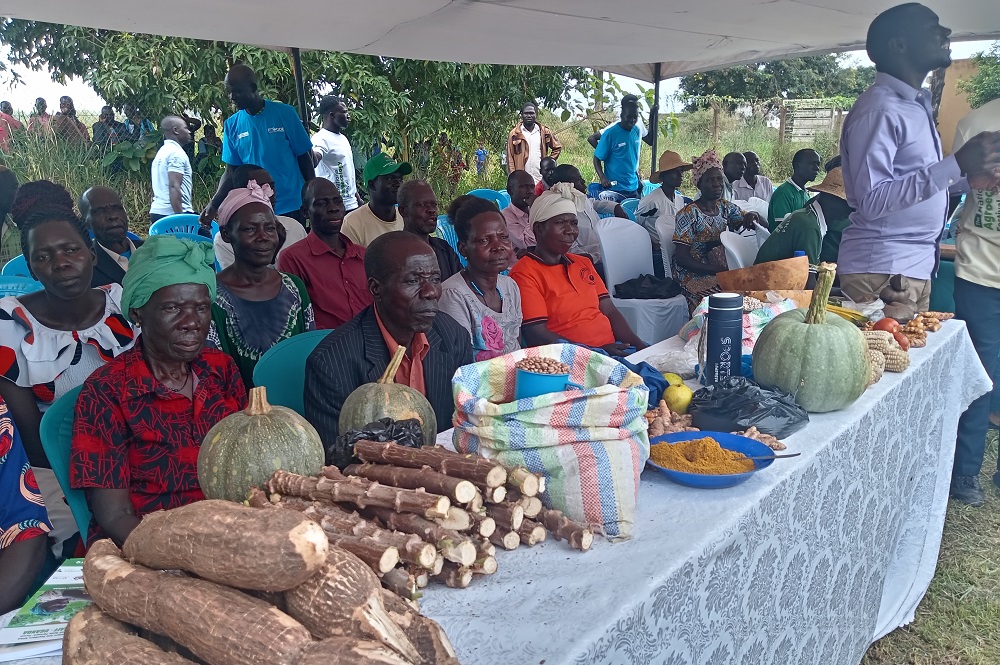
Amuru, Uganda: Civil society actors in Uganda’s agriculture sector have renewed calls for the government to ban the importation and circulation of highly hazardous pesticides (HHPs), warning that their continued use poses serious risks to public health, the environment, and the livelihoods of smallholder farmers.
The appeal was made on Friday, October 31, during the closing session of the Annual National Agroecology Dialogue 2025 held at Lamogi Sub-county Headquarters in Amuru District. The weeklong forum brought together farmers, policymakers, researchers, and activists to discuss sustainable farming solutions and food safety challenges.
According to the Pesticides Action Network (2023), Uganda has 459 out of 669 pesticide brands classified as highly hazardous — accounting for 68.6 percent of all registered brands. Alarmingly, about 65 percent of these contain active ingredients banned in European countries due to toxicity concerns.
Bernard Bwambale, a food safety expert with the Global Consumer Center (Consent), cautioned that continued exposure to these chemicals could increase cancer and other chronic illnesses among Ugandans.

“We need stronger efforts to ensure access to safe food,” Bwambale said. “If the government fails to restrict these chemicals, cancer and related illnesses will continue to rise.”
Amuru Resident District Commissioner (RDC), Geoffrey Osborn Oceng, admitted that weak enforcement of agricultural safety regulations had undermined efforts to protect farmers and consumers.
“We have technical staff and extension workers responsible for food safety, but many are doing the contrary,” Oceng said. “We must promote organic fertilizers and agroecology to prevent soil degradation like what has happened in parts of Kenya.”
Nyeko Robert, Treasurer of ESAFF Uganda, expressed concern that smallholder farmers were increasingly dependent on commercial seed varieties that rely heavily on chemical inputs.
“Traditional seeds are dying out, and that worries us. Many farmers now buy processed seeds that depend on agrochemicals — a practice that is costly and dangerous to people’s health,” he warned.
Nyeko cited the cassava variety TME 419, which he said rots quickly if not harvested early, unlike traditional cassava varieties that can remain in the garden for up to three years. He also noted that most commercial seeds on the market cannot be replanted, forcing farmers into dependence on large seed and agrochemical companies.

To counter this, ESAFF Uganda has launched initiatives to help farmers preserve and share indigenous seed varieties. The organization has already established three seed banks in Serere, Apac, and Omoro Districts, with a fourth under construction in Guru Guru, Lamogi Sub-county (Amuru), expected to open early next year.
Hakim Baliraine, the National Chairperson of ESAFF Uganda, said the agroecology movement seeks to empower farmers to influence agricultural policy and reduce dependence on commercial seed monopolies.
“If smallholder farmers are not involved in dialogues with policymakers and researchers, they become enslaved to seed companies. At ESAFF, we mobilize and train farmers to embrace agroecology for independence and resilience,” Baliraine stated.
He urged Amuru District authorities to strengthen monitoring of ongoing agroecology projects to ensure they deliver tangible benefits to local farmers.
The forum ended with a renewed collective demand for government action to ban hazardous pesticides, promote organic alternatives, and protect Uganda’s food systems from the growing threat of chemical pollution.
If you would like your article/opinion to be published on Uganda’s most authoritative news platform, send your submission on: [email protected]. You can also follow DailyExpress on WhatsApp and on Twitter (X) for realtime updates.