

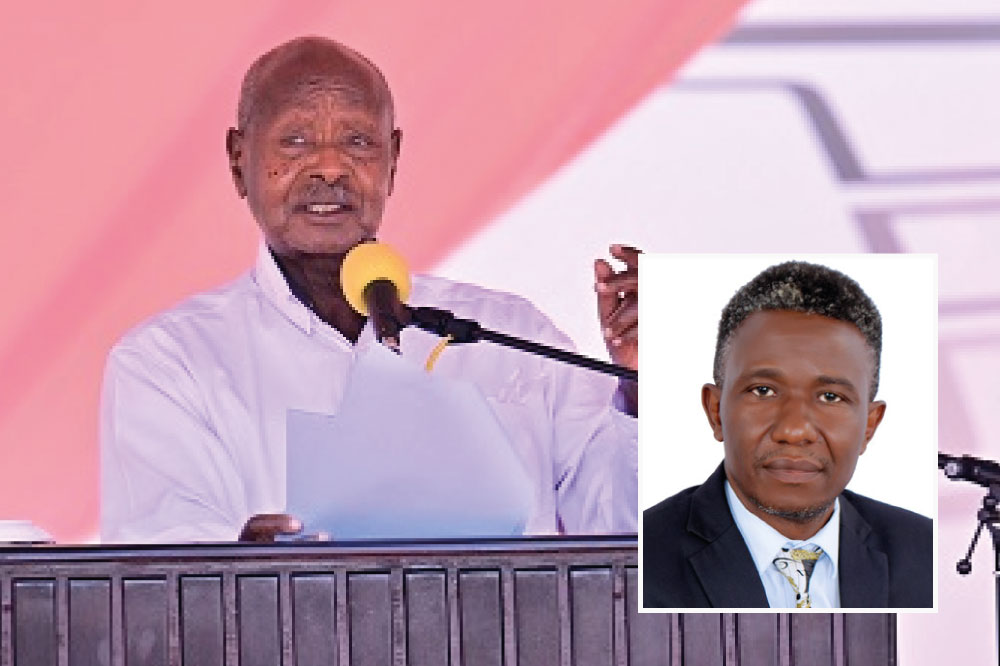
Kampala, Uganda: President Museveni used his 2026 State of the Nation Address to launch a robust defence of his government’s four-decade record, directly responding to a recent Daily Monitor article that described Uganda’s journey under the National Resistance Movement (NRM) as “40 years in the wilderness.”
The President’s remarks were in response to Tegulle’s May 31 Daily Monitor column titled “New Cabinet, Same Centre of Gravity, 40 Years of Wandering in the Wilderness,” in which the veteran journalist questioned whether repeated Cabinet reshuffles have translated into meaningful change for ordinary Ugandans.
In one of the most striking moments of the address delivered before Parliament, Museveni argued that critics who portray Uganda’s progress since 1986 as a failure are ignoring fundamental transformations that have taken place across the economy, infrastructure, agriculture, education and security sectors.
“In the negative Monitor newspaper, there is an article by an individual called Gawaya Tegulle saying that Uganda has spent 40 years in the wilderness. How can Uganda be in the wilderness when we have moved from where we were in 1986 to where we are now?” Museveni asked.
The President argued that any honest assessment of Uganda’s progress must begin by comparing current realities with the situation inherited by the NRM government in 1986, when the country was emerging from years of political instability, economic collapse and armed conflict.
According to Museveni, Uganda’s Gross Domestic Product has grown from approximately USD3.9 billion in 1986 to more than USD69 billion today, while export earnings, electricity generation, milk production and industrial output have all expanded significantly.
“You cannot talk of the wilderness when the economy has grown many times over, when exports have multiplied, when electricity has expanded and when millions of people have moved into the money economy.”

The President suggested that some commentators deliberately ignore objective indicators of development because they are driven by political biases rather than facts.
He questioned how a country that has expanded access to education, health services, electricity, telecommunications and transport infrastructure could still be described as wandering in the wilderness.
Museveni pointed to sectors such as dairy farming as examples of the country’s transformation. “In 1986, Uganda was producing about 200 million litres of milk. Today, we are producing more than 5 billion litres. Is that the wilderness?”
He similarly cited improvements in road infrastructure, industrialisation and regional trade, arguing that Uganda’s current position is incomparable to the country the NRM found four decades ago.
“Correct Diagnosis of Problems”
While defending his government’s record, Museveni acknowledged that challenges remain but argued that leadership should focus on solving problems rather than merely highlighting them. “The most important contribution is not lamentation. It is correct diagnosis of problems and practical solutions.”
The President used the opportunity to reiterate his administration’s new governance mantra of “No More Sleep,” warning public officials against complacency, corruption and poor service delivery.
“No more sleep. No more corruption. No more kukongola. No more politeness to non-performers.”
Observers noted that the remarks appeared aimed not only at opposition critics but also at government officials whom Museveni believes have slowed implementation of key programmes.

The Debate Over 40 Years
Tegulle’s article has sparked significant debate in political and media circles since its publication.
In the commentary, the columnist argued that despite changes in ministers and government structures over the years, President Museveni remains the central figure around whom Uganda’s political system revolves. He questioned whether successive Cabinet appointments have fundamentally altered the country’s development trajectory.
The article resonated with critics who argue that Uganda’s economic growth has not sufficiently translated into jobs, improved public services and opportunities for the country’s youthful population.
But Museveni’s response suggests he views such arguments as overlooking the broader gains made since 1986. Throughout his address, the President repeatedly challenged Ugandans to assess the country based on measurable outcomes rather than political rhetoric.
He cited gains in peace and security, agricultural production, export growth, infrastructure development and regional integration as evidence that Uganda has made substantial progress under NRM rule.
“Wealth creation cannot happen without peace, infrastructure and markets. These are the foundations we have been building,” Museveni said.
The President also defended ongoing investments in railways, oil infrastructure and industrial parks, arguing that they will accelerate Uganda’s transition to a high middle-income economy.
Museveni’s public rebuttal of Tegulle underscores the broader national conversation about how Uganda’s last four decades should be judged. While supporters point to economic growth, infrastructure expansion and political stability as evidence of success, critics continue to raise concerns about governance, unemployment, service delivery and corruption.
If you would like your article/opinion to be published on Uganda’s most authoritative news platform, send your submission on: [email protected]. You can also follow DailyExpress on WhatsApp and on Twitter (X) for realtime updates.


