
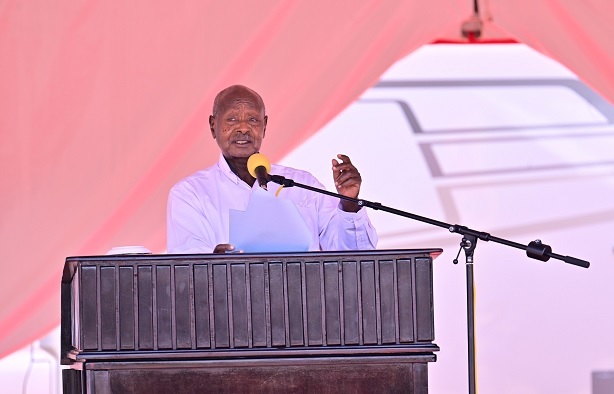
Kampala, Uganda: President Museveni has unveiled an ambitious legislative programme with 38 Bills and key policy measures for the 2026/27 financial year, setting the stage for what could become one of the busiest law-making periods in the history of the 12th Parliament.
While delivering the State of the Nation Address at Kololo Ceremonial Grounds on Thursday, Museveni said the proposed legislation is intended to strengthen governance, improve public service delivery, support economic transformation and provide the legal framework needed to drive Uganda’s development agenda.
“I now present to Parliament the legislative agenda for the next financial year. There are many, and the ministers responsible will table these Bills to Parliament,” Museveni told legislators.
The legislative package combines new Bills with measures carried forward from the previous financial year and spans critical sectors including education, agriculture, health, transport, security, communications, tourism, labour and public finance.
Among the headline proposals is the Building Substances Bill, 2025, aimed at regulating construction materials and standards within the building sector.
Government is also seeking to strengthen national security through the Small Arms and Light Weapons Control Bill, 2023, which seeks to tighten regulation of firearms and related weapons.
Education reforms dominate agenda
A significant portion of the legislative programme focuses on reforms within the education sector.
Government plans to amend the Universities and Other Tertiary Institutions Act as part of efforts to improve governance and standards within higher education institutions.
The Education (Pre-Primary, Primary and Post-Primary) Act, 2008 is also slated for amendment, alongside the introduction of the Curriculum, Assessment and Admissions Bill, which seeks to streamline curriculum implementation, learner assessment and school admissions.

The proposed reforms come amid growing concerns about education quality, curriculum relevance and learner outcomes.
Agriculture and food security reforms
In agriculture, ministers are expected to table the Food and Agriculture Regulatory Authority Bill, 2026, which aims to strengthen regulation across the agricultural value chain.
The Animal Diseases (Amendment) Bill, 2026 is also expected before Parliament as government seeks stronger disease surveillance and control mechanisms to protect Uganda’s livestock sector.
Agriculture remains the backbone of Uganda’s economy, employing the majority of the population and contributing significantly to exports.
Major health sector changes
The health sector is set for extensive legal reforms through amendments to several professional regulatory laws.
These include the Pharmacy and Drugs Act, the Nurses and Midwives Act, and the Allied Health Professionals Act.
The reforms are expected to strengthen professional standards, improve regulation of healthcare practice and enhance service delivery.
Tourism, labour and transport
Government also plans to amend the Uganda Tourism Act as part of efforts to strengthen the country’s tourism industry, one of Uganda’s leading foreign exchange earners.
Other key proposals include the Workers’ Compensation (Amendment) Bill, 2024, which seeks to improve protection for workers injured in the course of employment.
In transport, the government will introduce the Uganda Railways Bill, 2026, as authorities seek to revitalise the country’s railway infrastructure and improve cargo and passenger transport services.

Real estate sector to get dedicated law
One of the most anticipated proposals is the Real Estate Bill, 2025, which seeks to regulate Uganda’s rapidly expanding property sector.
The proposed legislation is expected to address concerns around land transactions, property development, consumer protection and professional standards within the real estate industry.
Legal and ICT reforms
Government also intends to introduce the National Legal Examinations Centre Bill, 2026, aimed at strengthening legal training and professional certification.
The Information and Communication Bill, 2023 is another key proposal expected to shape Uganda’s digital transformation agenda and ICT regulatory environment.
Finance and accountability measures
Beyond legislation, government will present several major fiscal and accountability documents to Parliament.
These include the Annual Macroeconomic and Fiscal Performance Report for FY2025/26, the Annual Budget Performance Report, the Annual Report on the Petroleum Fund, and the National Budget Framework Paper for FY2027/28 to FY2031/32.
Other key documents include the Semi-Annual Budget Performance Report, Draft Estimates of Revenue and Expenditure for FY2027/28, a Treasury Memorandum on implementation of parliamentary recommendations, a statement on tax expenditures, a government asset divestment plan, and a report on public debt, loans, grants and guarantees.
Bills, Policy Frameworks and Statutory Instruments for FY2026/27
- Building Substances Bill, 2025
- Small Arms and Light Weapons Control Bill, 2023
- Universities and Other Tertiary Institutions (Amendment) Bill
- Education (Pre-Primary, Primary and Post-Primary) (Amendment) Bill
- Curriculum, Assessment and Admissions Bill
- Food and Agriculture Regulatory Authority Bill, 2026
- Animal Diseases (Amendment) Bill, 2026
- Local Government (Amendment) Bill
- Uganda Tourism (Amendment) Bill, 2025
- Pharmacy and Drugs (Amendment) Bill
- Nurses and Midwives (Amendment) Bill
- Allied Health Professionals (Amendment) Bill
- National Legal Examinations Centre Bill, 2026
- Information and Communication Bill, 2023
- Workers’ Compensation (Amendment) Bill, 2024
- Uganda Railways Bill, 2026
- Real Estate Bill, 2025
- Intelligence Services Policy Framework
- Annual Macroeconomic and Fiscal Performance Report for FY2025/26
- Annual Budget Performance Report FY2025/26
- Annual Report on the Petroleum Fund FY2025/26
- National Budget Framework Paper FY2027/28 – FY2031/32
- Semi-Annual Budget Performance Report FY2026/27
- Half-Year Macroeconomic and Fiscal Performance Report FY2026/27
- Ministerial Policy Statements for FY2027/28
- Draft Estimates of Revenue and Expenditure for FY2027/28
- Appropriation Bill, 2027
- Report on Multi-Year Commitments
- Treasury Memorandum on Auditor General Recommendations for FY2025/26
- Statement of Tax Expenditures of Government for FY2025/26
- Plan for Divestment of Government Assets
- Report on Public Debt, Loans, Grants and Guarantees FY2025/26
- Income Tax (Amendment) Bill, 2027
- Excise Duty (Amendment) Bill, 2027
- Value Added Tax (Amendment) Bill, 2027
- Stamp Duty (Amendment) Bill, 2027
- Tax Procedures Code (Amendment) Bill, 2027
- Other Statutory Financial and Accountability Measures to be Tabled During FY2026/27
Parliament faces heavy workload
The expansive programme now places significant responsibility on the 12th Parliament, which must balance legislative scrutiny with budget approvals, oversight responsibilities and constituency representation.
Questions have already emerged about whether Parliament will be able to process the full legislative agenda within a single financial year.
The concern stems from the previous parliamentary calendar, during which government tabled more than 30 Bills and policy measures but fewer than half were ultimately enacted into law.
Nevertheless, the 2026/27 legislative programme signals government’s intention to accelerate reforms across multiple sectors as it pursues its broader economic transformation agenda.
If you would like your article/opinion to be published on Uganda’s most authoritative news platform, send your submission on: [email protected]. You can also follow DailyExpress on WhatsApp and on Twitter (X) for realtime updates.