

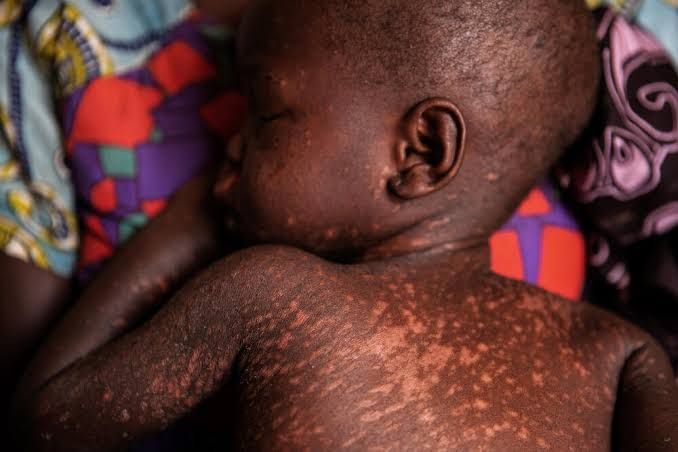
Between January and April 2026, at least 20 districts, including Bulambuli, Kassanda, Amolatar, Kibaale, Nwoya, Gulu, and Adjumani, have confirmed outbreaks, with 12 measles-related deaths already recorded this year.
Kampala, Uganda: The Ministry of Health has confirmed a resurgence of measles cases across the country, raising alarm over rising infections and deaths among children, as government rolls out a nationwide vaccination response.
Addressing the media at the Uganda Media Centre on Thursday, Director General Health Services Dr Charles Olaro warned that measles is a deadly viral and highly contagious disease. “It spreads fast from person to person through respiratory droplets or direct contact and poses a serious threat to children under 5 years of age, more especially to unvaccinated children,” Dr Olaro said.
“Please take note that a person with measles is contagious from about 4 days before the rash appears to 4 days after rash onset,” he added, outlining signs and symptoms of measles, such as fever, skin rash, cough, runny nose, and red eyes, among others.
According to official data at the Health Ministry, in 2025 alone, 66 districts reported measles outbreaks, recording over 10,163 cases and 60 deaths, with 31% of fatalities occurring in the Karamoja region. Between January and April 2026, outbreaks have already been confirmed in 20 districts, including Gulu, Adjumani, Kagadi, Kikuube, Mubende, and Lira, with 12 deaths recorded so far.

“A total of 12 measles-related deaths were confirmed in 2026. These were in: Kagadi, Kikuube, Adjumani, Bulambuli and Karenga. The deaths were attributed to underlying conditions like malnutrition, delay in seeking care, and not receiving the MR vaccine,” Dr Olare noted.
Investigations indicate that 75% of infections are among children under five years, with 64% of affected children having never received a measles-rubella vaccine. An additional 33% had received only one dose, leaving them inadequately protected.
The Ministry attributed the outbreaks to gaps in vaccination coverage, particularly the low uptake of the second measles-rubella dose administered at 18 months. While the first dose coverage stands at 92%, the second dose lags at 64%, well below the 95% threshold required to prevent outbreaks.
Other contributing factors include vaccine hesitancy fueled by misinformation, limited access to health services in hard-to-reach areas, weak surveillance systems, and delayed health-seeking behaviour among communities.
Despite Uganda improving measles vaccination coverage from 79% in 2016 to 90% in 2024, officials say the gap remains significant enough to sustain transmission.
In response, the Ministry of Health, with support from partners including Gavi, the Vaccine Alliance, World Health Organisation, and UNICEF, has announced a nationwide measles-rubella immunisation campaign scheduled for October 1–5, 2026.

The campaign will target all children aged 9 to 59 months across the country, including refugee populations, regardless of their previous vaccination status. Vaccination will be offered free of charge through health facilities, schools, outreach sites, and mobile community posts.
“We also urge community leaders, religious leaders, cultural leaders, health workers, community health workers, all groups such as Lions club, Rotary International etc; and partners to intensify mobilization efforts to ensure that no child is left behind,” he said.
Dr Olaro emphasized that measles is preventable by giving at least two doses of the measles vaccine. “It is a safe vaccine. The first dose is given when the child is 9 months old or soon afterwards. The second dose should be given when the child is 18 months of age.”
He, however, warned that complications such as pneumonia, diarrhoea, malnutrition, and delayed treatment continue to drive fatalities, while some survivors suffer long-term neurological damage.
Authorities have now called on parents, caregivers, and community leaders to prioritise immunisation and ensure no child is left unprotected. “Every child under five years old should receive two doses of the Measles‑Rubella vaccine at 9 months and again at 18 months of age to achieve full protection against the disease and to help safeguard the health of the entire community,” Dr Olaro concluded.
If you would like your article/opinion to be published on Uganda’s most authoritative news platform, send your submission on: [email protected]. You can also follow DailyExpress on WhatsApp and on Twitter (X) for realtime updates.


