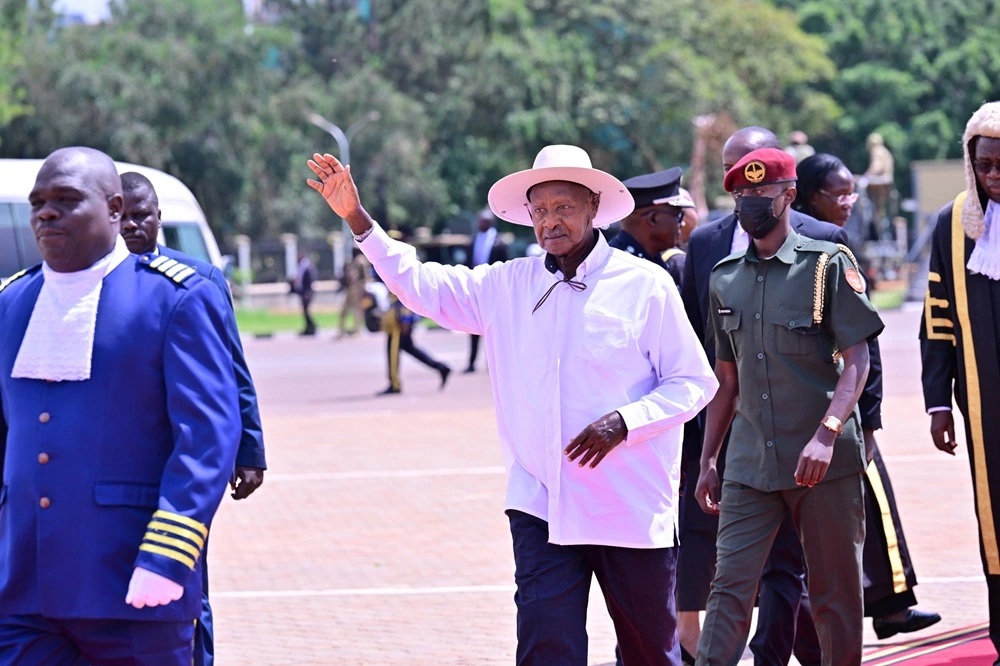
Entebbe, Uganda: President Yoweri Museveni has unveiled a new governance and economic transformation agenda centred on fighting corruption, improving service delivery, accelerating wealth creation, and holding public officials accountable, declaring that Uganda can no longer tolerate complacency and non-performance.
Delivering the 2026 State of the Nation Address before Parliament on Thursday, Museveni thanked Ugandans for their participation in the recent elections and for overwhelmingly supporting the National Resistance Movement (NRM), while reiterating his post-election call of “No More Sleep.”
The President clarified that the slogan goes beyond vigilance and represents a wider campaign against corruption, laziness, diversion from national priorities, exploitation of productive citizens, and tolerance of non-performing leaders.
“It is ‘No More Sleep’ and to clarify the message, I should add: no more corruption; no more kukongola (leaning on your hoe when others are digging); no more kugumaaza (diverting attention from the real target); and no more politeness to non-performers who want leadership for their own ego and personal interests,” Museveni, 81, said.
The President used the address to reflect on Uganda’s economic transformation journey, arguing that the country has moved from a largely subsistence economy at independence to a lower middle-income economy driven by commercial agriculture, manufacturing, services and ICT.
Museveni highlighted the transformation of the dairy industry as one of the NRM government’s most significant achievements, noting that annual milk production has risen from 200 million litres in 1986 to 5.4 billion litres today. He said the sector now saves Uganda billions in import substitution while generating export earnings.
He also defended long-running government wealth creation programmes such as Entandikwa, NAADS, Operation Wealth Creation, Emyooga and the Parish Development Model (PDM), arguing that they have helped millions of Ugandans transition from subsistence farming into the money economy.
According to the President, PDM has already reached 3.7 million households and government will continue increasing funding to support wealth creation at the grassroots. He revealed that each rural parish has already received Shs557 million under the programme, with additional funding planned over the next five years.
On the economy, Museveni said Uganda’s Gross Domestic Product has expanded from USD3.9 billion in 1986 to USD69.3 billion, while GDP per capita has risen above the threshold required for lower middle-income status. He noted that household poverty has declined significantly and that life expectancy has improved from 43 years to 68 years.
The President projected economic growth of 6.4 percent this financial year and 10 percent in the next financial year, which he said would push Uganda’s economy to approximately USD80 billion even before the commencement of commercial oil production.
Museveni further highlighted growth in exports, saying Uganda’s export earnings reached USD18 billion in the 12 months ending March 2026, driven by increased production of coffee, dairy products, fish, cocoa, cement, maize, bananas and sugar, among other commodities.
The President also pointed to major investments in infrastructure, including roads, railways, petroleum pipelines and electricity generation. He noted that electricity generation capacity has increased from 60 megawatts in 1986 to more than 2,000 megawatts today, with government targeting 50,000 megawatts in the long term through hydro, solar, gas, wind, geothermal and nuclear energy.
On governance, Museveni warned public officials against corruption and poor performance, saying leaders who fail to deliver results should leave public office. “Leadership is not for ego but for the people and the country,” he said.
The President also outlined government’s legislative agenda for the 2026/27 financial year, which includes amendments to education, health, local government, tax, tourism, labour and railway laws, alongside several new policy and regulatory frameworks aimed at supporting economic transformation.
Below is his full speech at SONA26
STATE OF THE NATION SPEECH JUNE 2026
Vice President, Speaker and all the other Leaders and fellow Ugandans. I am, again, very happy to address you on this occasion of the State of the Nation Address for the year 2026.
First of all, I thank and congratulate all the Ugandans for having participated in the series of elections ever since the 15th of January 2026 and for massively supporting the NRM. Above all, I thank God for all these victories and for the peace in the Country in spite of so many evil People that have been plotting to disturb the peace. During the Presidential Inauguration, I put forward the call of “no more sleep”. Some People are already distorting it as just “no sleep”. It is “no more sleep” and to clarify the message, I should add: no more corruption (obusi kuzi); no more Kukongola (leaning on your hoe when others are digging); no more Kugumaaza, Kuhuzya (diverting somebody’s attention from the real target to a wrong target); No more kutuhenda (overburden us when we work and you are just sitting down); and no more politeness to non – performers who want leadership for their own ego and personal interests.
The story of the NRM and Uganda, starts in the early 1960s. Personally, I started waking up our People in 1959 when I visited Mbarara Stock Farm as a Junior Secondary one (P.7) pupil of Mbarara High School, having come from the Ntungamo area that was democratically outside the money economy and everybody was in okukolera ekidda Kyoonka (working only for the stomach ⎯ Subsistence). Combined with the school education when we came to know about the enclosure movement in the UK (Kusiba Sengenge) for agriculture, the industrial Revolution in Europe, etc, by 1965, the sectarian politics of the political groups notwithstanding, our ideas about the social- economic transformation, had coalesced. It was clear that the small enclave economy of the British of the 3Cs and 3Ts, was a disaster for the majority of the People. You want proof? Just look at the infant mortality rate in 1962 and the average life – expectancy. They were 128 per 1,000 live births and life-expectancy was 46.8. We soon grasped the importance of having vertically integrated and horizontally integrated national economies.
In the 20 years of chaos (1966-1986), our views were, eventually, crystallized into the 10 points programme of Kanyaara (1984). Point no.5 of those 10 points, run as follows: “Building an independent, integrated, self sustaining national economy”.
However, for People to participate in the vertical and horizontal integration of the economy of the Country, they had to join the money economy first and move out of the traditional, pre−capitalist economy of working for ekidda kyoonka (working only for the stomach ⎯ just subsistence).
Since my nomadic family had migrated from Ntungamo to Nyabushozi, it was the good luck of Nyabushozi that we started our activities there. These activities involved sensitizing the Population of the cattle corridor to stop nomadism, make enclosures around their land (sengenge), engage in commercial agriculture with ekibaro (cura, aimar, calculation for profit and maximum returns). You can see in the videos, the families we started with. Between 1966 and 1986, in spite of the wars, we sensitized People about abandoning nomadism for sedentary agriculture. Between 1986 − 1989, we campaigned for prioritizing the enterprise of dairy farming for the small and medium farmers while the big players could continue with the ranching for beef. By 1995, the cattle corridor had started changing ⎯ People getting income per month from the milk, building better houses, paying School fees for children in paying Schools. Indeed, our late comrade, Magaga, the father of Kavuma, came to me and told me that he did not know what to do with the money − being paid every 15 days − “nka − owomushaara” (like a paid public servant). That was the tragedy of Uganda at that time. Only the colonial Civil Servants, could get regular income. This change in the cattle corridor by the traditional families of Abatasoma (those who did not go to school) engineered by us, was against the advice of the professionals. They were all saying, to a man, that the Banyankore could not change from their pre − capitalist life style to a money economy. Moreover, when we were doing this, nobody from among the colonial elite, would agree to support us. It is only Mzee Byanyima who gave us sh.20. With my colleague Mwesigwa Black (who died in 1972 in our wars), we used sh.7 per person to use Mungonya’s bus from Mbarara to Rushere through Ruhuumba ⎯ that is sh.14. Mwesigwa was a smoker, so he took away sh. 1.20cts to buy a packet of sportsman. That left us with sh.4.80cts. After holding public meetings at Rushere, we used Bazariranwa bus up to Katongore, each using sh. 1.20cts ⎯ that is sh.2.40cts. In the Katongore area, we started moving on foot up to near Naama where we spent the night leaning against the harvested millet (omubishiisha − in the sheaves of millet). After addressing a Public meeting at Naama, the group gave us bicycle rides to Mzee Bitaseine’s place, near Rwamasha dam. Moving on foot, we addressed meetings, including a mega one at where there is Kaaro Secondary School now.
You should have seen grandfathers and other adults, listening to these young People. I was just 22 years old that time and Mwesigwa was just slightly older. Thereafter, we moved on foot out of Mzee Rutanyohoka’s home that we had made our camp and spent the night at Rushere with Mzee Mihinga.
Thereafter, our remaining sh.2.40cts could only take us up to Nyakasharara and from there we walked on foot, all the way to Mbarara, spending a night at my Kraal in Akairungu ⎯ near Biharwe − Mbarara area. It was now 1967, January and it was time to take up our temporary teaching jobs and get our own money to easily support our voluntary struggle for our People. Therefore, when I hear leaders talking of allowances to reach their People and get them out of poverty, I almost get nausea. Even those who get Government allowances, do not go to the field. I hear that many just stay in Kampala. Another mistake, is for leaders to give personal money to constituents. As you can see here, we had no money to give to anybody. The only money we had, even when we started getting our own salaries, was for bus transport. Most of the time, I would ride the bicycle from Kazo to Buruunga; from Buruunga to Rwakyitura and back. The only fuel I needed was no fat on my body. We would share food and accommodation with our hosts − the population.
God has kept me here and I am now 82 years old (almost) in spite of the efforts we expended in the Resistance. The most important contribution to the People was the diagnosis of their problems and the prescriptions we offered. They were enough to rouse their enthusiasm and expectations. That was the reason they massively joined the young Party we formed in 1980, known as UPM, after the Parties were, again, allowed to exist; No money given to them but accurate analysis and prescription that was a projected solution.
By 1986, the production of milk in Uganda was 200 million litres per annum. It is now 5.4 billion litres, saving USD 1.56 billion of imports and earning USD 285.4 million in export earnings. Uganda used to import tinned condensed milk from as far away as New − Zealand, packed paper milk from Kenya, butter, cheese, yoghurt, powered milk etc from Denmark, etc. Uganda is now a big exporter of all those products. That is our work. The People in the cattle corridor need to deepen their work by going away from Okusetura (free−range) to growing pasture and indoor feeding of cattle, goats and sheep. The only people who indirectly helped us in this, were the late King, Gasyonga and some community leaders like Eriazari Biteembe, who had mobilized Banyankore to come back from where they had been dispersed by the spread of tse-tse flies following the invasion of tse-tse flies from Karagwe (Tanzania) in 1918 and after.
To be saluted, in particular, is President Eisenhower of the USA that deployed USAID to spray against the tse – tse flies using a chemical known as dieldrin. When President Clinton visited us in March,1998, I wanted him to visit the cattle – corridor and see the outcomes of the good USAID had done. However, his People preferred to take him to Mukono to see pan − cakes. Ever since the coming into power of the NRM, we have eradicated the tse-tse flies in Kiboga, Ngoma, Busoga, Lango, etc. With the shift from Kusetura (free−range) to indoor feeding of the dairy and beef cattle and stopping the primitive practice of property fragmentation after the death of the head of family, Uganda will overtake Countries like the Netherlands, Australia, Argentina, etc, in production levels of dairy products, beef, leather, etc.
After this success, I started inviting delegations of leaders from other parts of Uganda to visit and learn. This is where the questions of no more sleep, no more kukongola, no more kugumaaza, no more kuhenda (overburden others), no more politeness to non- performers, etc, come in. The County of Nyabushozi, each day, delivers to the factories and milk – coolers, 1.15 million litres of milk. There are 115 milk coolers in Nyabushozi alone, mainly private and there are now 160 milk and milk products factories in Uganda.
Having succeeded in the Nyabushozi − Kazo area and having been inviting delegations after delegations, in 1995, I made a Country wide tour on exactly this point. I studied the whole Country and I recommended the two modes of agriculture ⎯ Intensive agriculture for People with small pieces of land and extensive agriculture for People with big pieces of land. In the 1996 manifesto, we reduced it into the 4 acres model with 7 activities for intensive farming and for other products for the plantations and big farmers with big pieces of land. With four acres or less, you could engage in: zero-grazing for one acre of pasture with 8 fresian cattle; one acre of coffee; one acre of fruits; one acre of food for the family; poultry for eggs and piggery in the backyard; and fish farming near the wetlands.
With large farming, there was more flexibility; you could undertake any or all of these seven that were high income earners even when you do them on a small scale and you could also take on the low – returns activities but on large – scale because the Country also needs them. These are products like tea, cotton, sugar-cane, cattle ranching, etc.
The logical question was: “How do we, the cashless People of Abakolera ekidda kyoonka, start?” Immediately, in 1997, we put entadikwa money at the sub-county to work as a revolving fund. I remember checking in Lubaga Division; there was a DP Chairperson known as Sendikadiwa at that time in that area. Since that time, we have never relented: NAADS in the year 2001; OWC in 2013; PDM, starting with the year 2022; emyooga in the year 2020; etc etc. Many families have listened and benefitted. In my up – Country tours, I found a man (James Mudebo) in Sironko who had benefited from banana suckers under NAADS, another (Nicolas Chelimo) in Bukwo who had benefited from Apple seedlings under OWC and another one (Micheal Kazibwe) near Jinja who had benefited from 2,000 coffee seedlings under OWC and a dairy cow under NAADS. Here are their testimonials. Then there is the man from Karamoja who had benefitted from both PDM and OWC.
With the big farmers and manufacturers, the Government has put a total of ug sh.1,600 bns in the UDB. The interest rate for that money is 12% per annum. The interest rates for PDM is 6% and payable after two years. Hence, for sh. 1 million, the borrower will return sh.1.2 million. We are always creating other funds for the ghettoes, for the musicians, etc.
Unlike the colonial agents who never want to plan for Africa, we have told Ugandans that our economy has got potential in four sectors: Commercial Agriculture; Manufacturing; Services; and ICT. The President is here, Parliament is here; once People have woken up from sleep and they want low cost capital, if sh.100 million per parish per annum or any of the other funds is not enough, we can increase the money by adjusting from other areas. With the cattle corridor, we did not wait for low interest capital. As already said, our only contribution to them was the “word” ⎯ the advice to go from nomadism to sedentary agriculture, to go from okukolera ekidda kyoonka to working for the stomach and the pocket and do so with ekibaro. Additionally, I gave the area 20 milk coolers that had been brought by Danida. That was all. They converted their indigenous Ankole cattle into half-breeds with the fresians (ebiihwa) and they took off.
However, wealth creation cannot take place if there is no peace and law and order and supportive infrastructure. The UPDF always guarantees peace in the Country. The Police and the Judiciary must ensure law and order.
The NRM has struggled to tarmac the core national roads from the North at Oraba, Aru, Nimule and Musingo to the South at Mutukula, Murongo bridge, Kakituumba, Katuna, Kyanika and Bunagana in the South. We have tarmacked the roads from East to West from Busia, Lwakhakha, Suam, Amudat to Mpondwe, Busuunga and Ishasha in the West. This does not include the tarmac roads linking to the water bodies that are also transport connections such as at Jinja, Majanji, Port – Bell, Butiaba, Kaiso − Tonya, Bukakata, etc. We are revamping the metre-gauge railway and building the standard gauge one. We are working with Kenya and Tanzania on the pipelines for crude petroleum products and for the refined products. This will move cargo, heavy cargo, away from the roads to the railway and the petroleum products from the road to the pipeline. That leaves the roads for only passengers and light cargo. The murram roads must be maintained always. Where is the sh.3bn per district? If it is not enough, why not bring up the matter?
Therefore, the NRM has identified all the requirements for building a prosperous Uganda. The NRM has also provided for the means for individuals, families or companies, that want to be part of the social − economic transformation story. As I have said before, our mission has been to ensure that the individuals, the families or the companies that listen to our message, are assisted to be wealth and jobs creators. Right from the beginning, we realized that the internal factors are crucial but not enough to ensure the social − economic transformation of Uganda. We needed to answer the question: “If the individuals, families or companies, create wealth and produce products and services in the four sectors of commercial agriculture, manufacturing, services and ICT, is the internal market enough?” Our answer was: “No. The internal market cannot be enough”. Indeed, if internal markets were enough, why would a Country like China with 1.3bn People or India with 1.4bn People, be looking for external markets? Hence, ever since the 1960s, we have been having a Pan – Africanist agenda on top of the patriotic agenda within Uganda. The pan − African agenda, was aimed at the economic integration of the whole of Africa in a Continental market and for the Political integration within East Africa leading to the Political Federation of East Africa. The economic integration, would deal with the Prosperity of the African People while the Political integration of parts of Africa that are compatible, would deal with the strategic Security of Africa, especially defence on land, in the air, at Sea and in Space.
Therefore, for the wealth creators of Uganda, most of the factors are in place now. That is why we are saying: No more sleep; no more kukongola (leaning on your hoe while others are working); no more Kugumaaza (diverting People’s attention); no more corruption; and no more politeness to the non – performers who want leadership for ego and personal interests. We must ensure that enju kunju (house to house) for families with land, they get into the money economy with ekibaro. The ones without land, their solution is emyooga (skills specialization). Indeed, with increasing population, it will be neither possible nor necessary for everybody to have land. That is why there are the other sectors: Manufacturing and artisanship, services (e.g trading, transport, entertainment) and ICT (BPOs etc). In the developed Countries, very few People own land.
I saw in the negative Monitor Newspaper an article by an individual known as Gawaya Tegulle who is always writing mendaciously and maliciously, saying that Uganda has been “wandering in the Desert for forty years” like the children of Israel. Those who are wandering in the desert, are partly those who listen to those liars. It is true that many of the leaders do not amplify this message of how People can get out of poverty. However, those who do, change their lives. I understand Gawaya comes from the Bugwere area. Let him visit Maama Nabutono and her husband of Bukodi cell, Kasasira ward, Kasasira Town Council. Uganda has gone through five phases of positive development. These are the recovery phase of bringing back some of the 3Cs and 3Ts of the colonial enclave economy and ending the informalization of the economy into magendo (smuggling), Kibaanda (forex black market) and kusamula (speculation), following the destruction of the economy by Idi Amin; expanding that enclave economy; diversifying it and that is how the dairy sector changed the cattle corridor and the cassava is changing many parts of Uganda ⎯ these are totally new cash products; Value addition to some of the raw – materials e.g. gold; and the knowledge economy of the automobiles, vaccines, computers, etc. What is “high sounding sloganeering” there? These are achievements on the ground. Let Gawaya go to the nearby Mbale Industrial Park. How can such a park be in a “desert” where there is no water or peace or production. Yes, there are problems of the issues like drugs in health centres, etc. That is why the NRM introduced democracy from the very beginning by getting People to elect the committees of the Resistance Councils. Especially, in the Bukedi area, FOBA started killing those elected leaders, until we crashed FOBA. Elect People who help in exposing those mistakes.
The facts of the matter, are that with the limited waking up, where 67% of the homesteads as compared to 9% in 1962 are now in the money economy, Uganda has graduated from the Least Developed Countries to a Lower Middle Income Country. Our GDP rose from USD3.9bn in 1986 to now USD 69.3bn by the forex exchange method or to 197.1bn by the PPP method. The GDP per Capita has risen to USD1,278 while the threshold for lower middle income status is USD1,136. Household poverty has declined from 56.4% in 1992 to now 16.1%. Life Expectancy was 43 years and it is now 68 years. The infant mortality was 122 per 1,000 born alive and it is now 36 per 1,000 born alive. In other words, our economy has expanded 17 times in the last 40 years of recovery, expansion, diversification, value addition, entering the knowledge economy and transformation.
This financial year, the economy is projected to grow by 6.4% and the next financial year the GDP will grow by 10% pushing the size of the economy to USD 80billion. All this is before the start of the flow of our commercial oil. In the last 15 years alone, the Country has added 31 new products to the export basket. Uganda now exports manufactured goods, including pharmaceuticals, refined gold, steel, ICT products, ceramics, plastics, the dairy products already talked about. Uganda’s exports reached USD18bn in the twelve months ending in March, 2026.
The 67% of the People that have listened to our message and friends from outside that have invested here, have turned our Country into a Country of surpluses: Milk 5.4billion litres from 200million litres in 1986; 727,000MT of fish; 9.3million of 60kgs bags of coffee from 2million bags in 1986; 76,173 metric tonnes of cocoa; cement from 4,900 to 7 million metric tonnes; maize from 200,000 to 5 million metric tonnes; bananas from 6,660,000 to 11 million metric tonnes; cassava from 3.5 million to 4.5 million metric tonnes; sugar from 152,000 to 700,000 metric tonnes; etc, etc.
We are now set for further and faster growth and transformation. With Electricity we have moved from 60mgws in 1986 to now 2,098mgws. We are, however, aiming at 50,000mgws from hydro, solar, gas, wind, nuclear and geo − thermal.
Therefore, all the leaders must ensure that those programmes are down − loaded in their respective areas. In the next 5 years, all the households with land must get the low − interest capital in the form of
PDM. There is already Sh.557 million in the Parish. It has reached 3.7 million households. We are going to put Sh.100 million plus sh.15 million for the leaders per annum per parish in the rural areas and Sh.300 million plus sh.15 million for the leaders per ward in the towns. Ug. sh.760bn has gone to the emyooga, operating from the constituency level. Where is that money? How many and which emyooga associations, have benefited from this money?
On account of peace, some traders have generated alot of capital through imports. These are the ones that built arcades, real estate. There is a young lady, Nanteza, that is always show − casing on UBC, the different real estate developers. See some of the pictures. A Ugandan returnee from abroad was trying to buy a flat in the Kampala area and they were demanding USD 1.2 million. As she was trying to mobilize the money, the resident Ugandans had bought all the flats. She was amazed at how rich some of the Ugandans are. A middle class is coming up. The question is: “What sort of middle class are we witnessing coming up? Are they the comprador bourgeoisie that are agents of foreign interests (importers, commission agents, etc) or are they part of the national bourgeoisie that build the capacity of the Country through being big or small farmers, manufacturers, service providers and ICT operators?”
Let us, therefore, move. No more sleep; no more kukongola; no more corruption; no more kugumaaza; no more politeness towards non − performers. All the non-performers must leave leadership. Leadership is not for ego but for the People and the Country. In agriculture, it is possible to have Pan − Ugandan rural transformation. In the Kisozi area, I have 9 villages with 2048 homesteads now. As of today, all the 2048 homesteads have joined the money economy with coffee, bananas, dairy farming, goat rearing and poultry etc. In the cattle corridor, most of the original families have joined the money economy, through the dairy economy. In order to stabilize agriculture, we are addressing the issue of irrigation. Apart from the big irrigation schemes such as Mubuku, Doho, etc, we are developing many micro, solar-powered irrigation schemes, working with a British group known as Nexus Green. As we speak they have worked with Government to put solar powered irrigation systems in Ngora, Serere, Bukedea, Amolatar, Kwania, Apac, Kasanda, Masaka, Mukono, etc.
In conclusion, however, the two residual problems with the peasantry are, as pointed out above, some of them still relying on okusetura (free range) which under − utilizes the land. A square mile of well cleared farm (no muteete, no shrubs, no bugaando), will cater for 300 long − horn Ankole cattle, including enyena (the calves). With pasture growing and zero − grazing, a square mile will cater for 6,000 cattle. With free − range, you need 3 acres for one cow; with zero − grazing, one acre can support 8 Friesian cattle and 12 Ankole ones. We are aggressively sensitizing them on this. The other residual issue is the primitivity of property fragmentation in the form of inheritance after the head of family has died. These recent arrivals from poverty, need to be sensitized about family companies instead of individual inheritance. With these measures and those earlier mentioned, we shall have massive production and will also create jobs for hundreds of millions of Ugandans and the Africans from the neighbouring Countries. All this is before you add Manufacturing, Services and ICT.
Thanks, and let us work differently.
Yoweri Kaguta Museveni
PRESIDENT OF THE REPUBLIC OF UGANDA