
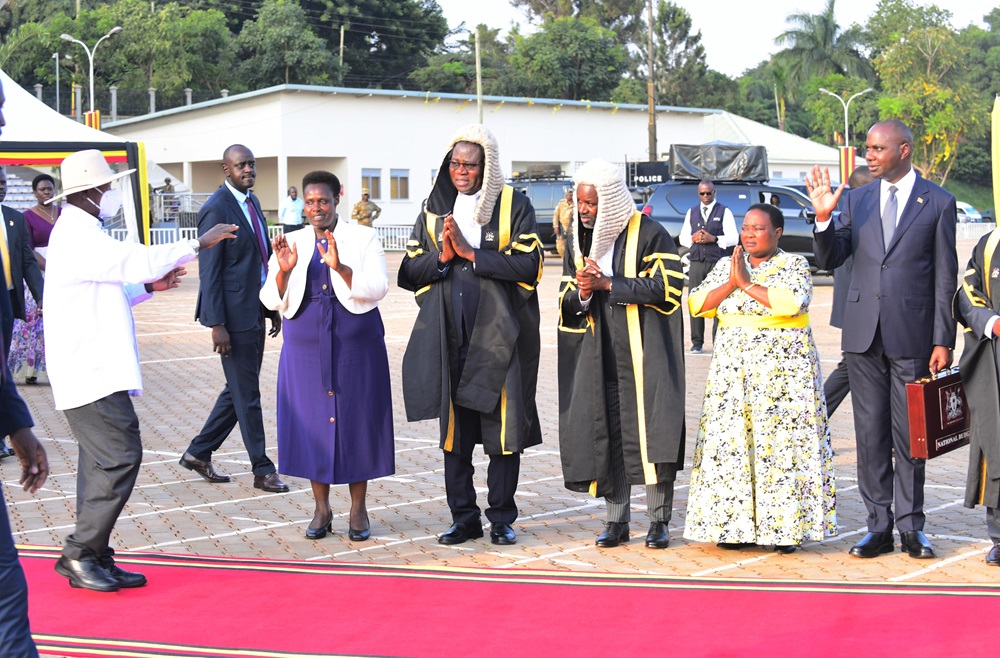
Kampala, Uganda: President Museveni has projected a new phase of accelerated economic growth for Uganda, saying the country’s oil sector, wealth creation programmes, and strategic infrastructure investments will drive the next stage of socio-economic transformation.
Speaking shortly after the presentation of the Shs84.39 trillion FY2026/27 national budget at Kololo Independence Grounds on Thursday, Museveni said Uganda’s current economic performance demonstrates the resilience and potential of the country’s economy despite global uncertainties.
“You have heard how the economy is performing well, in spite of many problems in the world. The economy is performing well because Uganda is a very rich country. We’ve got a lot of potential,” Museveni said.
The President noted that Uganda’s economy is projected to grow by 6.4 percent this year, but expressed optimism that growth will accelerate significantly to 10.2 percent following the commencement of commercial petroleum production.
“This growth of 6.4 percent is still modest. Next year, growth will go to 10.2 percent because of petroleum. The performance is good by world standards, but in my view, it can be stronger,” he said.
Oil Expected to Transform Revenue Base
Museveni said the anticipated oil revenues will provide government with additional resources to finance critical development priorities and reduce infrastructure bottlenecks that have historically constrained economic growth.
According to the President, Uganda is expected to earn approximately USD1.5 billion annually as the government’s share from the oil and gas sector. He revealed plans to establish a sovereign wealth fund to preserve part of the oil earnings for future generations while investing strategically in transformative projects.

“Government will be getting an extra USD1.5 billion per year. We shall discuss how to save some of this money through a sovereign fund while using part of it for crucial infrastructure,” Museveni said.
Among the priority investments highlighted were the Standard Gauge Railway, petroleum pipelines, electricity expansion, and irrigation infrastructure aimed at lowering the cost of doing business.
Despite the positive economic outlook, Museveni argued that Uganda’s biggest challenge remains integrating all citizens into productive economic activity.
He said government interventions over the years have increased the number of households participating in the money economy from just 32 percent in 2013 to approximately 67 percent today.
However, the President expressed concern that nearly one-third of Ugandan households remain outside the money economy. “Thirty-three percent are still refusing to join the money economy. This is now the challenge we must solve,” he said.
Museveni credited programmes such as Operation Wealth Creation, NAADS, Entandikwa, and the Parish Development Model (PDM) with helping millions of Ugandans engage in commercial agriculture and income-generating enterprises.
He called on political leaders, local government officials, and technical staff to intensify mobilisation efforts at the parish level to ensure every household participates in wealth creation activities.
Leaders Tasked on Service Delivery
The President also challenged Members of Parliament, district leaders, and local government officials to improve oversight of government programmes and public services.

He raised concerns about reports of theft of Parish Development Model funds and persistent weaknesses in service delivery, particularly in health facilities.
“PDM money is being stolen. Leaders must monitor these programmes because the money belongs to the people,” Museveni said, warning that leaders who fail to supervise government programmes risk undermining efforts aimed at fighting poverty and improving household incomes.
Expanding Markets Key to Growth
Museveni said Uganda’s development strategy is anchored on production and market expansion, noting that Africa remains the country’s most important market. “When you produce, you must sell. Africa is our sure market, and then we can add other markets,” he said.
The President cited milk production as an example of Uganda’s untapped economic potential, arguing that low household incomes continue to suppress domestic consumption despite rising production levels.
According to Museveni, increasing household earnings through commercial activity would not only reduce poverty but also stimulate domestic demand for locally produced goods.
The President also renewed calls for environmental conservation and orderly urban development, warning against encroachment on wetlands and forests.
He argued that protecting natural resources remains essential for sustaining economic growth, agriculture and public health. “We have done well, but we can do much better. Uganda is a very rich country,” Museveni said.
The FY2026/27 budget is expected to be a critical foundation for Uganda’s next phase of economic expansion as the country positions itself to leverage oil revenues and accelerate its long-term goal of becoming a middle-income economy.
If you would like your article/opinion to be published on Uganda’s most authoritative news platform, send your submission on: [email protected]. You can also follow DailyExpress on WhatsApp and on Twitter (X) for realtime updates.