
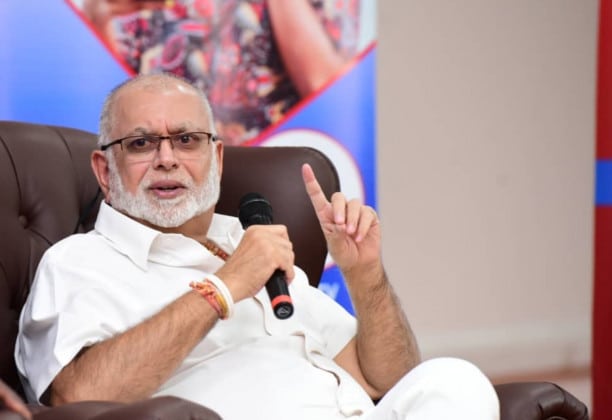
Kampala City, Uganda: Ruparelia Group Chairman Dr Sudhir Ruparelia has opened up about his family’s deep roots in Uganda, recounting dramatic childhood experiences in Kasese and the difficult circumstances that forced him to leave the country during Idi Amin’s 1972 expulsion of Asians.
Speaking during an exclusive conversation with Pan African Pyramid (PAP) speaker Andrew Irumba Katusabe at Crane Chambers, Ruparelia described himself as a fourth-generation Ugandan whose family’s connection to East Africa dates back more than a century.
According to Ruparelia, his great-grandfather first arrived in Mombasa in 1897 before the family later settled in Uganda. His father was born in Kampala in 1932, while he himself was born at Nakasero Hospital in 1956.
“We are four generations in Uganda,” Ruparelia said, emphasizing his family’s long-standing connection to the country.
The veteran businessman spent much of his childhood in Katwe-Kabatoro near Queen Elizabeth National Park in Kasese, where wildlife frequently roamed close to homes and businesses.
Sudhir vividly recalled growing up among elephants, lions, buffaloes, hippos and antelopes in a setting few Ugandans experience today. One of his most memorable stories involved elephants that regularly visited the family compound at night in search of food scraps.
According to the Ruparelia boss, one evening his mother was away and no cooking had taken place. When elephants arrived expecting food waste in the rubbish area and found none, they became agitated and damaged part of the family’s house.

He also recounted a frightening encounter involving a pride of approximately 20 lions.
During a family outing inside the national park, his father’s Volkswagen vehicle reportedly stalled directly in front of the lions.
The family was left terrified as they struggled to restart the car while surrounded by predators. Fortunately, the vehicle eventually started and they managed to drive away safely.
Despite the extraordinary wildlife encounters, Ruparelia described his upbringing as relatively modest.
His family operated a shop and petrol station in Kabatoro and placed significant emphasis on education.
At the age of five, he was enrolled in boarding school in Kampala before later studying in Jinja and returning to Kampala for secondary education.
However, his studies were disrupted by the 1972 expulsion of Asians ordered by then-President Idi Amin.
Ruparelia revealed that unlike many families who left Uganda immediately, he remained in the country until the final day of the 90-day deadline. “I wanted to stay,” he said, explaining that Uganda was the only home he had ever known.

He noted that he held a Ugandan passport and identified strongly with the country despite the growing uncertainty surrounding the expulsion.
Eventually, as conditions deteriorated and communities emptied, he made the difficult decision to leave. On November 5, 1972, at the age of 16, Ruparelia boarded one of the last flights out of Uganda.
He revealed that he personally organised his departure using money left behind by his parents.
Rather than spending all the funds on himself, Ruparelia said he used part of the money to purchase airline tickets for families that could not afford to leave Uganda.
Among those he helped was a family of five.
Reflecting on the gesture, he said helping others was consistent with cultural values that emphasise generosity and support for those facing hardship.
His departure marked the beginning of a new chapter that would eventually take him to the United Kingdom before his return to Uganda, where he would go on to build one of East Africa’s largest private business empires.
The revelations form part of a broader Pan African Pyramid series exploring Ruparelia’s life journey, including his years as a young refugee in London, how he met his wife, his return to Uganda and the development of the Ruparelia Group into one of Africa’s most influential business conglomerates.
If you would like your article/opinion to be published on Uganda’s most authoritative news platform, send your submission on: [email protected]. You can also follow DailyExpress on WhatsApp and on Twitter (X) for realtime updates.