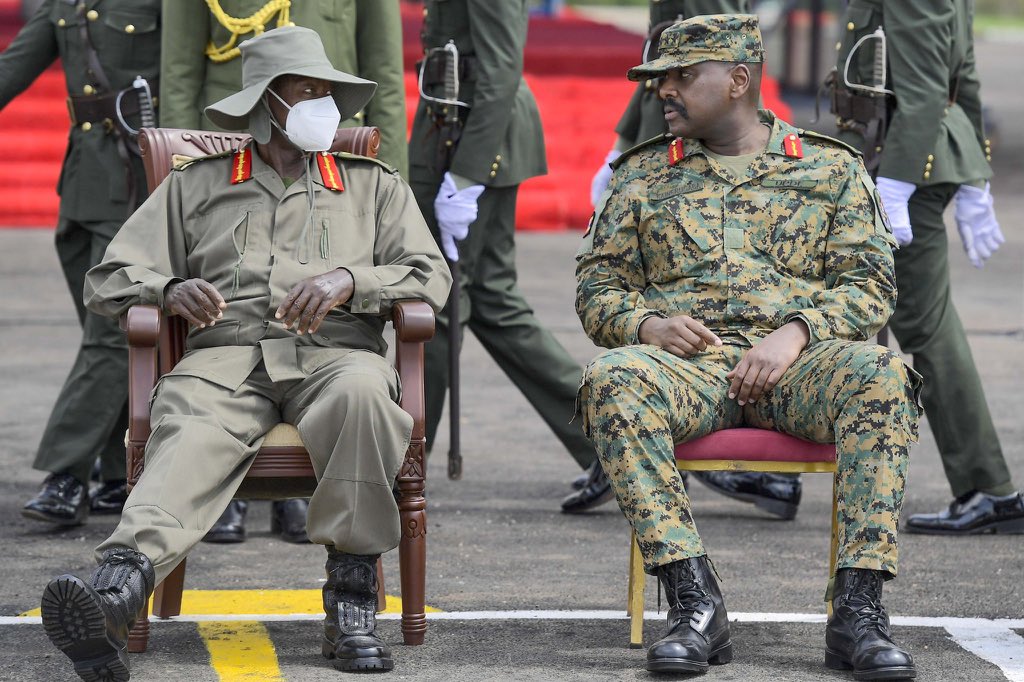
Kampala, Uganda: President Museveni has strongly defended the recent security operations spearheaded by First Son and Chief of Defence Forces (CDF) Gen. Muhoozi Kainerugaba, insisting they are not a return to authoritarianism but a necessary campaign to eliminate impunity, strengthen accountability, and safeguard Uganda’s peace and economic transformation.
In a nationally televised address on Saturday, July 04, Mr Museveni responded to growing concerns from religious leaders, human rights organisations, opposition politicians, and sections of the public over the recent wave of arrests, detentions, anti-corruption operations, and security crackdowns that have dominated the country’s political landscape.
The President said the operations represent a new phase in Uganda’s governance agenda, which he described as “No More Impunity,” complementing the government’s existing campaign slogan of “No More Sleep” against corruption and inefficiency.
“Wakili twebakka kutulo created mainly by the UPDF, boona bagaggawale (wealth for all) created by the NRM that have resulted in metamorphosing Uganda into a lower-middle-income country, must also be reinforced by no more sleep, no more kukongola, no more corruption and, now, no more impunity,” Museveni said.
The President argued that although the National Resistance Movement (NRM) restored peace after years of political instability, institutional weaknesses within the political class, the bureaucracy, and parts of the Judiciary had gradually allowed corruption, criminality, and abuse of legal processes to flourish.
“It is good that the security forces have come in to fill the gap,” he said.
Inter-Religious Council concerns
Mr Museveni, 81, revealed that the address followed recent meetings with the Inter-Religious Council of Uganda, during which religious leaders raised concerns over allegations of illegal detentions, disappearances, justice, human rights, environmental degradation and trade order.
The President acknowledged the concerns but rejected suggestions that Uganda was sliding back to the dark years that preceded the NRM government. Instead, he said the recent interventions by security agencies should be viewed as measures intended to preserve the peace and freedoms achieved over the past four decades.
“Therefore, what the security forces have been doing recently is not a regression in the fight for freedom but a consolidation of our long fight for the principles of patriotism, Pan-Africanism, socio-economic transformation and democracy,” he said.
Without mentioning every recent operation individually, Mr Museveni gave his clearest endorsement yet of the security initiatives undertaken under the leadership of Gen. Muhoozi Kainerugaba, the CDF, and his Special Advisor on Special Operations.
The recent months have seen intensified anti-corruption investigations, arrests of senior government officials, crackdowns on organised criminal networks, actions against individuals accused of threatening national security, and the closure of Nation Media Group Uganda operations.
Museveni argued that such interventions had become necessary because impunity had persisted for too long. “There was a weakness on the part of the political, administrative, and legal cadres of the Government in allowing this impunity to continue for so long,” he said.
He added that the continued circulation of what he described as false narratives had discouraged investors and tourists from coming to Uganda despite the country’s progress in peace and economic development.
“Some investors and tourists are scared away from coming to Uganda on account of those false stories. When people come here, they get amazed about the progress.”
Besigye case
The President also referred to the ongoing prosecution of opposition leader Dr. Kiiza Besigye, who has remained before the courts since his arrest in November 2024.

Museveni questioned why Besigye had repeatedly challenged aspects of the legal process instead of proceeding to trial.
“Why would this great democrat and human rights fighter spend so many calories on refusing to come to trial where he has got opportunity to prove his innocence and expose the undemocratic behaviour of the dictatorship of Museveni and his family?” he asked.
He further questioned why the justice system had allowed accused persons to delay criminal proceedings for prolonged periods.
Mr Museveni also defended the continued detention of certain suspects facing security-related charges, arguing that courts should not grant bail where there is a risk of interference with witnesses.
“The arrested opposition law-breakers may not get bail because they threaten the security of the witnesses,” he said.
The President further accused sections of the opposition of promoting violence and intolerance, citing previous riots, attacks on security personnel, threats to burn Kampala, and slogans opposing his swearing-in following elections.
He argued that such actions had increasingly compelled security agencies to intervene. “It is this undemocratic culture of some of the opposition elements that has been provoking the security forces to fill these gaps,” Museveni said.
The sharp remarks come at a time when several opposition politicians and activists remain before courts on various charges, with human rights organisations continuing to raise concerns over prolonged detention and access to bail.
If you would like your article/opinion to be published on Uganda’s most authoritative news platform, send your submission on: [email protected]. You can also follow DailyExpress on WhatsApp and on Twitter (X) for realtime updates.