
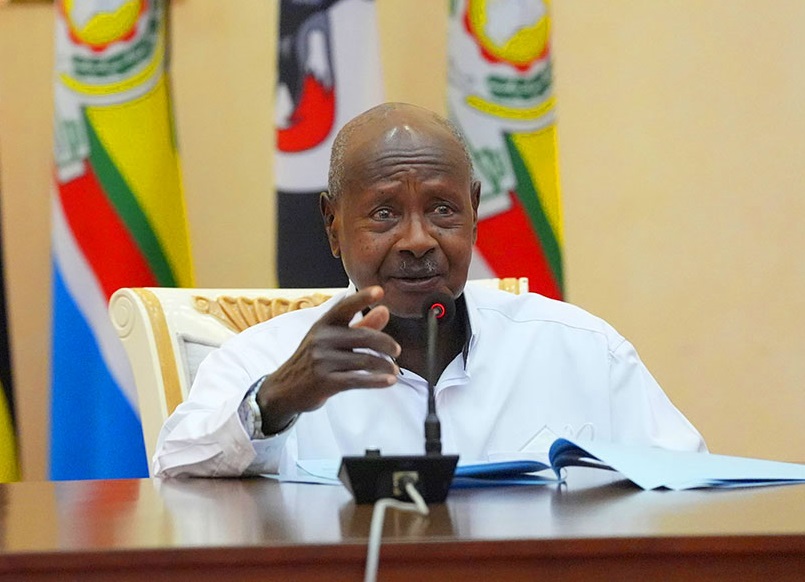
Kampala, Uganda: President Yoweri Museveni has questioned Uganda’s current application of bail, arguing that the justice system should not allow suspects accused of serious offences to use constitutional safeguards to obstruct justice or intimidate witnesses.
Speaking to the country in his national address on Saturday, Mr Museveni devoted a significant portion of his speech to the country’s justice system, saying while Uganda remains committed to human rights, the rights of accused persons must be balanced with the rights of victims and the wider public.
The President’s remarks come amid growing national debate over bail, prolonged detention, the treatment of opposition figures, and the role of courts in safeguarding constitutional freedoms.
Museveni maintained that the recent actions by security agencies should not be interpreted as an assault on human rights but rather as efforts to reinforce accountability and restore public confidence in the rule of law.
“The arrested opposition law-breakers may not get bail because they threaten the security of the witnesses,” Museveni said, arguing that courts should exercise greater caution before granting bail in cases where there is a likelihood that suspects could interfere with investigations or intimidate prosecution witnesses.
Museveni also criticised what he described as the prolonged use of legal processes to delay criminal trials, specifically referring to opposition leader Dr. Kiiza Besigye’s ongoing prosecution.
The President questioned why an accused person would repeatedly challenge aspects of the legal process instead of proceeding to trial, where evidence could be tested before an independent court.

“Why would this great democrat and human rights fighter spend so many calories on refusing to come to trial where he has got opportunity to prove his innocence?” Museveni asked.
He further questioned why the justice system had permitted accused persons to delay criminal proceedings for extended periods.
Rights must come with accountability
Throughout his address, President Museveni argued that respect for human rights should not translate into tolerance for criminality or impunity.
Drawing from traditional African justice systems, he said accountability has historically been central to maintaining peace within communities, unlike what he described as aspects of colonial legal practice that allow offenders to evade responsibility through procedural technicalities.
He said Uganda’s current campaign against corruption, organised crime and insecurity seeks to strengthen, not weaken, the rule of law. “The recent limited actions by security forces against some individuals and institutions are really long overdue actions to fill those gaps,” Museveni said.
Museveni’s remarks followed engagements with the Inter-Religious Council of Uganda, whose leaders raised concerns about allegations of illegal detentions, disappearances and broader human rights issues.
While acknowledging the concerns, the President rejected claims that Uganda is reverting to the abuses experienced under previous governments. Instead, he argued that today’s suspects are arrested and processed through formal legal institutions rather than being subjected to enforced disappearances or extrajudicial killings.

“Those who have been putting forward the slogan ‘Bizeemu’ are wrong,” Museveni said. “Ebyariwo meant that anybody arrested would not go to court but would end up as a dead body.”
He added that even members of the security forces who violate citizens’ rights should be held accountable. “I cannot allow impunity in our system even on the side of the security forces,” he said, citing previous prosecutions of soldiers involved in unlawful killings and misconduct.
The President’s latest comments are likely to reignite Uganda’s long-running debate over bail, particularly in cases involving terrorism, murder, economic crimes and offences related to national security.
Government officials have on several occasions proposed constitutional amendments to restrict automatic access to bail for suspects facing capital offences, arguing that some accused persons exploit the system to frustrate investigations and threaten witnesses.
However, human rights organisations, legal practitioners and opposition leaders have consistently defended bail as a constitutional right that protects the presumption of innocence and prevents arbitrary detention before conviction.
Critics have also argued that prolonged pre-trial detention undermines the right to liberty and fair hearing guaranteed under Uganda’s Constitution.
Museveni’s latest remarks suggest the government remains committed to pursuing a justice system that places greater emphasis on accountability and witness protection, even as debate continues over how to balance those objectives with constitutional human rights protections.
Article 23 of Uganda’s Constitution guarantees the right to apply for bail, although courts retain discretion to determine whether an accused person qualifies based on the circumstances of each case.
In recent years, proposals to amend bail laws have generated significant public debate, with supporters arguing the reforms would strengthen criminal justice while critics warn they could weaken constitutional safeguards and civil liberties.
If you would like your article/opinion to be published on Uganda’s most authoritative news platform, send your submission on: [email protected]. You can also follow DailyExpress on WhatsApp and on Twitter (X) for realtime updates.