Pallisa, Uganda: Farmers in Pallisa District have been urged to take advantage of the second planting season by adopting improved seed varieties and modern farming practices to boost food production amid rising food insecurity.
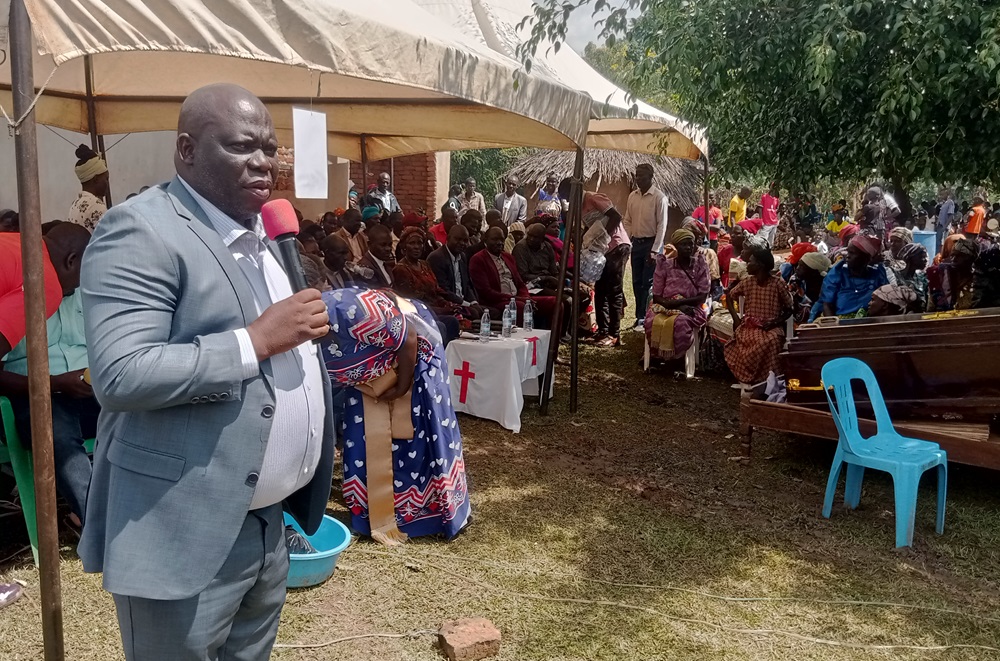
The call was made by David Ochwa, Executive Director of Agule Institute of Health Science and Management and former Member of Parliament for Agule County, while addressing mourners at a burial in Kateki Cell, Odusai Ward, Agule Town Council on Wednesday.
Ochwa said the disappointing first planting season had left many households struggling with food shortages and soaring prices, making the second rainy season critical for restoring food security.
He noted that a kilogramme of dry cassava chips now costs about Shs1,700, placing a heavy burden on families that consume an average of three kilogrammes per meal.
“That is not sustainable,” Ochwa said. “The first season disfavoured us. But I am now fully in the village, and I am also healing my potatoes. I request that we all get engaged in production. These second season rains, though irregular, are a gift we cannot waste.”
He cautioned that food insecurity is affecting not only household nutrition but also people’s health, children’s education and family livelihoods.
Ochwa also appealed to residents not to politicise every community engagement, urging them instead to allow elected leaders to perform their responsibilities while communities focus on increasing agricultural production.

“Give the elected leaders space to serve. Right now, our fight should be food,” he said.
Supporting Ochwa’s message, Julius Okiring, the Crop Production Extension Worker for Chelekura Sub-county, advised farmers to abandon recycled seed saved from previous harvests and instead purchase certified improved varieties from genuine agro-input dealers.
Okiring specifically recommended DK777 maize, describing it as a resilient variety capable of withstanding both excessive rainfall and prolonged dry spells. “We are expecting El Niño rains this season,” he said.
He also encouraged farmers to plant improved beans and potatoes while observing proper spacing to maximise yields.
Okiring further raised concern over free-ranging livestock, saying goats, sheep and pigs released into gardens during the second season often destroy crops.
“The problem is people releasing goats, sheep and pigs during second season. They cause havoc. I request livestock owners to zero-graze and cooperate with us,” he said.
Calls for Soil Fertility Restoration
William Agaret, the District Councillor representing Agule Town Council, agreed that increasing production remains essential but warned that declining soil fertility is becoming a major threat to agricultural productivity.

He attributed the problem to population growth, land fragmentation and continuous cultivation without allowing soils to recover.
Agaret urged farmers to complement improved seeds with appropriate fertilizer application to restore depleted soil nutrients. “Because of population pressure and land fragmentation, we are over-exploiting our land without rest,” he said.
Local leaders also called on government to strengthen agricultural support programmes. Yapesi Onoria, LC I Chairperson of Komolo Village, said local authorities had introduced by-laws requiring livestock owners to control their animals.
He explained that owners of stray goats are required to buy a rope worth Shs1,000 and pay a Shs5,000 fine whenever their animals are found roaming and destroying crops.
Onoria appealed to the District Agricultural Office to supply farmers with improved cassava varieties capable of producing higher yields. “Source for us the best cassava variety. The one we plant now gives poor yield. We hardly get three tubers from one plant,” he said.
Meanwhile, Abraham Osiire, the LC I Chairperson-elect of Ometai Village in Akisim Sub-county, urged government to institutionalise seasonal distribution of agricultural inputs.
He recalled that Members of Parliament in the 11th Parliament received seeds and hoes for distribution to communities and suggested that such interventions should become a routine programme every planting season.
“That should be a routine programme for every season so that people feel the intervention of government,” Osiire said.
Agricultural experts continue to encourage farmers across eastern Uganda to take advantage of the second rainy season by planting certified seeds and adopting climate-smart farming practices to improve food security and household incomes.
If you would like your article/opinion to be published on Uganda’s most authoritative news platform, send your submission on: [email protected]. You can also follow DailyExpress on WhatsApp and on Twitter (X) for realtime updates.