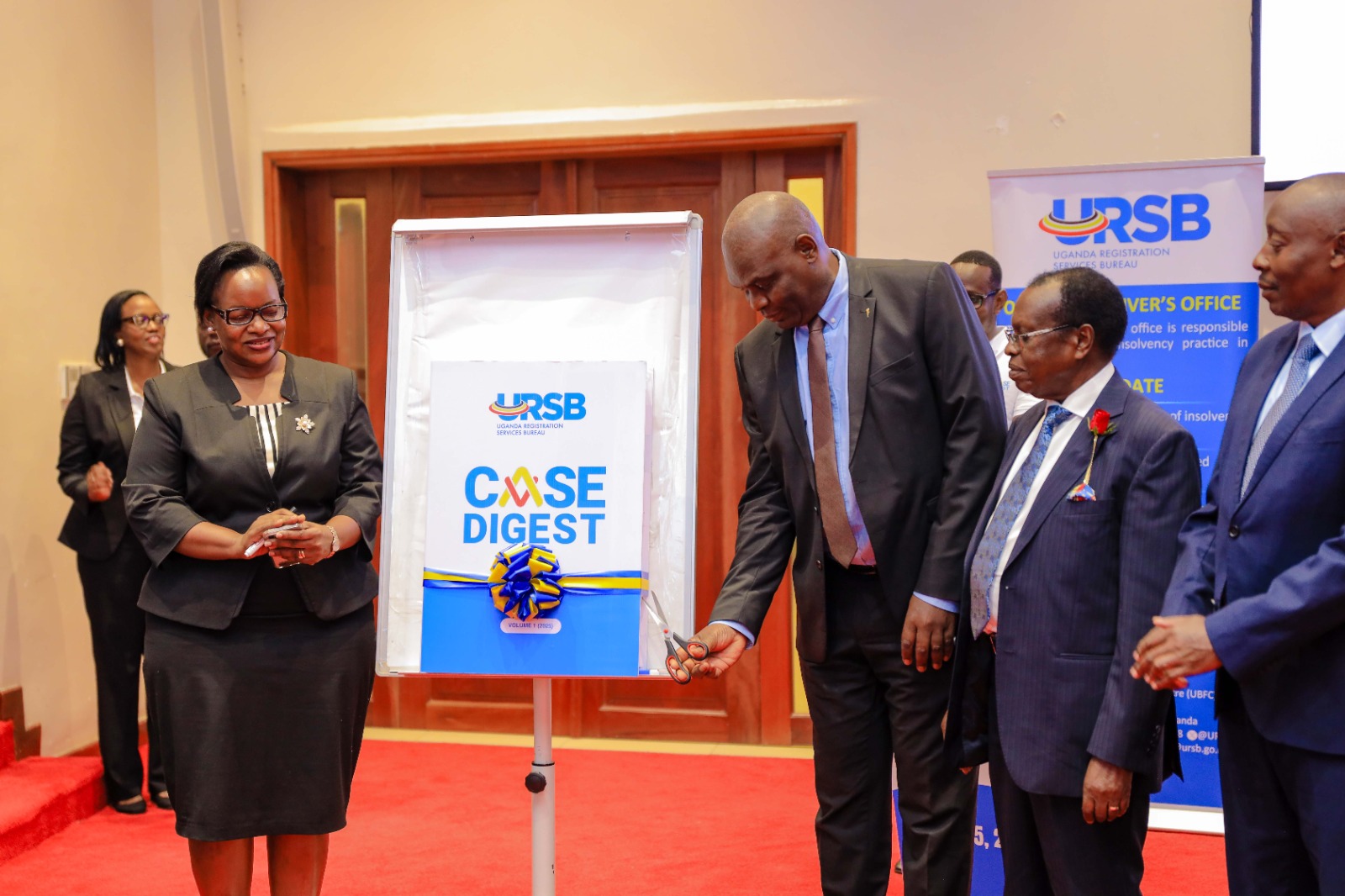
Kampala, Uganda: The Uganda Registration Services Bureau (URSB) has reaffirmed its growing role in strengthening commercial justice through its quasi-judicial mandate and Alternative Dispute Resolution (ADR) mechanisms, as highlighted in the newly published URSB Case Digest, Volume II, 2026.
The second edition of the Case Digest brings together selected decisions issued by URSB alongside relevant court decisions, providing practitioners, businesses, regulators and other stakeholders with practical insight into the interpretation and application of laws administered by the Bureau.
URSB Board Chairman, Rt. Hon. Amb. Francis K. Butagira emphasised the importance of effective institutions in supporting Uganda’s business environment.
“Through the Registrar’s quasi-judicial function, the Bureau continues to provide an accessible and efficient mechanism for resolving disputes, correcting registry irregularities, and protecting the legitimate interests of both businesses and the public.”
Amb Butagira noted that the decisions compiled in the Digest demonstrate URSB’s commitment to maintaining accurate and dependable registers while ensuring that commercial justice is administered fairly and transparently in response to the evolving needs of Uganda’s business and investment environment.

URSB Registrar General, Mercy K. Kainobwisho, noted that commercial disputes involving intellectual property ownership, company shareholding and management, governance and membership can have significant economic consequences when left unresolved.
“Through the quasi-judicial powers of the Registrar under the relevant laws, URSB provides an accessible, affordable, and efficient forum for dispute resolution.”
She further highlighted URSB’s adoption of efficient and cost-effective dispute-resolution mechanisms, including ADR and administrative processes, which save time and money for clients.
The Case Digest provides evidence of the growing use of amicable settlement within URSB’s commercial justice work. In its 2025 highlights for company matters, the Bureau records more than 30 decisions, with more than 10 resolved amicably, reflecting an effort to settle commercial disputes without necessarily subjecting parties to lengthy litigation.
The Bureau’s Legal Services Department also reported that during the 2024/2025 financial year, six cases were settled amicably, with the Digest specifically noting that the settlements promoted the use of ADR mechanisms. The same section records 10 cases determined in favour of the Bureau, resulting in savings to Government of approximately Shs1.1 billion.
The figures provide a practical illustration of the Bureau’s argument that ADR can reduce the time and costs associated with commercial disputes while allowing parties to pursue solutions that preserve business relationships and continuity.
The Case Digest serves not only as a record of decisions, but also as an important resource for promoting consistency, transparency and legal predictability. By making selected decisions accessible, it supports legal research and enables businesses and practitioners to identify emerging trends in corporate governance, compliance, insolvency and intellectual property protection.

Among the company disputes addressed by the Registrar is Niwagaba Willy Kanyamanzi v Eng. Dr. Bernard Kariko-Buhwezi and Geco Warehousing Limited, in which a dispute arose over the alleged forfeiture of a shareholder’s interest.
The Registrar found that the purported forfeiture was procedurally defective because the respondents failed to produce minutes, notice of the meeting or other formal records showing that the meeting had been properly convened. The disputed resolution was consequently declared null and void and ordered to be expunged from the register.
Another case, Chen Zhiming v Zhuangs Plastics and Parking Ltd, involved allegations of an illegal transfer of shares and forgery of the petitioner’s signature. The Registrar found that forensic evidence supported the claim that the signature on the transfer document was not that of the petitioner and ordered the relevant transfer document to be expunged from the register.
The Digest also illustrates how ADR interacts with Uganda’s wider commercial justice system. In Microfinance Support Centre Ltd v Kurbstone Investments (U) Limited and others, a commercial dispute had been referred by the High Court to arbitration under an arbitration clause in the parties’ agreement. However, the arbitration could not proceed after it emerged that Kurbstone Investments had already been dissolved through voluntary winding up, leading the court to set aside the referral to arbitration.
The publication further records a trademark enforcement matter in which parties opted for settlement and reconciliation under Section 160 of the Magistrates Courts Act. The accused agreed to pay Shs1.274 million to URSB to facilitate destruction of counterfeit goods, after which the court adopted the reconciliation agreement, released the accused and ordered destruction of the counterfeit goods.
According to the Registrar General, the Digest provides stakeholders with deeper insight into URSB’s mandate, the legal framework it administers and how those laws are applied in practice. The quasi-judicial decisions, she notes, complement the work of the courts by providing an affordable, efficient and accessible avenue for dispute resolution.
The Quasi-Judicial role development reinforces URSB’s contribution to a predictable and business-friendly legal environment, where disputes can be addressed efficiently, registry integrity protected, and businesses supported to operate with greater certainty and confidence.
If you would like your article/opinion to be published on Uganda’s most authoritative news platform, send your submission on: [email protected]. You can also follow DailyExpress on WhatsApp and on Twitter (X) for realtime updates.