
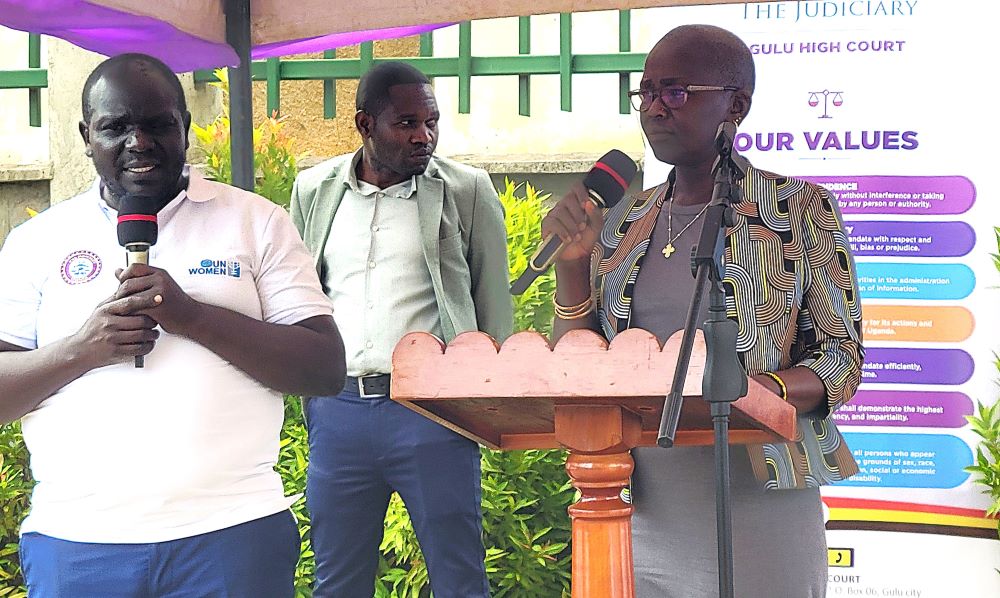
Gulu, Uganda: The Principal Judge of the High Court of Uganda, Justice Jane Frances Abodo, has directed the Gulu High Court Circuit to intensify the use of Alternative Dispute Resolution (ADR) mechanisms as pressure mounts from a growing backlog of land-related cases in the Acholi sub-region.
Justice Abodo made the call during a court open-day engagement in Gulu, where she revealed that land disputes now dominate the court’s caseload, slowing justice delivery and fuelling community conflicts.
According to court data, Gulu High Court is currently handling 1,857 cases, with 946 classified as backlog, many of them tied to unresolved land wrangles.
“The adoption of ADR mechanisms such as mediation and arbitration will help decongest the courts and deliver faster, community-centred justice,” Justice Abodo said.
Gulu High Court Resident Judge Philip Odoki confirmed that the judiciary has already begun referring selected cases, especially land disputes, to traditional leaders for mediation.

“We have very few judicial officers to handle this volume. By integrating traditional leaders and ADR, we can resolve disputes within communities quickly and affordably,” Justice Odoki said.
He urged residents to embrace out-of-court settlements, noting that many disputes currently clogging the system could be resolved at community level without formal litigation. “There are issues that do not need to be taken to court, yet people spend a lot of money pursuing them.”
Residents raised concerns over limited access to justice, citing high transport costs, long distances to court, and lack of legal awareness as key barriers.
Miriam Ajok, a resident of Gulu District, said many cases collapse because litigants fail to attend hearings due to financial constraints. “When someone comes from deep in the village and cannot afford transport, they abandon the case and lose by default,” Ajok said.
She called for expansion of court circuits and increased legal sensitization to help communities understand alternative justice mechanisms.
Concerns Over Corruption and Fake Lawyers
Participants also raised alarm over alleged corruption and the presence of impostors posing as lawyers within court premises.

Peter Omony accused some legal practitioners of exploiting vulnerable litigants, claiming that decisions are sometimes influenced by money rather than merit. “There is a need for accountability to ensure justice is not compromised,” he said.
Another resident, Ronald Okello, warned about fraudsters disguising themselves as lawyers to defraud unsuspecting villagers. “They dress like lawyers, wait in corridors, and target people who don’t understand the system. Once they take money, they disappear.”
He urged court authorities to install surveillance systems and enforce stricter controls to curb impersonation.
Land disputes remain one of the most persistent sources of conflict in Acholi. A 2016 study by Margarete Lagadya found that 32.1% of cases stem from boundary disputes, 18.1% from inheritance wrangles, and 15.5% from illegal land occupation.
Justice Abodo acknowledged the concerns raised and reaffirmed the judiciary’s commitment to expanding ADR, strengthening oversight of judicial officers, and improving access to justice.
She said the judiciary will continue to promote faster, fairer, and more accessible dispute resolution systems to ease tensions and restore confidence in the justice system.
If you would like your article/opinion to be published on Uganda’s most authoritative news platform, send your submission on: [email protected]. You can also follow DailyExpress on WhatsApp and on Twitter (X) for realtime updates.