

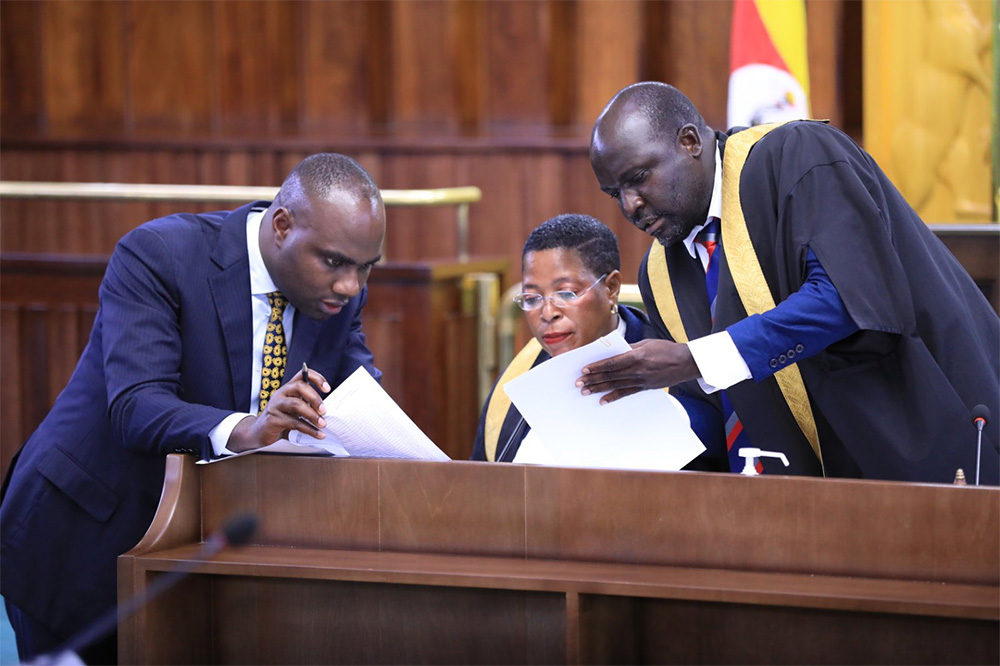
Kampala, Uganda: Parliament has approved a record UGX84.294 trillion national budget for the 2026/27 financial year, marking a significant increase from the UGX72.376 trillion allocated in the previous fiscal year.
The approval of the Appropriation Bill, 2026, signals an ambitious government spending plan, but it has also triggered intense debate over Uganda’s growing public debt and the sustainability of its fiscal path.
According to the approved estimates, the government will spend UGX33.6 trillion, about 40 percent of the total budget, on debt servicing, highlighting the increasing pressure of loan repayments on national resources. Uganda’s total public debt stood at UGX126.18 trillion as of December 2025.
Presenting the Budget Committee report, Vice Chairperson Remigio Achia warned that underfunding domestic arrears remains a major fiscal risk.
Parliament approved UGX317 billion for domestic arrears in FY2026/27, a sharp drop from UGX1.4 trillion in the previous financial year, despite the Auditor General placing the total arrears stock at UGX8.4 trillion.
“Government could take decades to clear arrears at the current rate,” Achia cautioned.

Domestic arrears, largely unpaid obligations to suppliers, continue to undermine private sector confidence, even though the Auditor General reported a decline from UGX13.8 trillion to UGX8.4 trillion in recent years.
The minority report, presented by Ibrahim Ssemujju Nganda and Lulume Bayiga, painted a more constrained fiscal outlook.
Ssemujju argued that a large share of the budget is already committed to non-discretionary spending, including debt servicing, wages, and administrative costs. “These items will consume about 70 percent of the entire budget, leaving limited space for development spending,” he said.
The report highlighted that debt servicing alone will rise sharply from UGX27.5 trillion in FY2025/26 to UGX33.2 trillion in FY2026/27, with cumulative interest payments projected at UGX46.9 trillion over six years.
Government also plans to borrow UGX25.9 trillion from domestic sources, including commercial banks and pension funds. Of this, UGX11.97 trillion will finance the fiscal deficit, while UGX13.9 trillion will refinance maturing debt.
Critics warn that this borrowing cycle could deepen fiscal vulnerabilities, particularly where project implementation delays result in idle funds accruing interest.
However, ICT and National Guidance Minister Chris Baryomunsi defended government policy, arguing that borrowing is necessary for development. “The issue is not borrowing, but ensuring that borrowed funds are used effectively,” he said.

Leader of the Opposition Joel Ssenyonyi described the country’s debt trajectory as “alarming,” citing inefficiencies and weak planning.
“In many cases, loans are secured before projects are ready, leaving funds idle while interest accumulates,” he said.
Speaker of Parliament Anita Annet Among also raised concerns over the sequencing of borrowing and project planning. “We agreed that feasibility studies must come first. But what is happening is the reverse, borrowing first, planning later,” she noted.
The approved budget prioritises implementation of the National Development Plan IV, with UGX35.7 trillion allocated to development programmes, UGX13.5 trillion to human capital development, UGX10.2 trillion to governance and security, and UGX8.8 trillion to transport infrastructure.
However, sectors such as digital transformation, housing, industrial development and public sector reform received relatively modest allocations, each below UGX500 billion.
The passage of the budget underscores a growing tension in Uganda’s fiscal policy—balancing development ambitions with rising debt obligations and limited fiscal space.
While government maintains that the spending plan will drive economic growth, analysts warn that without stronger oversight, improved loan absorption, and tighter fiscal discipline, the increasing cost of debt could constrain service delivery and long-term transformation.
If you would like your article/opinion to be published on Uganda’s most authoritative news platform, send your submission on: [email protected]. You can also follow DailyExpress on WhatsApp and on Twitter (X) for realtime updates.


