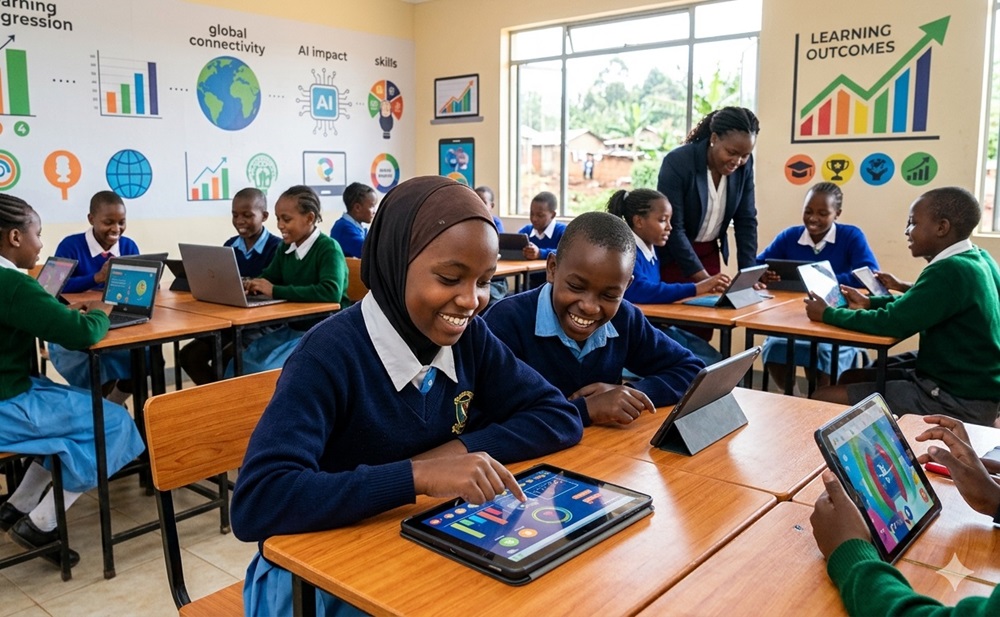
Artificial Intelligence (AI) is rapidly transforming how education systems operate across developing countries. It is creating new opportunities to improve learning outcomes, increase access to education, and address longstanding resource gaps. From personalized digital tutors in India and online learning platforms in Africa to adaptive learning systems in Southeast Asia, AI is reshaping both how students learn and how teachers deliver instruction.
The scale of the challenge is immense. According to the United Nations Educational, Scientific and Cultural Organization (UNESCO), more than 244 million children and youth worldwide remain out of school, with the majority living in developing and emerging economies. The World Bank estimates that nearly 70% of children aged 10 in these countries suffer from what it terms “learning poverty”—the inability to read and understand a simple text by age ten.
For many policymakers and education experts, AI offers a promising pathway to help bridge these educational gaps and expand opportunities for disadvantaged learners.
Increasing Access to Quality Education
Artificial Intelligence is helping to expand access to educational resources, giving more people the opportunity to learn regardless of their location. In many emerging economies, significant disparities still exist between urban and rural education systems. Students in rural communities often face shortages of learning materials, limited access to qualified teachers, and inadequate educational infrastructure.
AI-powered learning platforms are helping to address these challenges by delivering educational content through mobile phones, tablets, and computers. These systems use data-driven insights to tailor lessons to individual learners, allowing students to progress at their own pace rather than following a rigid, standardized curriculum.
Countries across Africa, Asia, and Latin America have increasingly adopted digital learning platforms that offer interactive lessons, language support, automated assessments, and supplementary learning resources beyond the classroom.
According to Data Intelo, the global Artificial Intelligence in Education market was valued at approximately $8.11 billion in 2025 and is projected to reach $104.87 billion by 2033, representing a compound annual growth rate (CAGR) of 32.9%.
Scalable Personalized Learning
One of AI’s greatest contributions to education is its ability to personalize learning at scale.

Traditional classroom settings often require one teacher to manage between 30 and 60 learners simultaneously, limiting opportunities for individualized instruction. AI systems can identify each student’s strengths and weaknesses, recommend targeted learning activities, and provide additional support where needed.
Research in educational technology suggests that adaptive learning systems can improve academic performance by between 15% and 30% compared to traditional one-size-fits-all teaching approaches.
In countries such as Brazil and Indonesia, pilot projects involving AI-powered tutoring systems have demonstrated significant improvements in mathematics and language learning, particularly among students who previously struggled to keep pace with classroom instruction.
The benefits are especially important in regions facing severe teacher shortages. Globally, education systems are expected to require an additional 44 million teachers by 2030. While AI cannot replace teachers, it can reduce workloads by automating routine tasks and providing supplementary instructional support.
Supporting Teachers and Educators
AI is not only benefiting students; it is also helping teachers become more effective.
Educators spend considerable time on administrative responsibilities such as grading assignments, tracking attendance, and preparing performance reports. AI tools can automate many of these routine tasks, allowing teachers to focus more on classroom engagement and student support.
In countries including Kenya, Vietnam, and the Philippines, AI-driven analytics are being used to identify students who may be at risk of academic failure. These predictive tools enable schools to intervene early, improving retention and completion rates.
The data generated by AI systems also helps school leaders and policymakers make more informed decisions about resource allocation, curriculum improvements, and educational planning. As a result, institutions can respond more effectively to areas of greatest need.
Breaking Language and Inclusion Barriers
Language diversity remains a major challenge in many developing countries. AI-powered translation and speech recognition technologies are making educational resources more accessible in local languages, helping learners better understand content delivered in their native tongues.

This is particularly important in communities where the language used in schools differs from the language spoken at home.
Natural Language Processing (NLP) technologies have also led to the development of text-to-speech software, speech-to-text tools, and adaptive learning interfaces for students with disabilities. These innovations are helping create more inclusive learning environments and expanding educational opportunities for historically disadvantaged groups.
Persistent Challenges
Despite its potential, AI is not without challenges.
Limited internet connectivity remains one of the biggest barriers to widespread adoption. According to the International Telecommunication Union (ITU), billions of people worldwide still lack reliable internet access, making digital learning difficult in many underserved communities.
Concerns also persist regarding data privacy, cybersecurity, and algorithmic bias. Students in rural and low-income areas may continue to face disadvantages due to limited access to digital devices, unreliable internet connections, and insufficient digital literacy skills.
Moreover, education experts caution against viewing AI as a complete solution to educational challenges. Learning outcomes are influenced by multiple factors, including teacher quality, curriculum relevance, parental involvement, community support, and broader socio-economic conditions.
Future Prospects
As AI technologies continue to evolve, many developing countries are increasingly viewing them as powerful tools for strengthening education systems.
Evidence from various pilot projects and implementation programmes suggests that AI can improve student performance by increasing access to learning materials, enabling personalized instruction, supporting educators, and promoting greater inclusion.
While significant challenges remain, AI offers a promising opportunity to address some of the most persistent educational barriers facing emerging economies. Through responsible implementation by governments, educational institutions, development partners, and technology providers, AI is likely to play an increasingly important role in shaping the future of education for millions of learners worldwide.
Reference: https://dataintelo.com/report/artificial-intelligence-in-the-education-sector-market
If you would like your article/opinion to be published on Uganda’s most authoritative news platform, send your submission on: [email protected]. You can also follow DailyExpress on WhatsApp and on Twitter (X) for realtime updates.