
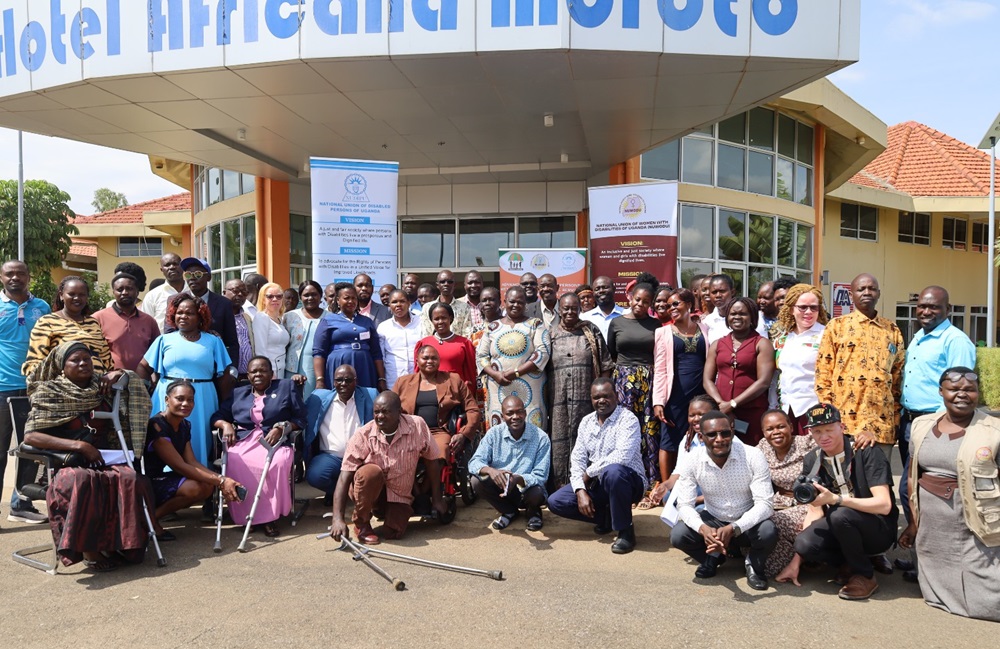
Moroto, Uganda: Leaders, disability rights advocates, government officials and development partners have called for greater inclusion of persons with disabilities (PWDs) in government programmes, social services and decision-making processes across the Karamoja sub-region.
The call was made during the Annual Convention on the Status of Disability Inclusion in Karamoja, held at Hotel Africana in Moroto under the theme: “Strengthening Disability Inclusion in Social Services and Decision-Making.”
The convention was organised by a consortium comprising the National Union of Disabled Persons of Uganda (NUDIPU), Albinism Umbrella and the National Union of Women with Disabilities of Uganda (NUWODU), with support from the Embassies of Denmark, Ireland, Sweden and the Netherlands.
The gathering sought to strengthen evidence-based disability inclusion through regional consultations that amplify the voices of persons with disabilities and promote coordinated action among government institutions, civil society and development partners.
Speaking at the convention, Mary Namutebi, Chief Executive Officer of Albinism Umbrella, urged leaders to translate policy commitments into practical action that protects the rights and dignity of persons with disabilities.
“Leadership is the difference between promise and practice. Let every commitment advance the dignity and rights of persons with disabilities,” Namutebi said.
She explained that albinism is a genetic condition inherited through recessive genes carried by both parents and affects people across all races and regions.
According to Namutebi, Uganda has an estimated 78,876 persons with albinism aged two years and above, many of whom continue to face stigma, discrimination, visual impairment and increased risks of skin damage and skin cancer.
“We must dismantle harmful myths and superstitions surrounding albinism. Many people with albinism continue to face barriers that undermine their dignity and participation in society,” she said.

She called for improved access to skin protection products, healthcare, inclusive education, social protection and greater participation in leadership and governance.
NUWODU Executive Secretary Beatrice Guzu highlighted the unique challenges affecting women and girls with disabilities, saying they continue to experience discrimination based on both gender and disability.
“Women and girls with disabilities continue to face barriers in accessing health services, education, economic opportunities and justice,” Guzu said.
She noted that harmful cultural beliefs and inaccessible maternity services continue to undermine the rights of women with disabilities and urged both government and development partners to prioritise inclusive service delivery.
NUDIPU Chief Executive Officer Esther Kyozira said the organisation works through 146 district unions and 17 national member organisations to advance the rights of persons with disabilities.
She called on newly elected local leaders to prioritise disability inclusion in planning, budgeting and decision-making. “As councillors begin a new term of leadership, they must prioritise disability inclusion in government programmes, council committees, budgeting processes and decision-making structures,” Kyozira said.
Representing Moroto District Local Government, Principal Assistant Secretary Samuel Lokong, speaking on behalf of the Chief Administrative Officer, urged leaders to recognise persons with disabilities as active contributors to development rather than passive beneficiaries.
He said Moroto District has continued to mainstream disability inclusion through planning processes, budget allocations and the training of paralegals to handle disability-related cases.
Presenting a case study from Nabilatuk District, District Community Development Officer Ruth Teko said persons with disabilities are actively involved in district planning and budgeting.
She said they are benefiting from programmes such as the Parish Development Model (PDM), Emyooga, Youth Livelihood Programme (YLP) and the Uganda Women Entrepreneurship Programme (UWEP). “Our persons with disabilities are not left out. They participate in planning meetings, access government programmes and are considered during budgeting processes,” Teko said.
She cited achievements including the election of a woman with a disability as Deputy Speaker of Nabilatuk District Council, disability mapping for planning purposes, scholarships for children with disabilities and inclusion in procurement opportunities.

Barriers Still Persist
During panel discussions, participants highlighted persistent challenges, including inaccessible schools, inadequate sanitation facilities, shortages of Braille learning materials, limited numbers of special-needs teachers, inaccessible health facilities, stigma and poor disability data.
Participants said many children with disabilities remain hidden at home because of cultural beliefs and discrimination, denying them access to education and other essential services. They urged communities to recognise that disability does not diminish a person’s ability to contribute to society.
The convention also explored the disproportionate impact of climate change on persons with disabilities.
Oscord Mark Otile, Executive Director of ACORD Uganda, said climate adaptation efforts must intentionally include vulnerable groups.
“Climate justice is not only about protecting ecosystems. Persons with disabilities, women and other vulnerable groups are often the most affected by climate change and face the greatest barriers before, during and after climate shocks,” Otile said.
He called for disability inclusion to be mainstreamed into district development plans, climate adaptation strategies and resilience-building programmes. “Persons with disabilities should not only be beneficiaries of climate interventions but also contributors to the decisions that shape them,” he added.
Calls for Stronger Advocacy
Representatives from disability unions in Amudat, Nabilatuk, Moroto, Kaabong and Karenga raised concerns over inadequate funding, poor dissemination of information, limited involvement in monitoring government programmes and exclusion from key decision-making platforms.
NUDIPU Board Chairperson Aero Kitty, who also serves as Councillor for Persons with Disabilities in Kotido District, stressed the importance of reliable disability data to support planning and advocacy.
Meanwhile, Jessica Ruth Ataa, Executive Director of the National Association of Women Organisations in Uganda (NARWOA), urged government, civil society and development partners to work together to advance disability inclusion.
“When we understand inclusion, we engage everyone. You can see a banner for a meeting but find no invitation for persons with disabilities. We must advocate as a team and support our people,” Ataa said.
If you would like your article/opinion to be published on Uganda’s most authoritative news platform, send your submission on: [email protected]. You can also follow DailyExpress on WhatsApp and on Twitter (X) for realtime updates.