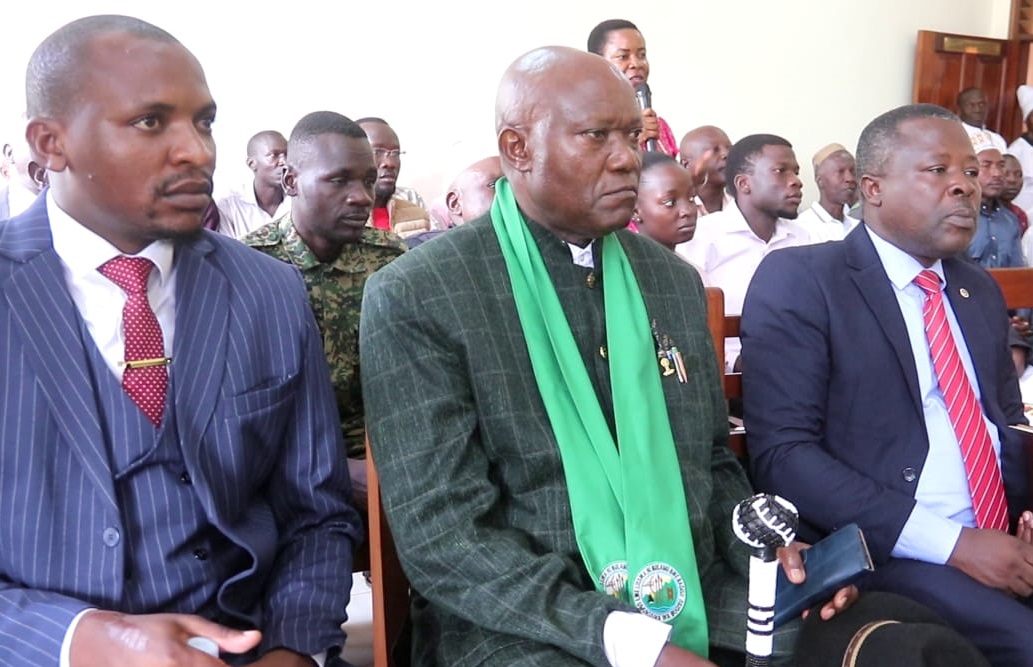
By Steven Masiga
On behalf of the Bamasaaba Cultural Institution, the Cabinet fraternity and the entire Bamasaaba people, allow me to salute and recognize the officials with whom we worked closely to ensure that the Bamasaaba cultural leadership dispute was resolved through mediation.
I particularly recognize the Minister for Justice and Constitutional Affairs, Hon. Norbert Mao; the former Chief Justice, His Lordship Alfonse Owiny-Dollo; the current Chief Justice, His Lordship Dr. Flavian Zeija; the Principal Judge, Her Lordship Dr. Jane Frances Abodo; and Justice Andrew Khaukha, Director of the Judicial Training Institute.
Special appreciation also goes to the panel of mediators led by Deputy Chief Justice Emeritus Anthony Butera, together with Prof. Andrew Khaukha, Director of the Judicial Training Institute; Francis Atooki, former Solicitor General; Francis Gimara, former President of the Uganda Law Society; and the Director of Alternative Dispute Resolution in the Judiciary.
As a cultural institution, we salute these distinguished professionals for their exemplary guidance in helping to extinguish a dispute that, for the last 15 years, had generated havoc, intrigue, malice, name-calling, bad blood and even death threats across the Bugisu region, particularly on social media.
How the mediation process began
The journey towards resolving the Bamasaaba cultural leadership dispute can officially be traced to the Alternative Justice Conference held in Munyonyo in 2025, organized by the Judiciary under the leadership of the then Chief Justice.
The conference brought together spokespersons of cultural institutions, prime ministers of cultural institutions, clan chairpersons and members of the Inter-Religious Council of Uganda, among other stakeholders, for capacity building on Alternative Justice Systems.

During that conference, I strongly advocated for resolving the Bamasaaba cultural leadership dispute through Alternative Dispute Resolution (ADR) instead of continuing with adversarial litigation, which had continued to divide our community.
Distinguished participants, including Hon. Norbert Mao, then Chief Justice Owiny-Dollo, then Deputy Chief Justice Dr. Flavian Zeija, the Director of Public Prosecutions, Her Lordship Jane Frances Abodo, Prof. Andrew Khaukha and Justice Mike Chibita, supported the proposal that ADR should be used to resolve cultural conflicts in Uganda, beginning with the Bamasaaba Cultural Institution.
Understanding Alternative Dispute Resolution
There are several schools of thought explaining Alternative Dispute Resolution. Uganda’s Arbitration and Conciliation Act defines ADR as the resolution of disputes outside the traditional courtroom, including court-annexed mediation, as was the case with the Bamasaaba cultural leadership dispute.
Similarly, Black’s Law Dictionary defines mediation as resolving disputes through negotiated settlement rather than litigation.
The concept of mediation is largely attributed to Professor Frank E.A. Sander, who introduced the idea in the 1970s through the revolutionary concept of the “multi-door courthouse.”
His theory envisioned courts as institutions with multiple doors through which disputes could be channelled into the most appropriate resolution mechanisms, including mediation, arbitration and conciliation, instead of automatically proceeding to litigation.
Uganda has undertaken considerable benchmarking from other jurisdictions in promoting Alternative Justice Systems and ADR. Both doctrinal and non-doctrinal research consistently indicate that more than 95 percent of community disputes are resolved through mediation and other alternative mechanisms, while only about 5 percent proceed to formal court litigation.
Under Uganda’s Civil Procedure Rules, mediation is encouraged before litigation proceeds. In fact, court records should demonstrate that mediation was attempted before a matter proceeds to full hearing.
ADR also enjoys constitutional and statutory backing under Article 126(2) of the Constitution and provisions of the Institution of Traditional or Cultural Leaders Act, 2011, including Sections 15(1) and 15(2), which encourage amicable settlement of disputes affecting cultural institutions.

The Bamasaaba settlement
The Bamasaaba cultural leadership dispute involved more than 100 court cases filed against the cultural institution and the Government of Uganda. Through mediation led by Deputy Chief Justice Emeritus Anthony Butera and the distinguished panel, all these matters were successfully resolved.
On behalf of the Bamasaaba Cultural Institution, I also salute the other parties to the dispute, particularly Mzee Wagabyalire, Mzee Sakwa Darlington and the other distinguished claimants who embraced mediation and agreed to resolve their differences peacefully.
As a result, the Bugisu region now enjoys peace as preparations continue for the Imbalu launch and the third coronation anniversary of His Highness Umukuka Jude Mike Mudoma.
Among the key agreements reached were that the cultural leader shall henceforth be officially referred to as the Umukuka of the Bamasaaba People, that the Inzu Ya Masaba Constitution will undergo a consultative review to align it with the Institution of Traditional or Cultural Leaders Act, 2011, and that His Highness Jude Mike Mudoma will continue to reign until 2028, with all pending court cases withdrawn.
Why this decision should become a locus classicus
The Judiciary should preserve this settlement as a locus classicus for future cultural leadership disputes in Uganda. The Bamasaaba mediation demonstrates that ADR restores relationships, rebuilds community cohesion and enables disputing parties to move forward together.
Unlike litigation, where the losing party ordinarily bears the costs and relationships often deteriorate further, mediation allows each party to meet its own costs while preserving dignity and mutual respect.
Whenever communities face disputes, they should first consider mediation. Through mediation, parties often leave the room smiling and talking to one another. In contrast, litigation frequently leaves former friends and neighbours more divided than before.
The Bamasaaba experience has demonstrated that lasting peace is not always won through courtroom battles. Sometimes, it is achieved around the mediation table.
The writer is a High Court Mediator, Legal Scholar and Spokesperson of Bamasaba Cultural Institution
If you would like your article/opinion to be published on Uganda’s most authoritative news platform, send your submission on: [email protected]. You can also follow DailyExpress on WhatsApp and on Twitter (X) for realtime updates.