
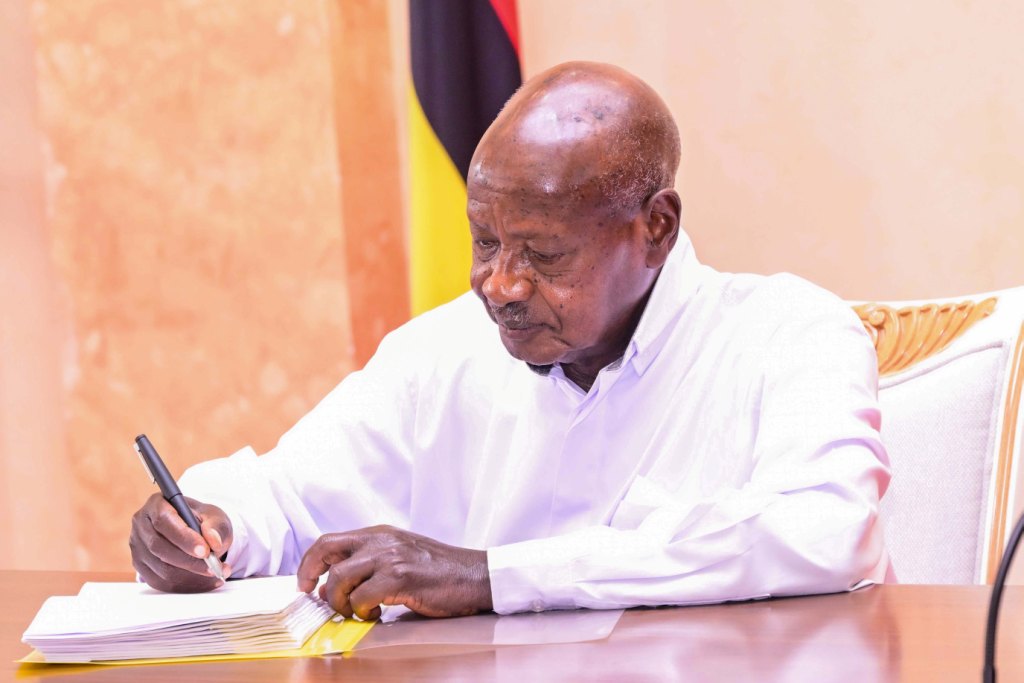
Kampala, Uganda: President Yoweri Museveni, on Wednesday assented to eight pieces of legislation, including the much-anticipated Copyright and Neighbouring Rights (Amendment) Act, 2026, in a significant legislative push as the current parliamentary term draws to a close.
The Copyright Amendment law, passed by Parliament on March 17, 2026, introduces sweeping reforms aimed at protecting creators in the digital era and ensuring fair compensation for intellectual property.
Under the new law, penalties for copyright infringement have been strengthened, with offenders facing fines of up to Shs50 million, imprisonment of up to 10 years, or both.
The legislation also empowers rights holders and the Registrar of Copyright to issue take-down notices to online platforms, compelling the removal of infringing content.
While copyright remains automatic upon creation, the law now requires registration with the Uganda Registration Services Bureau to access certain legal protections, including enforcement mechanisms.

In a move to regulate earnings from creative works, the Minister of Justice is authorised to work with URSB to establish systems for collection and distribution of royalties through the National Payment System.
The law further limits copyright assignment agreements to a maximum of 20 years, after which rights revert to the original creator, a provision aimed at preventing long-term exploitation.
Employment Law Expands Worker Protections
The President also signed the Employment (Amendment) Act, 2025, which significantly expands labour protections, particularly for domestic, casual, and migrant workers.
The law formally recognises these categories as employees under contracts of service, granting them equal access to employment rights after four months of continuous service.
Key provisions include mandatory workplace sexual harassment policies for all employers, extended paid sick leave of up to six months, and standardised severance pay of at least one month’s salary for each year of service.
Employers are also now required to provide lactation facilities and structured breastfeeding breaks or reduced working hours for mothers returning from maternity leave.

However, the contentious issue of a national minimum wage remains unaddressed.
Other Key Laws Signed
Among the additional laws assented to is the National Drug and Health Products Authority Act, 2026, which expands regulatory oversight of medicines, vaccines, diagnostics, and cosmetics.
The Energy Efficiency and Conservation Act, 2026 introduces mandatory standards and audits aimed at reducing energy waste, while the Non-Performing Assets Recovery Trust (Repeal) Act, 2024 dissolves the Trust and transfers its functions to the Ministry of Finance.
Also signed into law are the Forensic and Scientific Analytical Services Act, 2026 to strengthen forensic systems, the Public Enterprises Reform and Divestiture (Amendment) Act, 2024, and the Magistrates Courts (Amendment) Act, 2026.
Full List of Laws Signed by President Museveni
- Copyright and Neighbouring Rights (Amendment) Act, 2026
- Employment (Amendment) Act, 2025
- National Drug and Health Products Authority Act, 2026
- Energy Efficiency and Conservation Act, 2026
- Non-Performing Assets Recovery Trust (Repeal) Act, 2024
- Forensic and Scientific Analytical Services Act, 2026
- Public Enterprises Reform and Divestiture (Amendment) Act, 2024
- Magistrates Courts (Amendment) Act, 2026
End-of-Term Legislative Push
The batch of laws reflects a final wave of legislative activity as government consolidates key policy reforms across sectors including labour, health, justice, and energy.
The Copyright Amendment, in particular, is expected to reshape Uganda’s creative economy, while the Employment reforms signal a shift toward stronger labour protections.
If you would like your article/opinion to be published on Uganda’s most authoritative news platform, send your submission on: [email protected]. You can also follow DailyExpress on WhatsApp and on Twitter (X) for realtime updates.